Industrial factory construction is a large-scale investment project that requires strict control over structural standards, MEP infrastructure, and fire prevention and fighting safety. In practice, many investors do not have a dedicated engineering team to be present on-site, leading to risks such as construction that deviates from approved construction design drawings, material quality fraud, or extended handover schedules.
Using independent factory construction supervision services provides a professional management solution and serves as a representative mechanism to protect the investor’s financial and legal interests when working with the general construction contractor. This is a key solution that helps ensure building quality according to the approved factory design dossier, tightly control the budget, and put the project into safe operation on schedule.
Using professional factory construction supervision services helps investors establish an independent technical control system on-site. This team acts as the investor’s technical representative, protecting the company’s interests across four core aspects.
Supervision engineers are regularly present on-site to directly compare every construction activity with the approved construction design dossier. All stages, from setting out foundation gridlines and checking floor reinforcement density to verifying the verticality of steel frame columns, are inspected in detail.
Continuous cross-checking helps promptly detect technical deviations and requires the contractor to correct them immediately before acceptance and transition to the next work item.
Material quality directly determines the durability and service life of the factory. The supervision team strictly checks Certificates of Origin (CO) and Certificates of Quality (CQ) for all materials before allowing them to be received on-site.
Important materials such as ready-mixed concrete, steel structures, electrical cables, and insulated roofing panels must undergo independent sampling and testing procedures. Concrete compression testing and weld load testing help thoroughly prevent the general construction contractor from using poor-quality or incorrect-specification materials in the project.
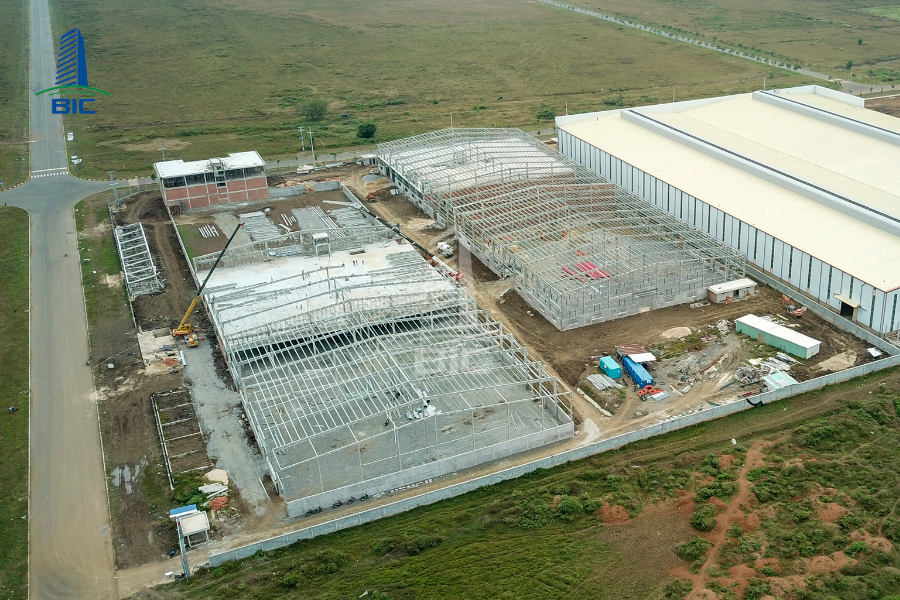
The factory construction supervision unit is responsible for closely monitoring the overall schedule and detailed weekly progress. When delay risks are detected, the supervision engineer urges and requires the contractor to add manpower and machinery to recover the workload.
In addition, the supervision consultant directly measures and verifies the actual completed quantities on-site. This provides a transparent basis for the investor to make payments according to actual work completed, fully eliminating the risk of inflated quantities or unreasonable additional costs.
Industrial construction sites involve many safety risks, especially during high-level steel frame lifting and the operation of high-capacity machinery. The supervision engineer checks personal protective equipment, safety net installation, and workers’ equipment operation procedures.
At the same time, the construction of MEP and fire prevention and fighting systems is closely monitored, ensuring installation at the correct locations according to the approved fire protection drawings and creating favorable conditions for project acceptance with competent authorities.
A standard factory construction supervision process covers the entire construction life cycle of the project, from legal preparation to building handover and operation.
Before construction begins, the supervision consulting unit reviews the legality of the entire project dossier. The supervision engineer checks the construction permit, factory design drawings, construction drawings, and fire prevention and fighting approval documents.
At the same time, the supervision consultant evaluates the feasibility of the construction organization method, overall schedule, and detailed schedule prepared by the contractor, ensuring that site safety and infrastructure conditions are ready.
The foundation is the load-bearing base for the entire factory. The supervision engineer directly checks the positioning of foundation gridlines, elevations, and the driven pile or bored pile construction process.
For reinforced concrete work, the supervision unit checks reinforcement specifications, steel types, stirrup spacing, and formwork cleanliness before accepting and approving concrete pouring. The concrete pouring process for foundations, grade beams, and factory floors is continuously supervised to control concrete slump, compaction techniques, and standard-compliant curing procedures.
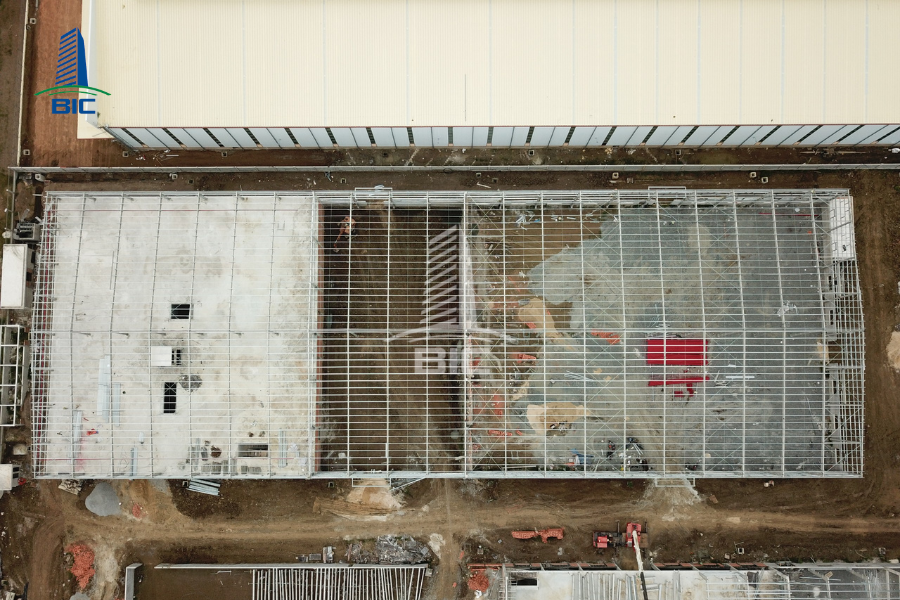
The pre-engineered steel structure is the most important component of an industrial factory. The factory construction supervision unit checks steel component fabrication quality directly at the manufacturing workshop, including welds, anti-rust coating, and steel thickness.
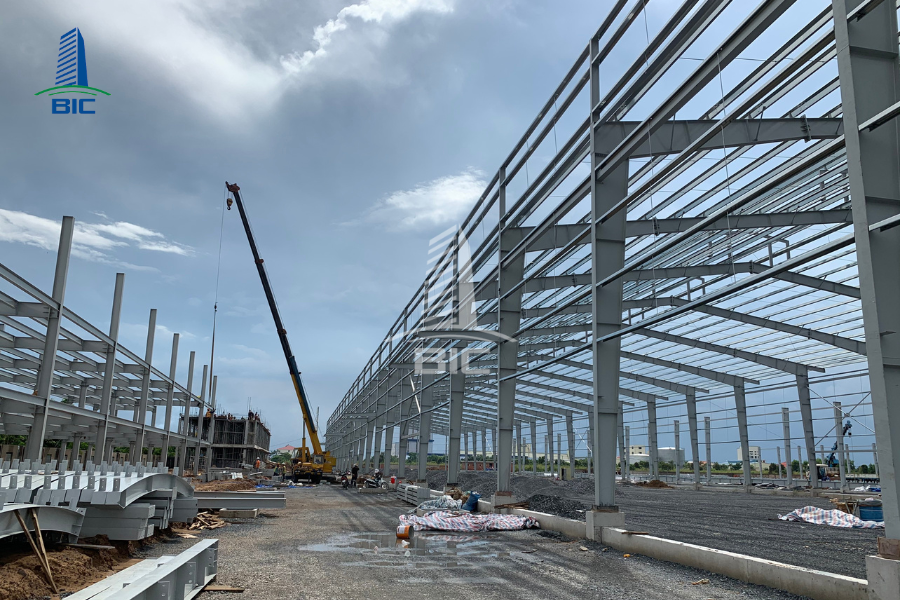
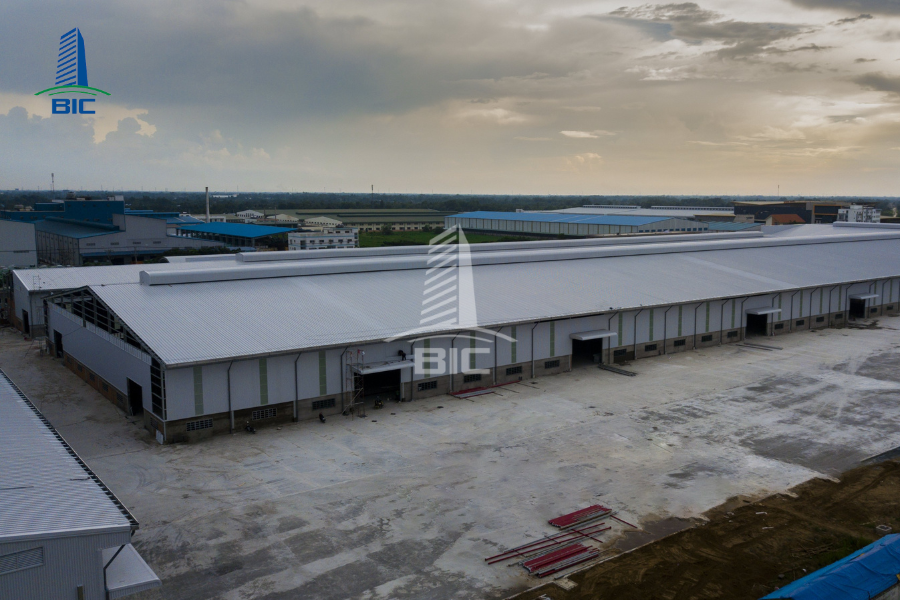
On-site, the supervision engineer checks the lifting and erection process, steel column verticality, high-strength bolt tightening, and roof bracing system. Installation of roofing sheets, wall cladding, and daylighting systems is also carefully inspected to prevent water leakage and ensure wind resistance.
MEP and fire prevention and fighting systems determine the operational safety of the factory. The supervision consultant checks in detail the installation of water supply and drainage pipelines, underground water tanks, transformer stations, power cable systems, and industrial lighting.
For fire protection infrastructure, the supervision engineer checks the installation positions of sprinkler heads, fire partitions, fire pump stations, and automatic fire alarm systems, ensuring strict compliance with the drawings approved by the fire police authority.
When work items are completed, the supervision unit organizes internal acceptance and coordinates with the investor for overall project acceptance. The supervision engineer checks the accuracy of as-built drawings prepared by the contractor, reviews material quality certification dossiers, and supports the investor in fire prevention and fighting acceptance with state authorities.
Project handover is only carried out when all systems meet quality and safety standards.
Factory construction supervision is not confrontational. It is a professional coordination mechanism that ensures the project is completed at the highest quality.
During construction, conflicts between construction design drawings and actual geotechnical conditions, or clashes between MEP pipelines, are difficult to avoid. The supervision consultant acts as a technical bridge, proactively communicating with the factory design team to propose prompt solutions and prevent construction progress from being interrupted.
The supervision consultant operates as an independent third party, cross-checking the management capability, manpower, construction equipment, and quality management process of the general construction contractor. This control helps the contractor maintain work discipline, comply with contractual commitments, and avoid arbitrarily changing technical solutions without approval.
All acceptance records for work items, construction stages, and completed quantities must include confirmation signatures from the direct supervision engineer. Actual measurement on-site fully eliminates informal approval, collusion, or false acceptance, bringing absolute transparency to the project payment dossier.
Choosing the right supervision partner determines the effectiveness of quality control. Investors should consider the following core criteria:
The supervision consulting unit must have full legal status, a business registration license, and a Construction Activity Capacity Certificate issued by the Ministry of Construction or the Department of Construction. The capacity grade of the supervision unit must correspond to or be higher than the grade of the factory project the investor plans to implement.
Supervision quality depends directly on the capability of engineers stationed on-site. Investors should prioritize units with civil engineers and MEP engineers who hold suitable individual practicing certificates and have directly supervised multiple large-scale industrial factory projects.
A reputable factory construction supervision unit must be equipped with specialized inspection devices such as theodolites, electronic total stations, weld ultrasonic testing equipment, and concrete slump testing equipment. Applying online site diary management software helps investors update technical reports and actual site images in real time.
The supervision unit must commit to objective independence and have no conflict of interest with the general construction contractor or material suppliers. The supervision consulting contract should clearly state liability and compensation terms if technical errors occur or if acceptance is carried out incorrectly.
Factory construction supervision services are not an additional expense, but an asset and quality assurance solution for the entire project. Having an independent and professional supervision consultant from the start of construction helps investors tightly control budgets, minimize technical risks, and ensure that the building complies precisely with the construction design drawings.
Working with a reputable supervision team alongside the general construction contractor is a strategic decision that helps the factory project reach completion safely, meet quality standards, and optimize long-term investment efficiency.
Contact the BIC team for detailed consulting on industrial factory projects.