The Japanese Prime Minister and his wife began an official visit to Vietnam that lasted until October 20. On October 19, Mr. Yoshihide Suga met with Japanese business community.
As a person living for 9 years in Vietnam, EY Vietnam Deputy General Director, in charge of Japanese business services Onose Takahisa expressed his excitement when Prime Minister Yoshihide Suga chose Vietnam as a destination on his first trip.
"Vietnam is one of the most important countries in the world to Japan", Mr. Takahisa said. According to him, Japanese companies are increasingly paying attention to the Vietnamese market, as evidenced by the fact that 15 out of 30 enterprises funded by the Government in the project to diversify the supply chain to ASEAN have chosen Vietnam as the destination.

Prime Minister Nguyen Xuan Phuc and Japanese Prime Minister Suga moved from the official pick up place to the conference room during their October 19 visit to Vietnam. Photo: Ngoc Thanh
Many other retailers such as Uniqlo and MUJI are also looking to expand more stores. Last weekend, Japan's largest cosmetic pharmaceutical chain Matsumoto Kiyoshi also set up its first store in Ho Chi Minh City. With Japan's largest retail chain AEON, Vietnam is also a foreign market that they consider a key investment and development. By 2025, the group plans to operate 25 shopping centers with financial preparation up to $ 2 billion.
Sharing with VnExpress, Mr. Nishitohge Yasuo, General Director of AEON Vietnam said that this market is very potential thanks to high GDP growth, the population size is expected to 100 people by 2025 with the average income of the people increasing rapidly. Modern retail acreage per capita is lower than in other countries...
Japan's population has fallen for the 11th year in a row, the largest rate in history, according to information from the Ministry of the Interior and Communications of this country in August. This pressure is one of the reasons why many sellers Japan must expand to countries with large scale and young population.
Meanwhile, Mr. Shimizu Akira, Chief Representative of Japan International Cooperation Agency (JICA) commented that the basic foundation that attracts Japanese enterprises is the young, hard-working and industrious workforce.
According to Goldman Sachs, labor costs in Vietnam are very competitive. The data shows that the revised minimum wage has risen sharply over the past decade but is only half that of China. In expensive cities like Hanoi and Ho Chi Minh City, the minimum wage is set at $ 190 a month, while in Shanghai it's $ 360 a month. In cheaper cities, wages in Vietnam and China are $ 132 a month and $ 220 a month.
On the other hand, free trade agreements (FTAs) with major partners also keep Vietnam away from increased protectionism. This makes this economy a safe haven for global manufacturing corporations. Vietnam also has a favorable position when sharing a border with China, about 2-3 hours drive.
By the end of September, Japan had nearly 4600 valid FDI projects with a total registered capital of nearly 60 billion USD, ranking second among 136 countries and territories investing in Vietnam. In 2019, a report by the Japan Trade Promotion Organization (JETRO) said that 66% of Japanese enterprises would make a profit when investing in Vietnam. 64% of enterprises answered that they have plans to expand production and business. A survey of NNA (Japan) company, based on 820 valid questions, said that Vietnam surpassed India, being the most promising investment destination in 2020 in Asia in the eyes of Japanese businesses.
The increased investment in Vietnam during this period, in addition to the above factors, also came from the ability of the Government to respond to changes, such as Covid-19.
“You guys are fighting and preventing epidemics very well. In Japan, to date, there are still up to 500 cases per day. I also find it difficult to balance the problem of anti-epidemic and economic development, but you have done very well with this dual goal”, Mr. Akira commented.
Mr. Vu Ba Phu, Director General of Trade Promotion Agency (Ministry of Industry and Trade) emphasized that the Japanese market still has plenty of room for Vietnamese products. Currently, imports from Vietnam only account for 3.1% of the total import turnover of this country.
According to him, the import-export structure of the two countries is complementary, not in direct competition. If Vietnam has a need to import high value-added technology goods, the Japanese will be interested in agriculture - forestry - fisheries, textiles, footwear,...
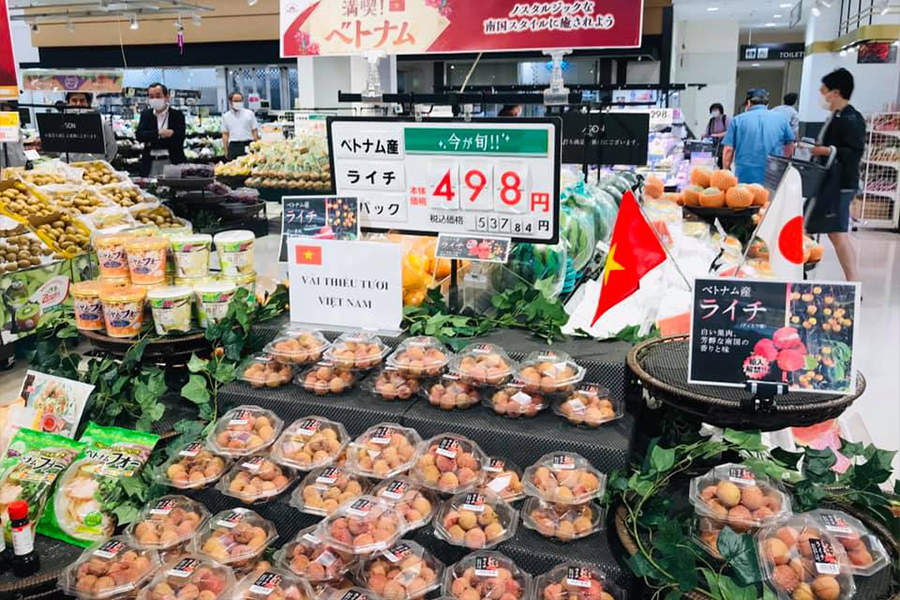
Vietnamese lychees are sold at Japanese supermarkets
"Recently, there has been a wave of Japanese businesses turning to Vietnam, increasing investment in building product factories and then exporting back to Vietnam", Mr. Phu said.
As with AEON, the total value of goods they export from Vietnam to Japan is increasing each year. In 2017, the total value of goods was 250 million USD, in 2019 that figure had increased to 370 million USD.
On the other hand, Vietnamese products have advantages thanks to many tariff preferences from FTAs that are both members, for example the Vietnam - Japan Economic Partnership Agreement (VJEPA), ASEAN Comprehensive Economic Partnership Agreement. - Japan (AJCEP), Progressive and Comprehensive Trans-Pacific Partnership Agreement (CPTPP)...
With the advantage of being the largest retail chain in Japan, AEON has successfully brought many Vietnamese products to Japanese consumers since 2015. According to this unit, the main products include garment (accounting for about 59%). , food (34.6%), agricultural products such as coffee, dragon fruit, banana, mango, lychee, seafood such as basa, shrimp,...
However, if Vietnam wants to receive opportunities, Vietnam needs to solve existing problems. JICA leaders said, Japanese enterprises are still "complaining" about Vietnamese labor force. They have a great need for talented people and skilled workers to take part in all stages of production. "Training human resources with expertise and high technology is an important factor at this time", Mr. Shimizu Akira said.
Besides, JICA only knew, businesses were also concerned about administrative procedures and law enforcement. Currently, Vietnam's regulations are relatively complete, but when applied and enforced, there is no clarity and transparency.
Or to facilitate exporting goods to Japan, Mr. Vu Ba Phu noted that Vietnamese businesses must meet very high standards of food hygiene and safety and technology. "Goods must ensure absolute safety when used", he said.
Japanese consumer tastes are also very specific. Many products, although meeting technical standards, are not suitable, making it difficult to sell well. For example, office fashion in Japan prefers simple colors, mainly three colors: gray, white, and black. Or fine-art wooden products exported to Japan must be smaller than those to Europe, America ... due to the specific size of houses and offices in this country. The distribution system in Japan is also complex, with many intermediate layers. Therefore, it is difficult for foreign enterprises to sell goods directly to supermarkets and consumers, but have to go through import clues.
On the other hand, many Japanese business representatives shared that Japan is a specific market, so in order to do business and cooperate, it is necessary to build a trusting relationship between the two sides. Vietnamese companies must have trust in Japan and vice versa.
"Understanding Japanese language, culture and business practices is extremely important", Mr. Phu emphasized. For example, how to hand over a business card, bring a catalog - including Japanese, English, on time for an appointment... are indispensable factors to create trust from the first meeting.
In addition, the Japanese are also more interested in product prices and have a preference for importing many types of goods in small quantities instead of large quantities as before, so to increase competitiveness, Vietnamese enterprises to increase productivity and reduce costs.
Phuong Anh - Quynh Trang
VnExpress