The textile and garment industry is one of the sectors with the highest energy consumption intensity in industrial production, especially in weaving, dyeing, and finishing processes. In the context of rising electricity and water costs, along with increasing pressure from export standards and sustainable development requirements, the challenge of energy optimization is no longer an option but has become a mandatory factor for every investor.
In reality, electricity, ventilation, and cooling account for a large proportion of the total factory operating costs, especially for textile and garment workshops that operate continuously with a high density of machinery. As energy prices continue to rise and international partners impose stricter requirements, investing in factory design from the outset with an energy-saving approach is no longer a choice, but an essential strategy.
With extensive experience in implementing numerous industrial projects, BIC approaches this issue from the root by providing an integrated design and construction solution that synchronizes architecture, structure, and MEP systems to optimize energy consumption from the initial stage. A well-designed plan not only helps businesses significantly reduce operating costs but also enhances the lifespan of the facility and improves the working environment for employees. On the contrary, if the design is unsuitable, future renovation and upgrade costs will be substantial and directly affect production schedules. Therefore, investing in a professional design is the foundation for textile and garment factories to operate efficiently and sustainably in the long term.
The textile and garment industry is one of the sectors with high energy consumption intensity in industrial production. The continuous operation nature of the production line means that machinery systems are almost constantly running across multiple shifts, resulting in high and stable electricity consumption over time. In addition, the production process generates significant heat from sewing machines, pressing machines, and finishing equipment, increasing the demand for ventilation and cooling throughout the entire factory.
Moreover, due to the wide space, long production lines, and high labor density, textile and garment factories require large-scale lighting systems to ensure accuracy in every production stage. This keeps the total electrical load for lighting and operations at a high level, requiring factory design solutions to be carefully calculated from the beginning to minimize energy waste.
In the operating cost structure of textile and garment factories, electricity typically accounts for approximately 15–25%, depending on the scale and level of automation. This is a significant proportion that directly impacts product costs and the company’s competitiveness in the market.
As electricity prices tend to rise, without optimization solutions from the design and construction stage, businesses will bear high operating costs throughout the building’s lifecycle. This not only reduces profit margins but also limits production expansion capabilities. Conversely, an energy-optimized factory can significantly reduce long-term costs and create a sustainable competitive advantage.
In addition to cost factors, textile and garment businesses today also face significant pressure from international standards, especially ESG (Environmental – Social – Governance). Major global partners and brands increasingly prioritize selecting factories that meet green production criteria, energy efficiency, and carbon emission reduction.
Applying standards such as LEED or EDGE not only helps businesses enhance their reputation but also expands opportunities to access export markets. In this context, energy optimization is no longer merely a technical solution but has become a strategic part of factory design, determining the ability to deeply participate in the global supply chain.

In the design and construction of textile and garment factories, building orientation is a fundamental factor that determines long-term energy consumption. Minimizing surfaces directly exposed to the west helps reduce solar heat radiation entering the factory, thereby reducing the load on the cooling system. At the same time, orienting the building to capture natural wind creates conditions for air convection flow, supporting effective ventilation without relying entirely on mechanical equipment.
A reasonable overall layout also helps optimize the distance between functional areas and take advantage of the site’s natural microclimate conditions. When these factors are handled properly from the beginning, businesses can significantly reduce the operating costs of cooling and ventilation systems throughout the factory’s lifecycle.
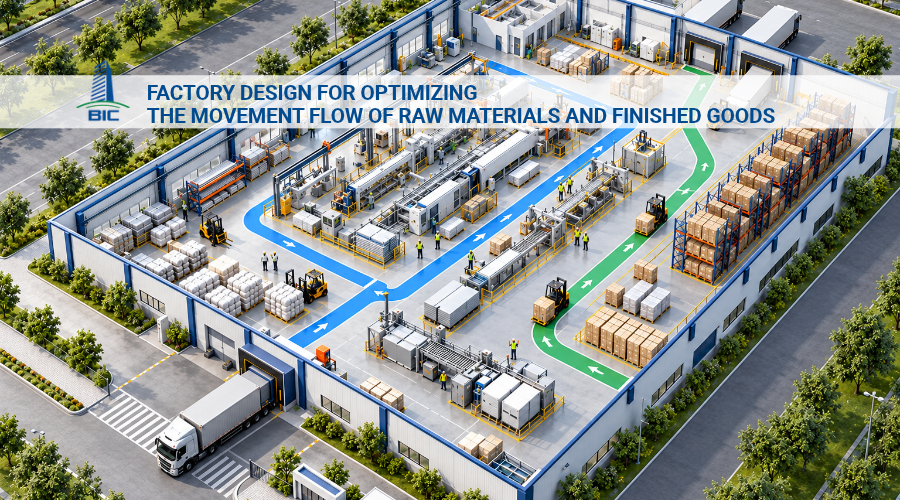
The functional layout in factory design not only serves production operations but also directly affects energy efficiency. Organizing the production line in a linear logic, minimizing intersections and unnecessary movement, helps reduce machinery operating time, thereby saving electricity.
In addition, a reasonable arrangement between production areas, warehouses, support facilities, and technical zones helps minimize energy loss, especially in areas requiring separate temperature control or ventilation. An optimized layout not only improves productivity but also contributes to sustainable operating cost reduction.
One of the most important principles in energy-efficient factory design and construction is the synchronization between architecture, structure, and MEP (mechanical, electrical, and plumbing) systems. When all disciplines are closely coordinated from the design stage, solutions such as ventilation, lighting, power supply, and cooling can be optimally integrated, avoiding overlaps or technical conflicts.
Conversely, if the design lacks synchronization, the construction process will require multiple adjustments, leading to material waste, increased costs, and schedule delays. More importantly, energy-saving solutions will hardly achieve maximum efficiency if not comprehensively calculated from the outset. Therefore, an integrated approach in factory design is the key to ensuring both technical and economic efficiency for the project.

The roof is the area most directly exposed to solar radiation, accounting for a large proportion of the total heat entering the building. Therefore, in factory design, choosing the right roofing solution plays a key role in controlling indoor temperature.
Common solutions such as insulated panel roofs, double-layer roofs, or ventilated roofs help reduce heat transfer into the production space. In particular, ventilated roof systems allow hot air to escape upward, reducing heat accumulation inside the factory. When properly designed, these solutions can lower indoor temperatures by 3–5°C, thereby significantly reducing the cooling system load and saving operational electricity.
Lighting is one of the major electricity-consuming items in textile and garment factories due to the requirement for high and continuous brightness. Utilizing natural light is an effective solution to reduce electricity costs while still ensuring working conditions.
In design and construction, materials such as polycarbonate skylight panels or skylight systems integrated into the roof and walls help distribute light evenly throughout the production space. When properly arranged, these solutions can reduce 30–50% of daytime lighting electricity consumption while creating a more comfortable working environment for employees.
The building facade is the first “skin” that receives environmental impacts, especially heat radiation. Therefore, facade treatment in factory design directly affects energy-saving efficiency.
Solutions such as sun-shading louvers help reduce direct radiation on walls and doors while still ensuring natural ventilation. In addition, using insulated walls or materials with low thermal conductivity limits heat absorption into the building. When these solutions are combined synchronously, the factory can maintain a more stable temperature, reduce dependence on cooling systems, and improve overall operational efficiency.

In factory design, choosing suitable lighting equipment directly affects electricity consumption levels. Industrial LED lighting is currently the optimal solution thanks to its ability to save 40–60% of electricity compared to traditional lighting, while also offering a long lifespan that reduces maintenance and replacement costs.
Especially for textile and garment factories, where stable and accurate lighting is required to ensure product quality, LED lighting not only provides excellent illumination intensity but also minimizes heat generation, helping reduce the load on cooling systems.
A common mistake in design and construction is using a uniform lighting system for the entire factory, leading to energy waste. In reality, each area of the factory has different lighting requirements and should be designed separately.
- Production area: requires high and evenly distributed brightness to ensure precise operations
- Inspection area: requires high-quality lighting with good color rendering to detect product defects
- Support areas: only need basic lighting levels to avoid unnecessary electricity consumption
Proper zoning of the lighting system helps optimize power usage and reduce electricity consumption while maintaining operational efficiency.
The application of technology in factory design is an inevitable trend to improve energy-saving efficiency. Smart lighting systems integrated with light sensors and motion sensors allow adjustment of intensity or automatic on/off control according to actual conditions.
Specifically, light sensors automatically reduce lamp power when sufficient natural light is available, while motion sensors activate lighting only when there are people or activities in the area. This solution not only reduces electricity waste but also enhances flexibility and modernity in factory operations.
In factory design, the electrical system must be calculated not only to meet capacity requirements but also to optimize energy efficiency. One of the key solutions is the application of variable frequency drives (VFDs) for equipment such as fans, pumps, and production machinery, allowing power adjustment according to actual demand instead of continuously operating at maximum capacity.
In addition, load distribution among areas and usage periods helps prevent local overloads and reduce energy losses. When properly designed from the beginning, the electrical system not only operates stably but also significantly reduces energy costs for the entire factory.
For textile and garment factories, water is an important factor in many production and sanitation processes. Therefore, an optimally designed water supply and drainage system helps conserve resources and reduce operating costs.
Solutions such as collecting, treating, and reusing water for suitable purposes (cleaning, cooling, etc.) help reduce input water consumption. At the same time, flow control and leak prevention in the system also play an important role in minimizing waste. This is an indispensable part of the sustainable factory design strategy.
The trend of integrating renewable energy is becoming increasingly common in factory design, especially rooftop solar power systems. With large roof areas, textile and garment factories have a significant advantage in utilizing this energy source.
Solar power not only helps reduce dependence on the power grid but also contributes to stabilizing long-term energy costs. In addition, the use of clean energy enhances the company’s image and meets environmental standards in the global supply chain. When integrated from the design stage, this solution delivers optimal technical and financial efficiency.

In factory design, BIM (Building Information Modeling) acts as a platform for simulating the entire building before actual implementation. Through a 3D model fully integrating architecture, structure, and MEP, technical solutions can be checked, evaluated, and optimized from the design stage.
The application of BIM in design and construction helps detect conflicts between systems early, minimize errors, and reduce issues during construction. At the same time, parameters related to energy, ventilation, and lighting can also be simulated to select the most optimal solution for the factory.
IoT (Internet of Things) is becoming an important tool in controlling and optimizing factory energy use. Through a system of sensors and connected devices, businesses can monitor real-time electricity consumption for each area or each piece of equipment.
The collected data helps managers quickly detect abnormal consumption points and make timely adjustments. When integrated from the factory design stage, IoT systems not only help save energy but also improve overall operational efficiency.
The trend of smart factory development is reshaping industrial operations, including the textile and garment sector. A smart factory is built on the foundation of automation and data, allowing machinery systems, energy systems, and production management to be connected and operated synchronously.
In factory design, orienting the project toward a smart factory model helps optimize production processes, reduce energy waste, and improve productivity. Beyond cost savings, this is also a strategic step that helps businesses enhance competitiveness and adapt to the digital transformation trend in the industry.
The first step in textile and garment factory design and construction is surveying the site conditions and conducting a detailed analysis of the investor’s needs. Factors to be assessed include production scale, product type, technology line, workforce quantity, and future expansion plans.
Collecting complete data from the beginning helps the factory design unit propose solutions that match actual operations, avoid under- or over-designing functions, and create a foundation for the next implementation steps.
Based on the survey data, the consulting unit will develop a preliminary design plan including the master layout, functional arrangement, and architectural – technical solution orientation. This is an important stage to determine the overall structure of the factory and ensure compatibility with the textile and garment production process.
The preliminary plan also serves as a basis for the investor to evaluate investment efficiency, balance costs, and choose the optimal implementation direction before proceeding to detailed design.
After the preliminary plan is approved, the technical design stage will be implemented with complete detailed documentation for architecture, structure, and MEP systems. In design and construction, synchronizing all disciplines at this step helps minimize technical conflicts and ensure construction feasibility.
At the same time, cost estimates are prepared based on the design documents, helping investors control budgets and establish clear financial plans. This is a key step to ensure the project is implemented according to cost and quality objectives.
The final stage in the factory design process is coordination with the contractor and on-site supervision. The design team closely follows the implementation process to ensure that the project is constructed according to the documents while promptly handling arising issues.
Close coordination between design construction not only ensures progress but also maintains project quality, especially the energy-saving solutions that were calculated from the beginning. This is an important factor for textile and garment factories to operate stably and efficiently immediately after completion.
From the perspective of a general contractor, BIC always approaches projects with an integrated strategy from the initial stage of factory design. Instead of separating each work item, the solution is built on close coordination between architecture, structure, and MEP systems to ensure consistency throughout the entire building.
This approach helps minimize technical conflicts while optimizing factors such as ventilation, lighting, and energy consumption. For textile and garment factories, where continuous and stable operation is required, integrated design from the outset is a decisive factor for long-term efficiency.
One of the core values that BIC delivers in design and construction is the ability to balance initial investment costs with long-term operating costs. Instead of focusing solely on reducing upfront construction expenses, the design plan is calculated to optimize total lifecycle costs.
Solutions such as selecting suitable materials, optimizing structural systems, and integrating energy-saving systems help investors significantly reduce operating costs, especially electricity and maintenance expenses. This is a strategic approach that helps businesses improve sustainable financial performance.
In practice, many projects incur additional costs and schedule delays due to the lack of connection between design and construction. With extensive practical implementation experience, BIC controls risks from the factory design stage by forecasting technical situations in advance and optimizing construction solutions.
Standardizing design documents combined with a strict control process helps minimize changes during implementation. This not only saves costs but also ensures project progress and quality according to commitments with the investor.
Beyond the design and construction stages, BIC aims to become a long-term partner accompanying businesses throughout the factory’s operation process. Design solutions are developed with a long-term vision, ensuring scalability, upgradeability, and adaptability to business growth.
This partnership helps investors not only own an efficient facility at the present time but also establish a solid foundation for sustainable development in the future. This is the distinct value that a professional design and construction unit brings.
In the context of rising energy costs and increasingly strict production standards, energy-efficient factory design has become a strategic factor for the textile and garment industry. A properly planned design and construction solution from the beginning not only helps businesses reduce operating costs but also improves production efficiency, enhances the working environment, and meets international sustainable development standards.
From a practical implementation perspective, BIC always emphasizes that the greatest value of a factory does not lie in the initial investment cost, but in its operational efficiency throughout the building’s lifecycle. Investing methodically in design is the way for investors to control costs, minimize risks, and create a foundation for long-term development.
If your business is planning to build or expand a textile and garment factory, choosing the right consulting unit and implementing the factory design properly from the beginning will be the decisive step for the success of the entire project.