In pre-engineered steel building projects, the flooring system is a component that has a major impact on investment costs, construction speed, and the long-term efficiency of the building’s use. Although they may share the same steel frame system, depending on the intended use, operating load, project scale, and operational requirements, each project will be suitable for a different type of floor. Some projects require lightweight solutions for fast construction, while others need floors with high load-bearing capacity, greater stiffness, or easy future expansion. Therefore, choosing a floor system cannot be based on intuition or only on the initial cost.
In reality, many investors focus heavily on the steel frame, roof, and wall systems but have not fully assessed the role of the flooring system in the overall construction design. Meanwhile, simply choosing the wrong flooring solution can lead to additional structural costs, extend the design and construction schedule, or affect the building’s operational capacity after it is put into use. This is why understanding the common types of floors used in pre-engineered steel buildings is an essential step before project implementation.
In the article below, BIC will help investors identify the most common types of flooring systems used in pre-engineered steel buildings today, clearly understand the characteristics, advantages, disadvantages, and scope of application of each solution, thereby selecting the most suitable option for the building’s function, budget, and investment objectives.
In a pre-engineered steel building, the floor system is the component that creates the usable floor area, receives operational loads, and transfers them to the building’s steel beams and columns. Depending on the structural solution, the floor may work as a steel–concrete composite slab, cast-in-place concrete slab on steel beams, precast systems such as hollowcore slabs, or lightweight flooring using fiber cement boards for areas with medium and light loads.
For investors, it is important to understand that the floor is not merely a “flat surface for use,” but a component that directly determines the building’s load-bearing capacity, space organization, and operational stability.
The floor system also plays a role in connecting with the steel frame to create an integrated structural system. For example, with deck slabs, the profiled steel decking acts as a support layer for concrete during construction and later works together with the concrete to form a composite slab after completion. With hollowcore slabs, the precast panels help create usable floor areas quickly, reduce on-site work, and are suitable for spaces requiring large spans. This shows that the choice of flooring directly affects how the building is organized and used in practice.
For investors, choosing the right type of floor directly impacts structural costs. Heavier floor systems usually require larger beams, columns, and foundations. On the other hand, lighter solutions can help reduce dead loads, thereby optimizing the steel frame and foundation system. This is why floor selection should be considered together with the overall building design problem instead of being treated as a separate secondary item.
The type of floor also clearly affects construction progress. Deck slabs and hollowcore slabs are often highly rated for construction speed because they reduce many stages involving formwork, temporary supports, or cast-in-place concrete compared to traditional methods. Meanwhile, lightweight systems such as Cemboard are suitable for areas requiring fast construction, renovation, mezzanine floors, or office spaces inside factories. When schedule is a major priority, this is a factor investors cannot ignore.
In the long term, the choice of flooring also affects functionality. A suitable floor type will provide more stable use, meet load requirements, reduce unwanted vibration, and create favorable conditions for future expansion or renovation. Conversely, if the floor is chosen only based on initial price without considering operational requirements, the building can easily face functional issues later.
The first criterion is the usage load. Investors need to clearly determine whether the floor serves as office space, mezzanine, warehouse, production area, or machinery area. This is the most important basis for deciding whether to use composite slabs, traditional concrete slabs, precast slabs, or lightweight floors.
The next criterion is the slab span and compatibility with the steel frame system. For spaces requiring large spans with fewer columns, hollowcore slabs or certain composite systems may offer clearer advantages. Meanwhile, smaller areas, moderate loads, or renovation projects may be more suitable for lightweight floors. In other words, choosing a floor must always go together with the overall structural problem of the pre-engineered steel building.
In addition, investors need to consider construction speed, investment level, and actual usage purpose. Some solutions may have higher material costs but shorten the schedule and reduce on-site work. Other solutions are more suitable when prioritizing stiffness, load capacity, or special usage requirements. Therefore, there is no single best floor type for every project; there is only the most suitable floor type for each project’s investment objectives, functionality, and implementation strategy.

This is one of the most commonly used flooring solutions in pre-engineered steel buildings thanks to its fast installation speed and excellent compatibility with steel frame systems.
In terms of structure, deck slabs usually consist of profiled steel decking, steel mesh or reinforcement bars according to design, followed by cast-in-place concrete to create a composite slab system.
From the investor’s perspective, the major advantage of deck slabs is the reduction of formwork work, which helps shorten construction time and is suitable for projects requiring fast-track schedules. This is why this solution is often found in pre-engineered buildings, factories with mezzanine floors, in-factory offices, or projects requiring a balance between schedule, load capacity, and investment cost.
Unlike deck slabs, this solution uses formwork, reinforcement bars, and concrete in the traditional way, but the supporting structure below is steel beams instead of concrete beams.
This solution is often considered when the building requires higher stiffness, special detailing, or spaces with heavy usage loads. Therefore, in actual design and construction, it is often used in office areas, auxiliary spaces, high-load floors, or locations where investors prioritize solidity and stability over construction speed.
Hollowcore slabs are precast concrete components, usually hollow-core slab panels, manufactured in factories and then transported to the site for installation.
The most outstanding advantages of hollowcore slabs are fast installation, good factory quality control, and suitability for multi-storey buildings, industrial facilities, warehouses, or areas requiring large spans and high loads.
For investors, this is a solution worth considering when erection speed is a major priority and the building layout follows a relatively clear modular plan.
This group of floors typically uses lightweight concrete panels, AAC panels, or lightweight load-bearing precast slab systems installed on beams or steel frames.
Because they reduce dead loads, these floor systems can help further optimize beams, columns, and foundations while shortening construction time in areas that do not require very heavy loads.
In practice, this solution is more suitable for auxiliary spaces, offices, mezzanine floors, or areas where investors want to optimize weight and installation speed.
This is a lightweight floor solution using fiber cement boards installed on a steel frame or light steel joist system.
In the context of pre-engineered steel buildings, Cemboard floors are often used for mezzanines, office spaces inside factories, renovation and expansion projects, or areas requiring flexible and easier disassembly compared to traditional concrete slabs.
However, this is not the optimal choice for every heavy load problem, so its application must closely follow functional requirements and structural calculations from the beginning.
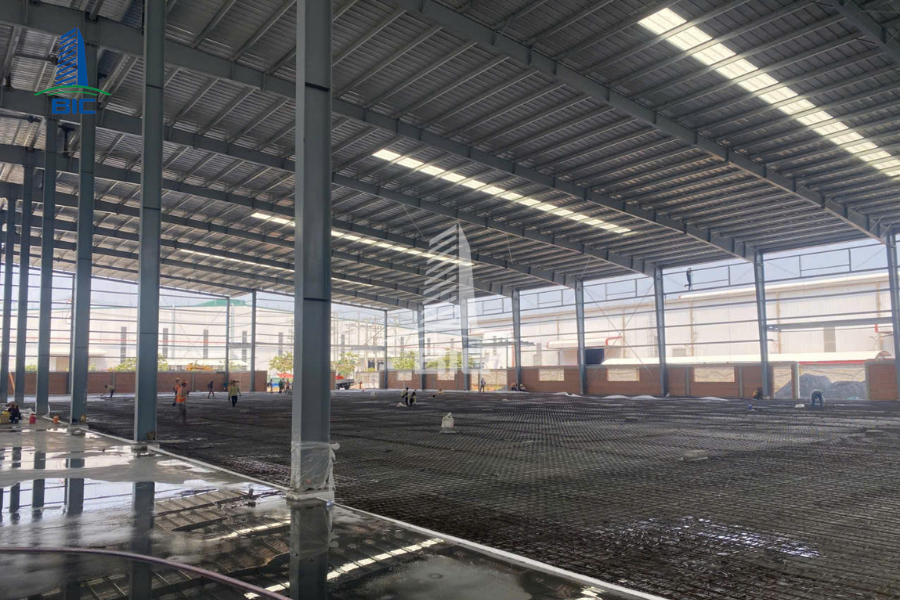
Composite deck slabs in pre-engineered steel buildings typically consist of three main layers: profiled steel decking, reinforcement bars or steel mesh as designed, and cast-in-place concrete on top.
During construction, the steel deck acts as permanent formwork. After the concrete reaches strength, the steel deck and concrete layer work together as a composite slab system.
In terms of working principle, the usage load is received by the concrete layer and distributed together with the steel deck to the steel beams below.
This type of floor uses formwork, reinforcement, cast-in-place concrete, and curing processes following the traditional concrete method.
The working principle is easy to understand: the reinforced concrete slab resists bending and distributes loads according to the design scheme, while the steel beams act as the main supporting system.
Because it is cast on site, this floor type has the advantage of easy geometric customization and handling of complex technical positions.
Hollowcore slabs are prestressed precast concrete panels with continuous voids running along the length of the slab.
This hollow structure reduces self-weight compared to solid slabs while maintaining span and load-bearing performance.
The working principle of hollowcore slabs takes advantage of prestressing to increase bending resistance and reduce deflection during use.
This floor group typically uses lightweight concrete/AAC panels or lightweight precast slabs placed on steel frames or support beams.
The principle of this floor type is to reduce dead loads on the frame system, thereby reducing requirements for beams, columns, and sometimes even foundations.
This floor system usually consists of a light steel frame/joist system, with load-bearing fiber cement boards installed on top, followed by finishing layers according to usage requirements.
The biggest advantage of this solution is reducing loads on the existing structure and being very convenient for mezzanines, in-factory offices, renovations, or spaces requiring flexible construction.

When looking at the initial cost layer, investors should not only compare the price of flooring materials, but also evaluate the total cost of the related structural system. Composite deck floor systems often have an advantage because the steel deck sheet serves both as permanent formwork and as part of the composite action with the concrete slab, thereby reducing part of the formwork work and accelerating construction progress. Hollowcore slabs also offer an advantage by minimizing many on-site activities such as temporary supports and wet concrete formwork. Meanwhile, cast-in-place reinforced concrete floors usually involve more on-site construction stages.
Therefore, from an investment perspective, deck flooring and hollowcore slabs are often more beneficial when the investor prioritizes time optimization and reducing on-site workload; meanwhile, cast-in-place floors are more suitable when the project prioritizes higher stiffness or specialized structural configurations. Lightweight concrete panels/AAC panels and fiber cement board flooring systems often provide the benefit of reduced self-weight, which in some cases helps optimize the cost of beams, columns, and foundations in medium-load areas. This is a technical conclusion based on the product characteristics and construction methods of each flooring system.
In terms of project schedule, deck floors and hollowcore slabs are typically the two most prominent options. Technical references on composite slabs show that deck flooring is highly regarded for its fast installation speed, reduced conventional formwork workload, and compatibility with steel frame structures. With hollowcore slabs, time-consuming on-site tasks such as propping and wet concrete shuttering are almost eliminated, and once the slabs are installed and the joints are grouted, the floor can quickly provide a working platform for subsequent trades.
Lightweight AAC panels also offer the advantage of “easy and fast installation,” making them suitable for accelerating progress in auxiliary areas or mezzanine floors. Meanwhile, cast-in-place concrete floors are slower because they must go through multiple steps such as formwork erection, reinforcement placement, concrete pouring, and waiting for the concrete to reach its required strength. Lightweight Cemboard/fiber cement board floors also provide fast installation advantages in mezzanines, in-factory offices, or renovation and expansion projects.
If high load capacity and floor stiffness are the priorities, investors will often consider cast-in-place reinforced concrete floors or hollowcore slabs more seriously. Hollowcore technical documentation shows that this system can be designed for heavy loads in factories, warehouses, and storage facilities, while also offering a relatively wide typical span-load range. Hollowcore systems can also incorporate structural topping when higher performance is required for concentrated loads, complex floor penetrations, or integration with heavier structural components.
Deck flooring performs effectively in many common building applications, but its optimal efficiency is generally found in medium to moderately high load categories, where investors want to balance speed, load capacity, and cost. Lightweight concrete panels/AAC panels and lightweight fiber cement board floors are more suitable for medium or light-load areas such as offices, mezzanines, and auxiliary spaces, rather than machinery zones or areas with significant concentrated loads.
In terms of expansion or renovation capability, lightweight flooring systems such as fiber cement boards/Cemboard or certain lightweight panels are generally more flexible due to their lower self-weight, dry or semi-dry construction methods, and reduced load on the existing structure. This is particularly beneficial for renovation projects involving old factories, office mezzanines, or additional auxiliary areas where the investor does not want to heavily interfere with the existing structural system.
Deck flooring is also relatively flexible in new steel-frame buildings because it integrates well with steel beams and aligns with fast-track construction strategies. In contrast, cast-in-place concrete floors and some heavier systems are usually less flexible if the building is expected to undergo major layout changes in the future, as demolition, cutting, or expansion work tends to be more complicated. This is a technical assessment derived from the structural configuration, self-weight, and installation methods of each flooring system.
In the long term, operational efficiency is not simply about whether the floor “can be used,” but rather how well the floor type matches the building’s actual function. Hollowcore slabs offer advantages in long-span capability, high load-bearing capacity, good fire resistance, and the ability to support more open spaces with fewer beams, columns, or partition walls. Deck flooring offers the advantage of balancing speed, structural efficiency, and compatibility with steel framing, making it highly suitable for many common pre-engineered steel building applications.
Cast-in-place concrete floors excel in stiffness and provide a solid, stable user experience in heavy-load areas or spaces with unique geometries. Meanwhile, lightweight AAC flooring and lightweight fiber cement board systems offer clearer benefits in auxiliary areas, offices, and mezzanines, where reducing weight, enabling fast construction, and maintaining adaptability are key priorities.
From the investor’s perspective, there is no single floor type that is best for every project; the optimal solution is the one that best aligns with the project’s load requirements, span, schedule, budget, and long-term operational plan.
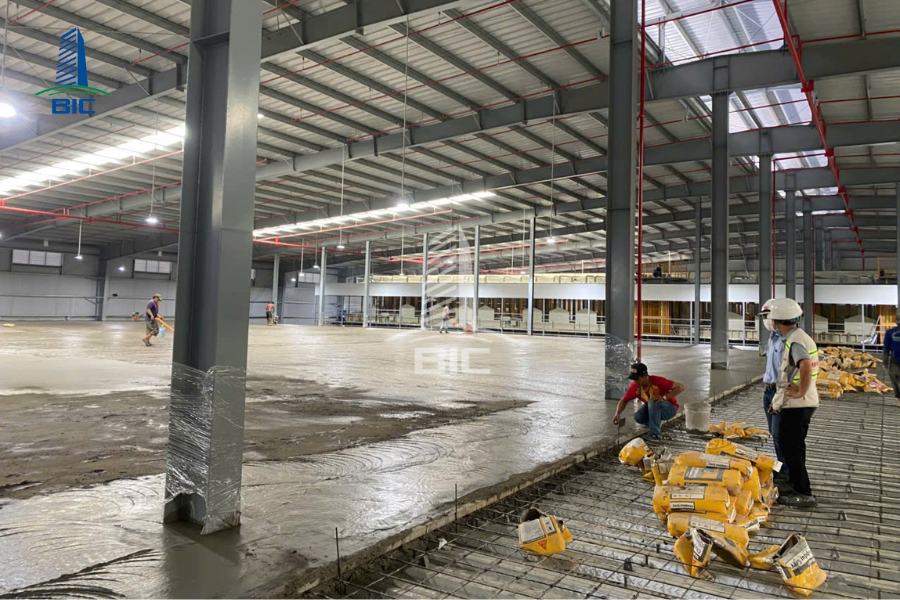
The first factor investors need to determine is what the floor will be used for. Even within the same pre-engineered steel building, flooring for offices, mezzanines, warehouses, production areas, or machinery zones will have very different requirements in terms of load capacity, vibration control, stiffness, and surface finishing. This is why one standard solution cannot be applied to every project. For simpler operational areas such as in-factory offices or auxiliary mezzanines, lightweight or semi-prefabricated floor systems may be more suitable. On the other hand, if the area is intended for production, storage, or concentrated heavy loads, the flooring solution must be upgraded accordingly.
From the perspective of factory design, functionality must always come before material selection. Choosing the right floor system from the beginning helps keep the entire structural, scheduling, and cost plan on track; whereas choosing based on habit or simply because a solution is currently popular can easily lead to adjustments later. This is a point many investors often overlook when first working with a design-build contractor.
After functionality, the most important factor is the actual load requirement. Technical references on hollowcore systems show that this type of flooring can be designed to withstand heavy loads for factories, warehouses, and storage facilities, while AAC panels and fiber cement boards are generally more suitable for medium or light-duty applications. This means the investor must clearly define whether the floor will support people, stored goods, machinery, or concentrated special loads before finalizing the solution.
If the load requirement is underestimated from the start, the consequence is not only a floor system that is weaker than actual usage demands, but it may also require strengthening beams, columns, or even structural reinforcement later. On the other hand, overdesigning the system unnecessarily can significantly increase the initial investment cost. Therefore, for pre-engineered buildings, load calculations must be finalized as early as possible during the design stage.
The floor type cannot be separated from the beam span and the structural layout of the steel frame. Technical documentation on composite slabs shows that deck floors perform effectively when integrated with steel beam systems, while hollowcore slabs have clear advantages in spanning longer distances and rapidly creating usable floor space for multi-story buildings or open-plan areas. This demonstrates that even with the same functional requirement, the optimal floor solution may differ depending on the structural scheme.
From an investor’s perspective, this is extremely important: the floor system should not be selected first and then force the structure to adapt. The correct approach is for the factory design and structural teams to simultaneously evaluate beam spans, load requirements, floor elevations, and steel frame types before deciding on the most suitable flooring system. When this process is followed correctly, the project becomes more synchronized, minimizes changes, and achieves better overall optimization.
Budget is one of the most important concerns for investors, but when it comes to flooring systems for pre-engineered steel buildings, the budget should be considered holistically rather than based solely on the flooring material cost per square meter. For example, deck flooring can reduce formwork requirements and shorten construction time; hollowcore slabs reduce on-site work; while lightweight flooring systems reduce self-weight, which can further optimize beams, columns, and foundations. Therefore, flooring costs must be evaluated together with steel frame costs, construction costs, and schedule requirements instead of as an isolated line item.
In other words, the cheapest floor type is not always the most cost-effective one. In some projects, a slightly more expensive material solution that shortens the schedule, reduces structural quantities, or lowers site organization costs may provide much greater overall investment efficiency. This is why investors should request the design-build contractor to analyze options based on total project cost rather than simply comparing the unit price per square meter.
If early handover is a top priority, the flooring system must be selected based on fast construction and ease of on-site execution. SCI documentation shows that composite slabs using steel decking are highly rated for construction speed, while hollowcore references emphasize reduced construction program time and the ability to provide early working platforms for subsequent trades. AAC panels and fiber cement boards also offer advantages in quick, clean, and efficient installation compared to cast-in-place concrete floors.
This is particularly important for pre-engineered steel building projects that need to be quickly put into operation, production, business use, or leasing. If schedule is a major priority, the flooring choice should align with the overall construction strategy from the outset rather than being optimized only once work has started on site. Getting this right at the planning stage helps reduce schedule pressure across the entire project.
Finally, investors should also look one step ahead: will the building require future expansion, renovation, or functional conversion? Lightweight flooring systems such as lightweight panels or fiber cement boards are often more flexible for renovation projects, mezzanines, in-factory offices, or areas where reducing load on the existing structure is important. Meanwhile, hollowcore slabs, deck floors, and cast-in-place concrete floors are generally more suitable for buildings with clearly defined functions and operating models from the beginning. This is a technical assessment based on self-weight characteristics, installation methods, and the modular nature of each floor system.
For investors, flexibility may not always be the number one priority, but if the business plans to expand or modify the layout in the future, this factor should be considered from the design stage. Choosing the right floor system from the beginning allows the building to adapt better, minimizes complex reinforcement work, and reduces the need for major structural modifications later.
From the contractor’s perspective, choosing a floor system for a pre-engineered steel building should not begin with the question, “Which type is currently popular?” Instead, it must begin with the actual usage requirements of the building. The investor must clearly define whether the floor is intended for offices, mezzanines, warehouses, production areas, or machinery zones, because each function comes with different requirements for load capacity, stiffness, vibration control, and finishing methods. This is also why the same steel-frame structure may be suitable for deck flooring, cast-in-place concrete floors, hollowcore slabs, or completely lightweight flooring systems depending on the application.
At BIC, assessing usage requirements is always considered the foundation before proposing a floor solution. When the operational needs are properly understood from the beginning, the proposed solution will be more practical and better aligned with reality, avoiding situations where a floor is selected out of habit and then requires structural or functional adjustments later. This approach helps investors control risks from the very first stage of the factory design process.
A flooring solution is only truly effective when it is considered simultaneously from both the design and construction execution perspectives. For example, deck flooring offers fast installation and composite action with steel beams, while hollowcore slabs excel in long-span capability and modular rapid erection; meanwhile, cast-in-place floors are more suitable when higher stiffness or specialized structural details are required. If the floor system is selected based only on architectural ideas without synchronization with the construction method, conflicts can easily arise on site.
Therefore, BIC always approaches floor solutions in an integrated manner: structure, functionality, materials, and construction methodology must all be considered together from the start. This approach ensures that investors receive not only a technically correct design on paper, but also a practical solution that can be efficiently executed on site, minimizing overlaps and maintaining stable project progress throughout implementation.
Each floor type has its own strengths, so the contractor must provide recommendations based on the investor’s actual objectives rather than applying a standard solution to every project. If speed is the priority, deck floors or hollowcore slabs often offer significant advantages by reducing formwork, temporary supports, and installation time. If the priority is reducing load on an existing structure or creating mezzanines, office spaces, or auxiliary zones, lightweight systems such as fiber cement boards or lightweight panels may be more suitable. For projects involving heavy loads or requiring high stiffness, cast-in-place concrete floors are often the safer option.
Based on this practical reality, BIC’s consulting approach is not based solely on initial unit price, but rather on the overall balance of three key factors: schedule, budget, and intended functionality. The goal is to help investors choose the flooring system that best fits the actual investment scenario, rather than simply selecting the most commonly used option on the market.
One of the biggest causes of unexpected costs in pre-engineered building projects is selecting the floor system too late, when the steel frame layout, beam spans, or load assumptions have already been nearly finalized. In reality, each flooring system brings very different requirements for beams, columns, connections, and construction organization. By carrying out structural breakdown and coordination early, the contractor can clearly identify from the beginning which floor type will be most optimal for the project, avoiding mid-project changes that increase steel quantities, alter construction methods, or delay the schedule. This is a direct technical conclusion based on the different structural behaviors and installation methods of deck floors, hollowcore slabs, and lightweight systems.
At BIC, early structural breakdown is a key method for controlling cost overruns before they occur. Once the floor type, beam span, load requirements, and construction approach are finalized early, the investor gains clearer visibility into the total investment cost, project timeline, and technical risks. This is a critical step in ensuring that the design-build process stays on the right track from the outset.
The true value of a contractor does not lie merely in proposing a floor type, but in the ability to accompany the investor from concept development through actual implementation. With floor systems such as deck slabs, hollowcore, or lightweight panels, the difference in efficiency comes not only from the materials themselves, but also from how construction is organized, how disciplines are coordinated, and how site details are controlled. Installation guidelines for precast slabs also show that site organization and construction safety alone are major contributors to project efficiency.
From this perspective, BIC not only advises on floor selection, but also supports investors throughout the entire process, from factory design to on-site execution. This approach ensures that decisions regarding flooring, steel framing, and project schedule remain fully connected throughout the project lifecycle, allowing the building to be not only technically correct but also more efficient in terms of investment and long-term operation.
Choosing the right floor type for a pre-engineered steel building does not only affect the initial investment cost, but also directly impacts construction progress, load-bearing capacity, flexibility in use, and long-term operational efficiency. Each flooring solution—from composite deck floors and cast-in-place concrete slabs to hollowcore systems and lightweight floor structures—has its own strengths and only delivers true efficiency when selected according to the project’s specific functionality, load requirements, and investment goals.
For investors, the key is not to find the most popular floor type, but to identify the solution that best fits the real project requirements. When calculated and coordinated from both the design construction stages, the flooring system helps the building operate more stably, minimizes structural changes, and optimizes long-term usability.
From a practical implementation standpoint, BIC believes that choosing the right flooring solution from the beginning helps the entire factory design project move in the right direction—from structural integrity and project schedule to long-term operational performance. This is not only a technical decision, but also a strategic investment decision for every pre-engineered steel building project.