The foundation is the core factor that determines the durability and stable operation of a manufacturing factory. However, in practice, many investors still underestimate this stage, choosing foundation solutions based on short-term cost considerations or subjective experience without conducting adequate surveys and calculations. As a result, the building may face serious issues such as uneven settlement, floor cracking, impacts on machinery, and production interruptions, leading to very high remediation costs.
In the context of rising construction costs, choosing the right foundation from the outset not only ensures technical safety but also serves as a long-term financial optimization strategy. A suitable foundation solution must be determined based on geological conditions, building loads, and future usage plans, while also being synchronously integrated into the overall factory design and construction design process.
In the article below, BIC will help investors clearly understand how to choose the right foundation, minimize risks, and optimize project efficiency, especially for facilities such as textile and garment factories and other common industrial production models today.
In any manufacturing factory, the foundation is the first and most important load-bearing component, responsible for transferring the entire load of the building to the underlying soil. This load includes not only the structural weight but also machinery, equipment, and production activities.
If the foundation is properly designed and constructed according to technical standards, the load will be evenly distributed, ensuring the building remains stable throughout its operation. On the other hand, if the foundation lacks sufficient load-bearing capacity or is unsuitable for the geological conditions, the building may experience differential settlement and structural cracking, directly affecting safety and usability.
Unlike residential buildings, manufacturing factories have complex and frequently changing load characteristics. Production machinery is heavy and operates continuously, creating static loads combined with dynamic loads caused by vibration and movement during operation.
In addition, factory floors usually cover a very large area, requiring the foundation to ensure uniform stability across the entire site. This requires a foundation solution that not only has adequate load-bearing capacity but also effectively controls uneven settlement to avoid affecting the production line.
The foundation is directly connected to the entire structural system above it. Once the foundation encounters problems, components such as columns, beams, floors, and walls are all at risk of being affected, leading to reduced quality and lifespan of the building.
Especially for operating manufacturing factories, repairing or reinforcing the foundation is extremely difficult, costly, and may interrupt production activities. Therefore, proper investment in the foundation from the construction design stage is not only a technical requirement but also a strategic decision to ensure long-term efficiency for the entire project.

Geological conditions are the most critical factor in choosing a foundation solution for a manufacturing factory. Each type of soil, such as soft soil, muddy soil, or sandy soil, has different load-bearing characteristics and stability levels, directly affecting the foundation solution.
In addition, the groundwater level is also a factor that must be carefully assessed, as it can reduce the soil’s load-bearing capacity and cause difficulties during construction. Through detailed geological surveys, the construction design unit can determine the soil bearing capacity and select the most suitable foundation type to ensure safety and cost optimization.
The building load is the basis for determining the type of foundation to be used. For textile and garment factories, the load is generally moderate, mainly from lightweight machinery and continuous production lines, so isolated footings or strip foundations can be used if the geological conditions are favorable.
In contrast, for heavy industrial factories such as mechanical workshops or steel manufacturing plants, large loads and strong vibrations require a higher-capacity foundation solution, typically pile foundations. Determining the correct load from the factory design stage helps avoid overload or unnecessary waste due to overdesign.
An important factor that is often overlooked is the future usage orientation. Investors need to clearly determine whether the building has plans for additional floors, expansion, or changes in the production line.
If this is not considered from the beginning, the current foundation may not meet future expansion needs, leading to reinforcement or reconstruction, causing high costs and affecting production operations. Therefore, the foundation solution must have a long-term vision aligned with the company’s development strategy.
Foundation costs typically account for about 10–30% of the total construction cost of a manufacturing factory, depending on geological conditions and the chosen foundation type. This is a major cost item but also one that cannot be arbitrarily reduced.
Balancing cost and safety is an important challenge in construction design. A foundation solution that is too cheap may involve many risks, while an overly conservative solution may waste the budget. The optimal solution is to choose the most suitable option for actual conditions, ensuring both economic efficiency and long-term structural durability.

Isolated footings are a common solution for manufacturing factories with light loads and good soil conditions. This type of foundation is designed separately under each column, helping transfer loads directly to the soil beneath.
The biggest advantages of isolated footings are low cost, simple construction, and fast implementation time. In construction design, isolated footings are often applied to lightweight factories such as textile and garment workshops or warehouses with relatively low loads. However, this solution is only suitable when the soil has good and stable load-bearing capacity.
A strip foundation is a continuous foundation running beneath rows of columns or walls, helping distribute loads more evenly than isolated footings. As a result, the building has higher stability, especially under average soil conditions.
In factory construction design, strip foundations are commonly used when the load is not too large but greater stability and prevention of localized settlement are required. This is a balanced solution between cost and technical efficiency, suitable for many medium-scale manufacturing factories.
A raft foundation extends across the entire building area, helping distribute loads evenly over the soil. This type of foundation is often used in weak soil conditions where isolated or strip foundations cannot ensure safety.
The advantage of a raft foundation is minimizing uneven settlement, thereby protecting the structural system above. In construction design, raft foundations are considered an effective solution for areas with complex geological conditions, helping improve the overall stability of the factory.
Pile foundations transfer the building load to stronger soil layers deeper underground through a pile system. Common pile types include reinforced concrete piles, driven piles, and bored piles.
This type of foundation has high load-bearing capacity and is suitable for buildings with large loads or weak soil conditions. Although the investment cost is higher than other foundation types, pile foundations provide superior safety and durability. In large-scale factory construction or heavy industrial projects, pile foundations are often the optimal choice to ensure long-term stability.
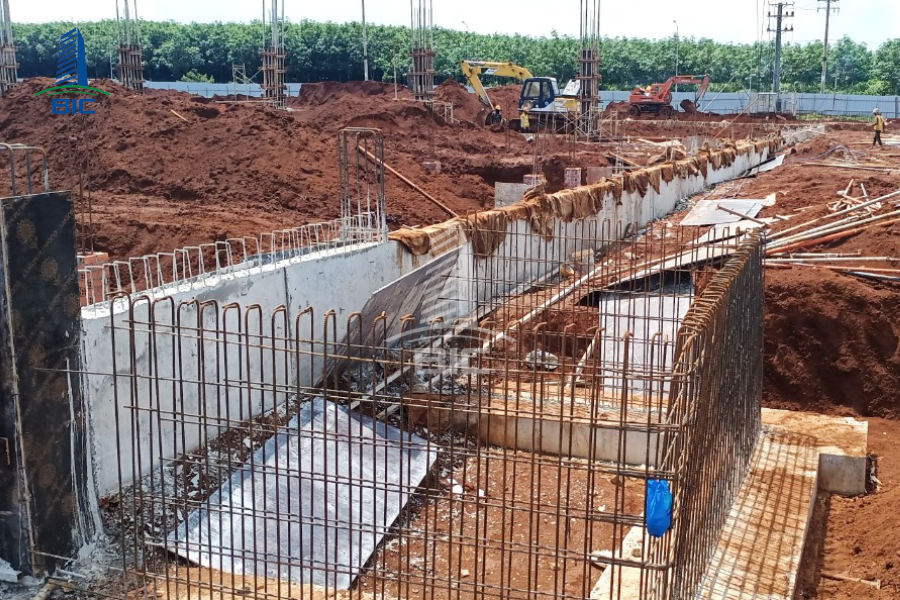
Foundation costs in manufacturing factories depend directly on the type of foundation and geological conditions. In terms of investment level, they can be arranged in increasing order as follows:
- Isolated footing: lowest cost, simple construction
- Strip foundation: moderate cost, improved stability
- Raft foundation: higher cost due to large concrete volume
- Pile foundation: highest cost, requiring specialized equipment and techniques
However, initial cost does not reflect the full investment efficiency. In many cases, choosing the right foundation from the beginning significantly reduces future repair and operating costs.
In terms of load-bearing capacity and stability, the foundation types differ significantly:
- Pile foundation: highest safety level, transfers loads to stronger soil layers, suitable for weak soil and heavy loads
- Raft foundation: high stability, minimizes uneven settlement
- Strip foundation: medium stability, suitable for relatively good soil
- Isolated footing: lowest safety level, highly dependent on soil quality
In factory design, safety should be prioritized over cost, especially for facilities that require continuous operation.
The choice of foundation must be based on the actual conditions of each project. Some typical situations include:
- Isolated footing: applied to sites with good geology and light loads such as small-scale textile factories or simple warehouses. This is a cost-saving option when conditions allow.
- Strip foundation: suitable for average soil conditions where higher stability than isolated footings is needed. Often used for medium-scale manufacturing factories with moderate loads.
- Raft foundation: selected when the soil is weak and there is a risk of uneven settlement. Suitable for large-area buildings requiring even load distribution.
- Pile foundation: applied to weak soil or buildings with heavy loads such as mechanical workshops and heavy manufacturing plants. This is the optimal safety solution, especially for projects requiring long-term stable operation.
There is no single “best” foundation type for every case. The optimal solution is the one that best fits the geological conditions, load requirements, and usage orientation of each manufacturing factory.
For textile and garment factories, building loads are generally moderate, mainly from lightweight machinery and continuous production lines. Therefore, foundation selection must balance investment cost and long-term stability.
If the soil condition is good and has high bearing capacity, isolated footings or strip foundations are reasonable choices, helping save costs while still meeting technical requirements. On the other hand, if the soil is weak or there is a risk of uneven settlement, pile foundations should be prioritized to ensure safety and stability during operation.
For manufacturing factories in the mechanical, metallurgical, or heavy industrial sectors, building loads are very large due to the use of heavy machinery and vibration during operation.
In this case, pile foundations are almost mandatory to transfer loads to deeper soil layers with better bearing capacity. This solution helps minimize settlement, improve stability, and ensure safety for the entire structural system, especially in buildings requiring continuous high-intensity operation.
Warehouse and logistics facilities are characterized by concentrated loads on the floor due to stored goods, forklifts, and continuous movement activities. Therefore, in addition to choosing the appropriate foundation, floor load-bearing requirements also play an important role.
In factory design, foundation solutions must ensure uniform stability across the entire area, preventing localized settlement that could affect warehouse operations. Depending on geological conditions, strip foundations, raft foundations, or pile foundations can be used in combination with high-load industrial floor design to ensure long-term efficiency.
One of the most serious mistakes in factory design is skipping or conducting only a superficial geological survey. Failing to understand soil characteristics, groundwater levels, and load-bearing capacity can lead to choosing the wrong foundation type from the outset.
Common consequences include uneven settlement, floor cracking, or structural instability after a period of operation. At that point, foundation remediation costs are not only very high but also directly affect production activities.
Many investors tend to choose the lowest-cost foundation option to reduce the initial budget. However, in factory design, this approach involves many potential risks.
An unsuitable foundation solution may cause serious issues during operation, leading to repair and reinforcement costs far exceeding the initial savings. Cost optimization should be based on overall efficiency, not just the upfront investment cost.
Another common mistake is calculating loads only based on current needs without planning for future expansion or changes in functionality. In reality, many manufacturing factories upgrade machinery, increase capacity, or expand scale after a period of operation.
If the foundation is not designed with a long-term vision, the building will face limitations in upgrading and may even require foundation reinforcement, causing additional costs and production interruptions.
In factory design, the foundation cannot be separated from the structural system above it. A lack of synchronization between the foundation and the structure may lead to unreasonable load distribution, reducing the load-bearing efficiency of the entire building.
In addition, poor coordination between disciplines can easily cause technical conflicts during construction, resulting in extra costs and schedule delays. Therefore, close coordination between foundation design and structural design is mandatory to ensure long-term quality and durability.
The first and most important step in foundation construction design is the geological survey. This process includes drilling surveys, soil sample testing, and evaluating parameters such as bearing capacity, settlement, and groundwater level.
The survey results form the basis for determining the appropriate foundation type and help predict risks that may arise during construction and operation. An accurate geological survey helps avoid costly mistakes in later stages.
After obtaining geological data, the next step is analyzing the loads of the manufacturing factory. Loads must be fully calculated, including static loads from the structure, machinery, goods, and dynamic loads generated during operation.
Accurate load determination ensures that the foundation is designed with sufficient capacity without unnecessary excess, thereby optimizing cost and ensuring building safety.
Based on the results of the geological survey and load analysis, the consulting unit will propose suitable foundation options such as isolated footings, strip foundations, raft foundations, or pile foundations. In construction design, comparing options must be based on many factors such as cost, safety, constructability, and actual site conditions.
The optimal solution is not the cheapest or the safest one, but the most suitable solution for the specific project conditions and long-term usage orientation.
After selecting the foundation solution, the final step is implementing the detailed technical design and rechecking the entire system. The design documents will include drawings, technical specifications, and specific construction requirements.
In construction design, rechecking parameters such as load-bearing capacity, settlement, and stability is a mandatory step to ensure the foundation solution fully meets technical requirements before construction begins. This is the stage that determines the quality and safety of the foundation throughout the building’s lifecycle.
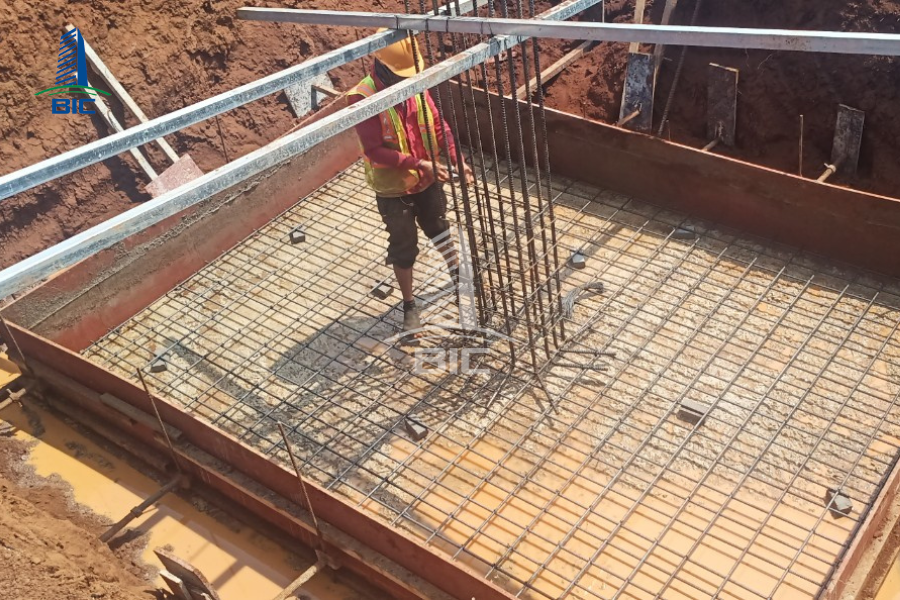
For manufacturing factory projects, practical experience is the most important factor when choosing a factory design and construction unit. A company that has implemented many similar projects will clearly understand common issues related to foundations, geology, and loads, thereby proposing suitable solutions and minimizing risks.
Experience is reflected not only in the company profile but also in the ability to handle real-life situations on site, especially for projects with complex geological conditions.
Each site has different geological characteristics, requiring a specific foundation solution. A professional construction design unit must be able to accurately analyze and evaluate soil types such as weak soil, sandy soil, and muddy soil to propose the appropriate foundation solution.
A clear understanding of geology not only ensures building safety but also optimizes cost, avoiding overdesign or insufficient load-bearing capacity.
Transparency in consulting is a key factor that helps investors control costs and make the right decisions. The consulting unit should clearly explain the foundation options, advantages and disadvantages, costs, and risks of each choice.
During the factory design process, transparent information helps investors understand the nature of the issue, avoid being completely dependent on the contractor, and minimize unnecessary additional costs.
In addition to design capacity, actual construction capability is an indispensable factor. A unit with construction experience will clearly understand the feasibility of each foundation solution and propose options suitable for actual conditions and project schedules.
The combination of design and construction ensures consistency throughout the implementation process, minimizing discrepancies between drawings and reality. This is an important factor in ensuring that the manufacturing factory achieves high quality and stable long-term operation.
The foundation is the core base that determines the durability, stability, and long-term operational capability of a manufacturing factory. Any mistake in choosing the foundation solution can lead to serious consequences such as settlement, cracking, impacts on machinery, and production interruptions. Meanwhile, future remediation costs are often much higher than investing correctly from the beginning.
Choosing the right foundation must be based on accurate geological surveys, complete load analysis, and synchronization in overall factory and construction design. This is not only a technical challenge but also a strategic decision that helps optimize costs and minimize long-term risks.
For investors, instead of looking for the cheapest option, the important thing is to choose the most suitable solution and work with a unit that has real practical capability. A properly designed foundation from the outset will be a solid base for the company to develop steadily, expand production, and improve investment efficiency in the future.