In an industrial factory project, the factory construction phase is not merely the process of turning drawings into reality, but also the stage that directly determines the quality of the building, the handover schedule, and the operational efficiency afterward. From the foundation, structural system, roof, wall cladding, to technical systems, every item is closely interconnected. If even one construction step is not properly controlled, the entire project may face delays, cost overruns, or affect operational capability after being put into use.
In reality, many investors focus heavily on the final completed result but have not fully recognized the role of each phase throughout the implementation process. Meanwhile, properly understanding the factory construction sequence from foundation to completion helps investors take a more proactive role in controlling progress, quality, and investment budget. At the same time, this is also an important basis for effective coordination between factory design, construction design, and actual on-site execution.
In the article below, BIC will help investors clearly visualize each step in the factory construction process, from preparation, structural works, steel erection, to finishing and handover, so that the investment process can be more systematic, minimize unforeseen issues, and optimize long-term efficiency.
In a factory construction project, progress does not only depend on the working speed at the site but also on the coordination between multiple consecutive phases such as foundation, structure, roof and wall cladding, auxiliary works, and technical systems. When investors clearly understand the implementation process, monitoring progress becomes more proactive instead of merely waiting for reports from the contractor.
Understanding each major stage also helps investors identify where the project currently stands within the overall schedule, which items need to be prioritized, and where delays may potentially occur. This is an extremely important basis for practical project control, especially for large-scale industrial factories or projects that need to be operational within a short period.
Costs in factory construction are not evenly distributed across all work items. Some parts account for a very large proportion, such as the foundation, main structure, roof and wall cladding, MEP systems, and fire protection systems. If investors do not clearly understand the construction process, budget control can easily become passive, especially when changes arise during implementation.
On the contrary, when understanding the construction sequence and the role of each work item, investors can more easily identify which costs are core expenses, which items require strict control, and which can be optimized. This helps minimize unplanned costs while improving investment efficiency from the early stages of the project.
The quality of a building is not determined at the finishing stage, but is formed through every step throughout the factory construction process. Items such as foundations, structure, floors, steel connections, electrical and plumbing systems, or fire protection all have important inspection milestones. If investors do not understand the process, they may easily overlook critical inspection points or only discover defects after the project is completed.
Understanding these inspection milestones helps investors coordinate better with the supervision consultant and contractor, thereby reducing situations where errors are only corrected afterward. This is especially important because construction mistakes not only increase costs but also directly affect the durability, safety, and long-term operational capability of the factory.
An effective project always requires close coordination between factory design and actual on-site implementation. In reality, many issues arise not because of poor construction, but because the design documents and construction organization were not properly synchronized from the beginning. When investors clearly understand the process, communication with the construction design unit and contractor also becomes clearer and more effective.
This understanding helps investors recognize the relationship between drawings and actual construction, thereby reducing technical conflicts, limiting mid-process adjustments, and ensuring the project is implemented according to the original direction. This is also the foundation for a factory construction project to achieve all three important objectives: on schedule, on quality, and on budget.
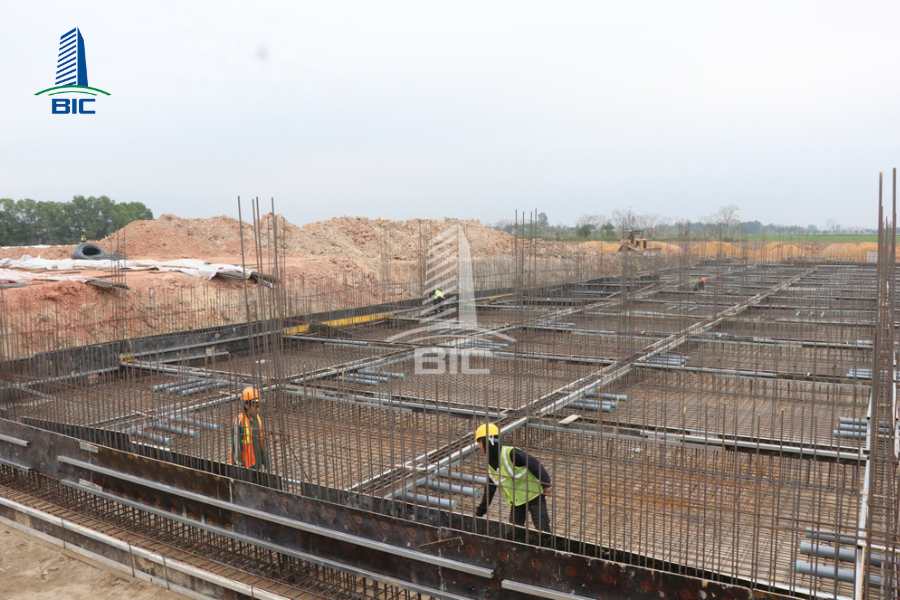
Before starting factory construction, surveying the site conditions is the foundational step to determine the feasibility of the entire project. At this stage, the implementation unit needs to fully assess the land topography, filling condition, natural elevation, drainage capacity, and factors that directly affect the construction organization plan.
In addition, surrounding infrastructure such as transportation roads, electrical systems, water supply and drainage, and connectivity with nearby areas also need to be carefully considered. Site accessibility will directly affect the transportation of materials, machinery, and later construction organization. If the initial survey is incomplete, the project is likely to face difficulties during actual implementation.
A geotechnical survey is an indispensable step before implementing industrial factory construction, as it is the basis for evaluating the soil’s load-bearing capacity. The survey results help clearly determine whether the soil is stable or weak, the groundwater level, settlement conditions, and technical factors related to foundation safety.
Based on this data, the construction design unit can then choose the appropriate foundation solution such as isolated footing, strip footing, raft foundation, or pile foundation. A correct foundation solution from the beginning not only ensures building safety but also helps control investment costs and reduce risks throughout the construction process.
To carry out factory construction systematically, the design documents must be fully completed before groundbreaking. This set of documents includes not only the architectural design but must also be synchronized with structural, MEP, and fire protection systems to ensure every work item has a clear basis for practical implementation.
The architectural drawings define the layout, functionality, and appearance of the building. Structural drawings are the basis for foundation, load-bearing frame, and floor construction. MEP drawings ensure that electrical, water, ventilation, and operational systems are arranged in an integrated manner. Fire protection drawings ensure the project complies with safety and legal requirements.
When the factory design documents are incomplete but construction has already begun, the risk of changes and cost overruns is extremely high.
After obtaining the design documents, the next step is to establish an overall construction plan to coordinate the entire implementation process. This is the stage of transitioning from drawings to practical organization, including developing schedules for each work item, allocating manpower, preparing machinery, and planning material supply.
A good plan helps tasks be carried out logically, avoids overlaps, and reduces the risk of interruptions during factory construction. At the same time, pre-preparation of resources also helps investors control progress and budget more effectively instead of dealing with issues passively once construction has started.
In addition to technical matters, legal procedures and site preparation are mandatory conditions before commencement. Investors need to complete necessary procedures such as construction permits, review relevant documents, and ensure the project is legally eligible for implementation.
At the same time, site handover, site clearance if necessary, and initial site setup must also be carried out. Organizing material storage areas, access roads, protective fencing, and site offices will create the foundation for a more orderly, safe, and efficient factory construction process from the very first day.
Throughout the entire factory construction process, setting out the structural gridlines is the initial step that plays a decisive role in the accuracy of the building. This work determines the exact positions of the main axes, elevations, and construction boundaries according to the construction design documents, serving as the basis for subsequent items such as excavation, column erection, and structural installation.
If the initial layout step is inaccurate, those errors may lead to a series of issues in later stages, from misplaced foundations to misaligned structural axes and additional adjustment costs. Therefore, this stage must be carried out carefully, thoroughly checked, and closely compared with the drawings before proceeding to actual construction.
After setting out the structural gridlines, the construction site moves into the excavation and ground treatment stage to prepare for the foundation works. Depending on the actual site conditions, this work may include site leveling, foundation pit excavation, foundation beam trench excavation, or treatment of weak soil areas to ensure stable construction conditions.
For sites with complex geological conditions, ground reinforcement is a very important step to improve load-bearing capacity and minimize uneven settlement in the future. If the ground is not properly treated from the beginning, the quality of the entire building will be affected. Therefore, this is not merely a site preparation step, but truly the stage that creates the foundation for the entire industrial factory project.
Foundation construction is the core item in the substructure works, directly determining the durability and long-term stability of the factory. Depending on geological conditions, building loads, and the factory design scheme, the foundation solution may be isolated footings, strip footings, raft foundations, or pile foundations.
Each type of foundation has different technical requirements and application scopes. Isolated and strip footings are generally suitable for stable soil conditions and moderate loads, while raft or pile foundations are used for weak soil areas or projects with heavy loads.
At this stage, construction must strictly follow the design documents, from foundation dimensions, reinforcement, elevation, to the concrete pouring process, to ensure that the building meets the required load-bearing standards right from the foundation.
After completing the foundations, the project continues with the construction of tie beams and foundation beams to connect the foundation positions into a stable system. This item plays the role of distributing loads, improving the integrated performance of the foundation system, and minimizing the effects of localized differential settlement.
In factory construction, tie beams and foundation beams not only enhance the stiffness of the foundation but also create a better base for the upper structural works. When the foundation system is tightly connected, the building will have a more stable base throughout its service life, especially for large-scale factories or facilities operating continuously under high loads.
At the end of the foundation construction stage, inspection and acceptance are mandatory before moving to the next work items. At this stage, all relevant parties will inspect the actual dimensions of the foundation, gridline positions, elevations, reinforcement, concrete quality, and the level of compliance with the construction design documents.
Careful acceptance of the foundation is extremely important because once completed, this item is difficult to inspect or fully repair. If defects are discovered too late, the rectification cost will be very high and may affect the progress of the entire project.
Therefore, investors need to pay special attention to the foundation inspection stage to ensure that the structural base of the building fully meets the required standards before proceeding to the next construction phase.
After completing the foundation works, the project moves into the floor construction stage. This item directly affects load-bearing capacity, stability, and the service life of the industrial factory. First, the ground surface must be leveled to the correct elevation according to the construction design documents, ensuring uniformity across the entire construction area.
Next, compaction work is carried out to increase ground stability and minimize localized settlement during operation. For factories with heavy loads, frequent forklift traffic, or heavy machinery, this leveling and compaction step must be strictly controlled, as it forms the foundation that determines the quality of the entire industrial floor above.
After the ground has been properly treated, the construction site proceeds with the installation of the crushed stone base layer and lean concrete to create a stable surface before pouring the main floor slab.
The base stone layer helps distribute loads, improve load-bearing capacity, and support underfloor drainage, while the lean concrete layer creates a flat and clean surface that facilitates the subsequent construction steps.
In factory construction, if this intermediate base layer is not executed properly, the floor may easily experience settlement, cracking, or reduced service life. Therefore, although it lies beneath the finished floor, it still plays a very important role in ensuring the long-term operational quality of the building.
Once the base is ready, the next step is to install reinforcement and arrange expansion joints according to the factory design documents. The reinforcement enhances the floor’s load-bearing capacity, especially in areas subject to heavy loads or continuous impact from machinery and internal transport vehicles.
At the same time, expansion joints are arranged to control concrete deformation caused by shrinkage or temperature changes, thereby reducing the risk of floor cracking during use.
This is a very important technical detail in factory construction, because a high-quality industrial floor not only needs sufficient strength but must also remain durable under long-term operating conditions.
Concrete pouring is the key stage that directly determines the quality of the factory floor. During this process, the contractor must strictly control the slab thickness, concrete grade, construction timing, and curing process to ensure that the concrete meets the design requirements.
In addition to load-bearing strength, floor flatness is also a very important factor, especially for projects using forklifts, racking systems, or machinery lines that require a highly level operating surface.
If the floor concrete does not meet flatness requirements or the designed thickness, future operational efficiency will be significantly affected, leading to considerable repair or renovation costs.
After the concrete is poured, the floor surface is treated and finished to meet the actual operational requirements of each type of industrial factory.
Depending on usage needs, the project may perform floor troweling for flatness, use surface hardeners to increase durability, or apply epoxy coating if dust resistance, abrasion resistance, or high hygiene standards are required.
This stage ensures that the floor not only meets technical standards but is also suitable for the specific operational needs of each business. A properly treated floor surface helps increase durability, reduce maintenance costs, and improve operational efficiency throughout the factory’s service life.
After completing the foundation and floor works, the project enters the main structural construction stage. This is the most important load-bearing framework of the entire industrial factory, determining the stability, durability, and formation of the usable space.
Depending on the construction design plan, the structural system may be steel structure or reinforced concrete, with each type having its own implementation process and technical requirements.
In factory construction, columns, beams, and structural frames must be installed in the correct position, correct elevation, and according to the technical specifications in the design documents.
Even a slight deviation at this stage can affect subsequent items such as the roof, walls, doors, and technical systems. Therefore, this step requires extremely high precision and close coordination between the factory design drawings and the actual site conditions.
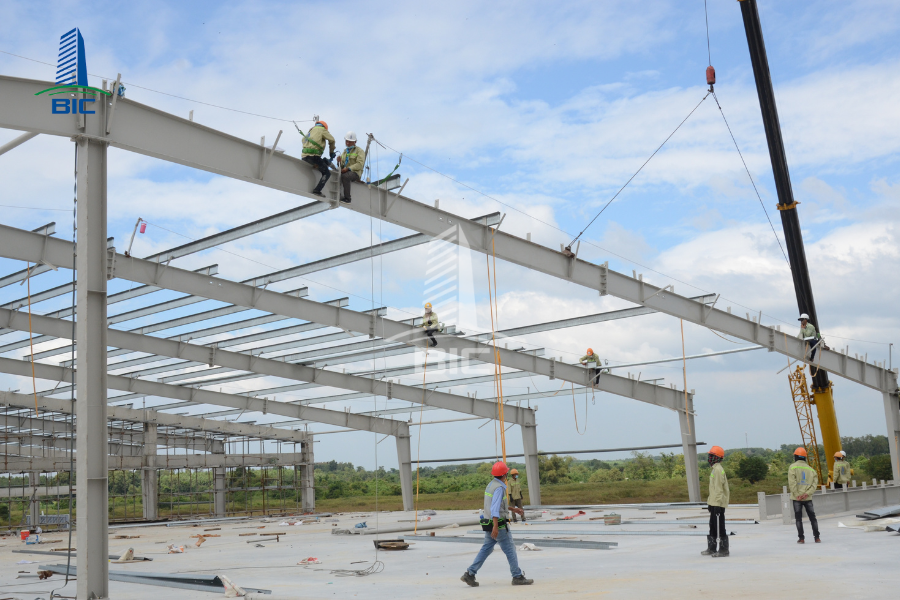
For projects using steel frames, the erection process is generally implemented in three main stages: fabrication of components at the workshop, transportation to the site, and on-site erection.
Pre-fabrication at the workshop helps ensure component quality, shorten on-site construction time, and improve erection accuracy.
When applied to actual factory construction, steel components such as columns, rafters, beams, and purlins are lifted and installed according to the correct technical sequence to ensure safety and stability for the frame system.
This stage not only requires suitable equipment and construction methods, but also strict progress control, because this is the phase that most clearly shapes the overall building.

During the factory construction process, the power supply and lighting system is one of the most critical components because it directly affects the operational capability of the entire facility. This stage includes the installation of electrical panels, cable trays, power supply systems for machinery and production equipment, as well as the lighting system serving the working areas inside the factory.
The electrical installation must strictly follow the construction design documents to ensure the correct capacity, proper positioning, and suitability for the actual usage requirements of each area. If the electrical system is not properly planned and synchronously implemented from the beginning, the factory may face overload issues, difficulties in expanding the production line, or additional renovation costs once operations begin.
Alongside the electrical system, the water supply and drainage system also plays a highly important role in factory construction, especially for facilities that require water for production processes or frequent sanitation.
This system typically includes domestic water supply, production water supply, rainwater drainage, and wastewater drainage.
Each pipeline network must be clearly arranged, properly designed, and convenient for future operation and maintenance. If constructed without proper coordination, the project may easily encounter leakage, poor drainage, hygiene issues, impacts on the operational floor area, and reduced service life of the factory building.
Therefore, this is a component that must be strictly controlled, from materials and elevation levels to the actual connection methods at the construction site.
For industrial factories, ventilation and cooling are factors that directly impact the working environment and production efficiency. Depending on the industry and operational characteristics, this system may include industrial fans, cooling pads, or air-conditioning systems in areas with specific requirements.
In factory construction, the installation of the ventilation system must be closely coordinated with architecture, structure, and functional layout to ensure reasonable airflow circulation, effective heat reduction, and no interference with other components.
A suitable solution helps improve working conditions, reduce heat accumulation, and support stable long-term operations.
For certain manufacturing industries, in addition to electricity and water, the factory may also require compressed air systems or specialized technical gas systems to support machinery and operational lines.
This is a highly specialized component that is not present in every project, but once included, the construction requirements are usually quite demanding.
The implementation of this system in factory construction must be based strictly on the technological requirements of each industry, from equipment placement and pipeline routing to maintenance accessibility and operational safety.
If not arranged properly, the system may reduce usage efficiency or create difficulties for future expansion and repair.
The fire protection system is a mandatory item with strong legal significance in every factory construction project.
This part usually includes fire alarm systems, firefighting systems, hydrants, sprinkler systems, and related equipment to ensure the project meets safety requirements before being put into operation.
Unlike many other technical components, the fire protection system cannot be handled reactively at the final stage. Instead, it must be implemented synchronously during the construction process.
When this system is installed correctly according to the design documents, the factory will not only have a smoother acceptance process but also a solid safety foundation for long-term operation.
After the main construction items and technical systems have been completed, the project enters the final finishing stage.
This step ensures that the entire industrial factory is reviewed once again before actual operation begins.
Typical tasks include industrial cleaning, resolving minor remaining defects, correcting details that do not meet requirements, and completing unfinished auxiliary items.
During the factory construction process, many minor details may not have been fully addressed in previous stages because they depended on the progress of other system installations.
Therefore, the final finishing stage is not only about aesthetics but also about cleaning, standardizing, and bringing the project into a ready state for overall inspection.
After the basic completion, the technical systems must undergo trial operation to check their stability and actual performance.
Important systems that need testing include electricity, water supply, ventilation, and fire protection, as these directly affect the safety and operational efficiency of the factory.
The trial run helps identify technical issues early, such as unstable power supply, insufficient water pressure, ineffective ventilation, or fire protection devices that do not function synchronously.
In factory construction, if this step is skipped or carried out superficially, the risk of issues arising after handover is very high.
Therefore, this is a crucial stage to ensure the project is not only completed in terms of construction but also fully ready for operation.
A factory is only truly complete when the building structure and production line can operate smoothly together.
Therefore, at this stage, it is necessary to recheck the coordination between the functional layout, technical systems, operational flow, and the actual placement of machinery and equipment.
The goal is to ensure that the factory is ready for use without issues such as insufficient power supply for machinery, inadequate operating space, overlapping logistics flows, or technical systems that do not effectively support the production process.
This is an especially important step in factory construction, particularly for projects with high operational requirements or those that need to be put into use immediately after handover.
At the end of the completion and overall inspection stage, the project moves into the acceptance process.
First is the internal acceptance stage, where the contractor reviews the quality of each item, compares it with the factory design documents, and rectifies any non-compliant points.
This is followed by the acceptance process with the investor to confirm that the project has been completed according to the agreed scope of work, quantities, and quality standards.
This step concludes the entire factory construction process, helping all parties reach agreement on the final results before moving to the handover stage.
A thorough acceptance process not only helps control quality but also serves as an important basis for protecting the investor’s interests and ensuring the project can be put into stable and safe use.
After the project has been completed and the main work items have been accepted, the next step in the factory construction process is the completion of the as-built documentation.
This is an important set of documents that reflects the entire actual implementation process of the project and serves as the basis for the investor’s future management, operation, and maintenance.
The as-built documentation usually includes as-built drawings, acceptance reports for each work item, and technical documents related to the installed systems and equipment.
For industrial factories, this document set is not merely a procedural requirement, but also helps the investor clearly understand the actual condition of the building after construction, avoiding difficulties when inspection, repair, or future upgrades are required.
After the documentation is completed, the project will be officially handed over to the investor.
This stage is not simply the transfer of a completed construction site, but the handover of the entire built facility together with all necessary documents and operational instructions required to put the factory into use.
In actual factory construction projects, the handover must be clearly carried out in three main aspects: handover of the actual building condition, handover of technical documentation, and handover of operation guidelines for related systems.
When the handover process is implemented fully and professionally, the investor can receive the project more easily and reduce risks during the initial operational stage.
Before the factory officially begins operations, a comprehensive safety inspection must be conducted to ensure that all work items are fully ready.
This is the final review stage for the building structure, electrical systems, fire protection systems, and equipment serving production or technical operation.
This inspection is extremely important because even if the building has been completed, a minor fault in the electrical system, equipment, or fire safety measures may cause serious consequences once the facility is put into use.
Therefore, in the factory construction process, the pre-operation safety inspection is a requirement that must never be overlooked, helping the investor feel more secure before starting actual production.
A well-executed factory construction project does not end at the moment of handover but continues into the warranty and post-handover support stage.
During the initial operational period, the building may develop some minor issues or require adjustments to better suit actual usage conditions.
At that point, the role of the contractor is not only to handle defects but also to accompany the investor to ensure the factory operates stably.
Having a clear warranty mechanism and timely support after handover helps reduce pressure on the investor during the initial stage of use.
At the same time, this also reflects the capability and responsibility of the contractor, especially for industrial factories that require continuous operation and allow little room for error.
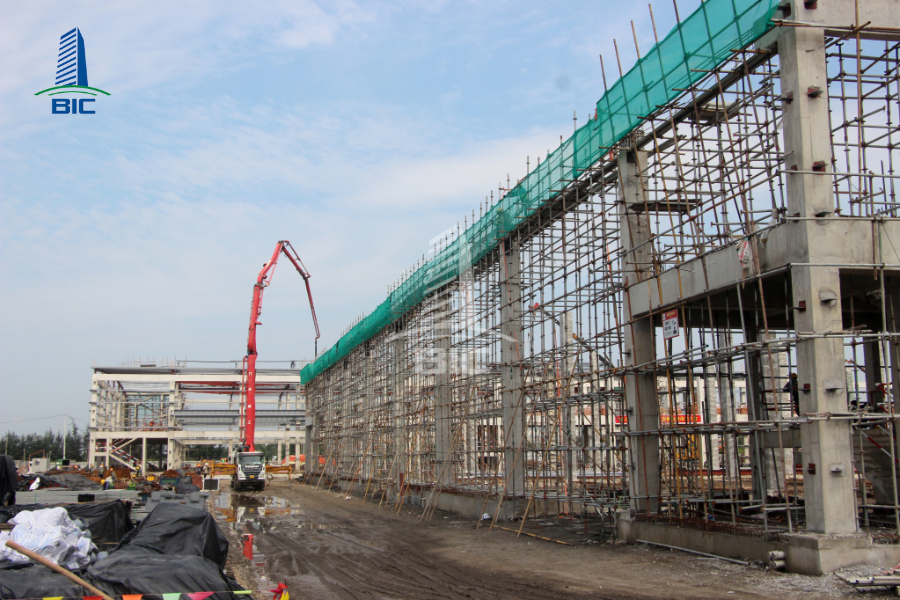
Throughout the entire factory construction process, the foundation is one of the work items that most significantly affects the project schedule.
This is the starting point of the project, so any delay at this stage will almost certainly push back all subsequent steps.
In particular, actual geotechnical conditions are often difficult to fully control if the initial site investigation is incomplete or if the land has weak soil, a high groundwater level, or complex subsurface layers.
When geotechnical conditions are unfavorable, the project may need to change the foundation solution, improve the ground, or add reinforcement measures, leading to extended construction time and increased costs.
Therefore, for investors, this is always a work item that must be carefully assessed from the outset if they wish to effectively control the schedule of the industrial factory project.
For many factory construction projects, especially steel-frame factories, the steel structure has a major impact on the overall schedule.
Unlike work items directly constructed on site, steel structures usually go through multiple steps such as drawing breakdown, workshop fabrication, quality inspection, surface coating, transportation, and on-site erection.
If just one link in this chain is delayed, the entire erection schedule will be affected.
If fabrication is not completed on time, structural members are not synchronized, or transportation does not follow the plan, the site can easily fall into a waiting state, interrupting subsequent work.
Therefore, steel structures are always a work item that requires close schedule management in factory construction projects.
MEP and fire protection systems are highly complex work packages and often require significant coordination time in the final phase of the project.
Although these are not the main structural components, they are mandatory conditions for the factory to become operational.
During the factory construction process, electrical, plumbing, ventilation, technical gas, and fire protection systems must be implemented in coordination with the architecture, structure, and functional use requirements.
If the design documents are unclear, the disciplines are poorly coordinated, or mid-project adjustments are required, the schedule will be significantly affected.
In particular, fire protection is a legally critical work item, so any lack of coordination in implementation or acceptance may delay project handover.
This is why MEP and fire protection systems are always among the most schedule-sensitive components.
The construction progress of a factory does not depend only on manpower and construction methods, but also heavily on the ability to supply materials at the right ti