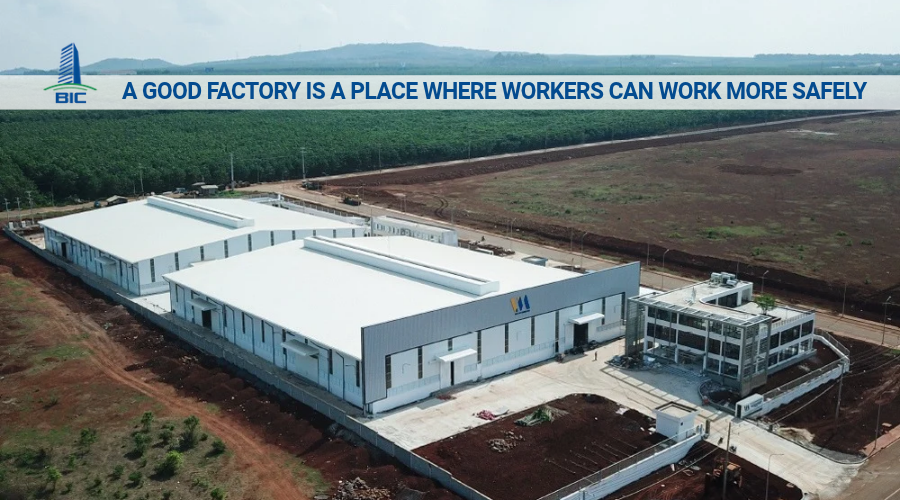
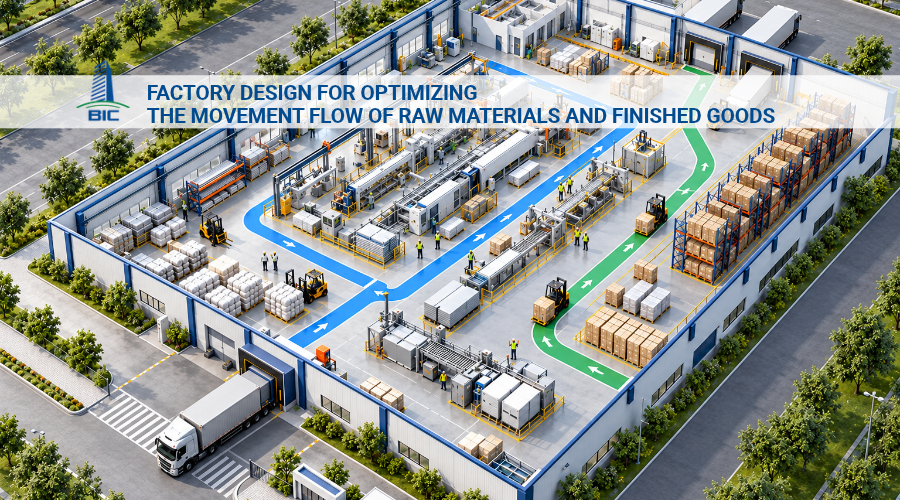
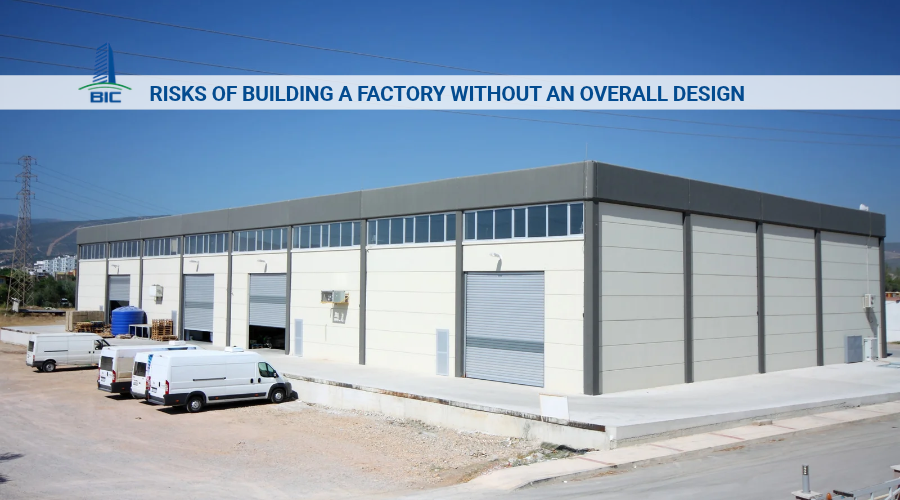
Pre-engineered buildings are becoming increasingly popular and widely used in various types of projects due to their versatility and prominent features. The installation process of pre-engineered buildings plays an important role as the final step in completing a pre-engineered building project according to the exact requirements and standards expected by customers.
Pre-engineered buildings are a type of structure constructed from pre-manufactured and pre-engineered steel components at the factory according to the design drawings, then transported to the site and assembled. The main components of pre-engineered buildings include: steel frames, roof sheets, wall panels, doors, windows, etc.
Benefits compared to traditional buildings:
- Cost-saving: Pre-engineered buildings help save construction costs by 20% to 30% compared to traditional buildings due to shorter construction time, less labor, and fewer materials required.
- Quick construction: Thanks to pre-manufactured components, pre-engineered buildings can be constructed and completed within a few weeks to a few months, much faster than traditional buildings.
- Flexibility: Pre-engineered buildings can be easily expanded, relocated, or adapted to different uses, meeting the changing needs of businesses.
- High durability: Pre-engineered buildings are made of galvanized steel or electrostatically painted steel, with corrosion resistance, termite resistance, and high load-bearing capacity, ensuring long-term durability.
- Environmentally friendly: The construction process of pre-engineered buildings causes less environmental pollution compared to traditional buildings.
Pre-engineered buildings are the optimal construction solution for businesses in the modern age, providing many benefits in terms of cost, time, flexibility, and durability. With outstanding advantages, pre-engineered buildings are increasingly favored and widely applied in various fields.
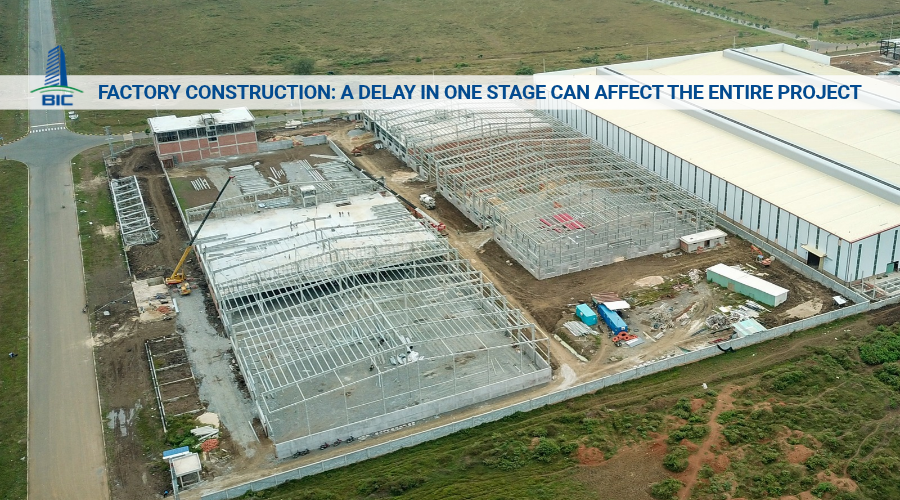
After the design unit designs the pre-engineered steel frame building, the components are designed, manufactured at the factory, transported to the construction site, and the construction of the pre-engineered building is carried out according to the standard process to ensure safety and quality of the project. This process includes the following steps:
Installation of rigid bracing:
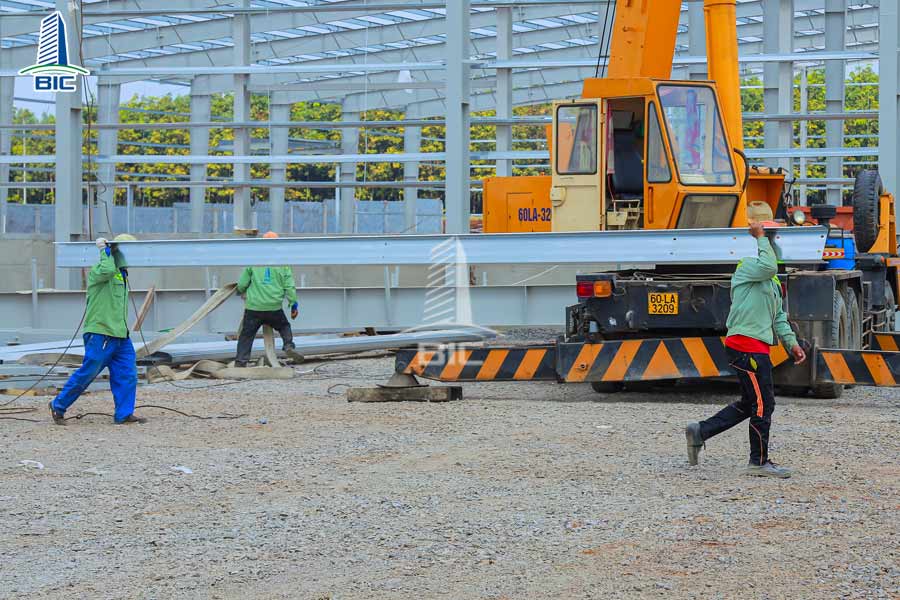
- Use a crane with large lifting capacity to install the first 4 end columns.
- Install scaffolding at the positions of end columns and fix them with bolts.
- Use lifting equipment to install the roof truss frame and fix it with bolts.
Assembly of the pre-engineered steel frame:
- Install in sequence from inside to outside, starting from the bay with wind bracing (columns and roof).
- Wrap straps to fix components at two points: 1/4 length from the head and 1 distance from the end of the purlin.
- Fix the connection points between the column and the truss with sturdy bolts.
- Continue installation as above until the truss frame is completed.
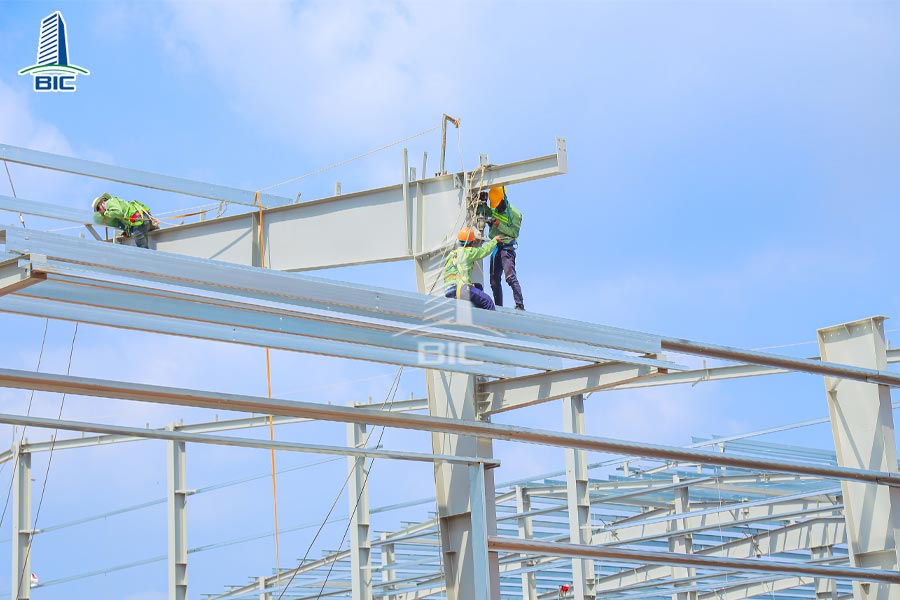
Construction of bracing:
- Install permanent cross-bracing cables for columns and truss beams.
- Measure the exact position of installation and temporarily fix the bracing with bolts.
Installation of truss frame and purlins of pre-engineered buildings:
- Use lifting equipment to bring the truss frame and purlins to the installation position.
- Adjust the position, verticality, and height of the truss frame and purlins to fit the design drawing.
- Secure the truss frame and purlins to the column with sturdy bolts.
- Clean the truss frame and purlins, repaint if there are scratches.
Installation of ridge beams:
- Use ropes to pull the purlins onto the roof.
- Secure the purlins in place with sturdy bolts.
- Install the ridge beam according to the design drawing.
Completion of installation of purlins and purlin supports:
- Use lifting equipment to bring the purlin support bar up to the roof.
- Use ropes to pull the purlins onto the roof and secure them with bolts.
- Install all permanent diagonal bracing cables for columns and truss beams.
- Adjust and securely fix the purlin supports.
Pulling roof sheets onto the roof:
- Use sliding tubes to move the roof sheets onto the roof.
- Temporarily fix the roof sheets with iron hooks to the previously installed roof purlins.
- Move the roof sheets to the correct position according to the design drawing.
Roofing:
- Install a safety cable system on the roof to ensure labor safety.
- Prepare necessary electrical construction equipment, ensuring that electrical construction does not directly contact the roof purlins and sheets.
- Start roofing from the edge of the roof, fix the first roof sheets with self-drilling screws, and adjust the position to ensure aesthetic appeal.
- Continue roofing row by row, overlapping the roof sheets according to the correct technique.
- Secure the roof sheets with self-drilling screws into the roof purlins at regular intervals according to the design drawing.
Installation of wall purlins, guttering, downpipes, wall sheets:
- Install a scaffolding system around the construction site.
- Construct the entire wall purlin system, including the main purlins and secondary purlins.
- Install wall purlins between the column frames.
- Install wall sheets for the walls surrounding the building.
- Install gutters and downpipes to collect and drain rainwater.
- Install vents to ensure air circulation for the building.
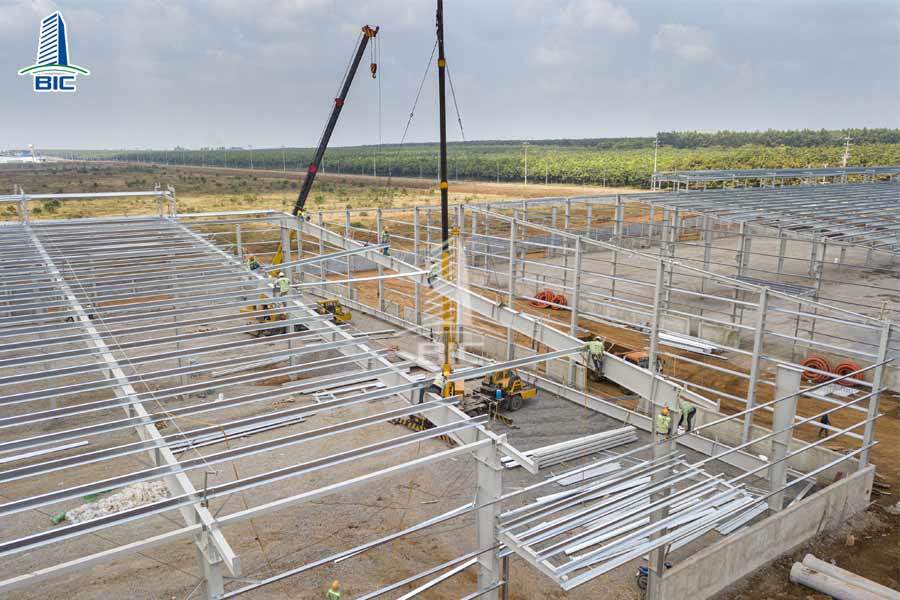
After completing the installation process of the pre-engineered steel frame building, the construction unit must conduct thorough inspections. Review all columns, frames, trusses, bolts fixed and check gaps at the roof sheet joints as well as at the ventilation openings to ensure the best quality of the project, with no errors.
After inspection and ensuring everything meets the requirements, the project will be handed over to the customer for use.
Throughout the entire process of constructing pre-engineered buildings and after completing the project, the construction unit is responsible for monitoring the progress and taking care of customers when needed. This includes regularly calling to monitor and support customers.
Note: The installation process of pre-engineered steel frame buildings must be strictly implemented in the correct order to ensure safety, consistency, and professionalism, minimizing errors during construction. The construction method must be agreed upon and supervised by an experienced team of engineers and architects.
The proper installation process for industrial pre-engineered buildings is crucial in ensuring the quality, safety, and efficiency of the project. Here are some key reasons:
Adhering to the proper installation process for pre-engineered buildings helps ensure that components are installed accurately, fit together tightly, and function effectively. This results in a durable structure with high load-bearing capacity and minimizes the risk of damage or failure during use.
In the installation of industrial buildings, if the process is not properly followed, weld joints can fail, and the steel frame structure may become unstable, leading to the potential collapse of the building.
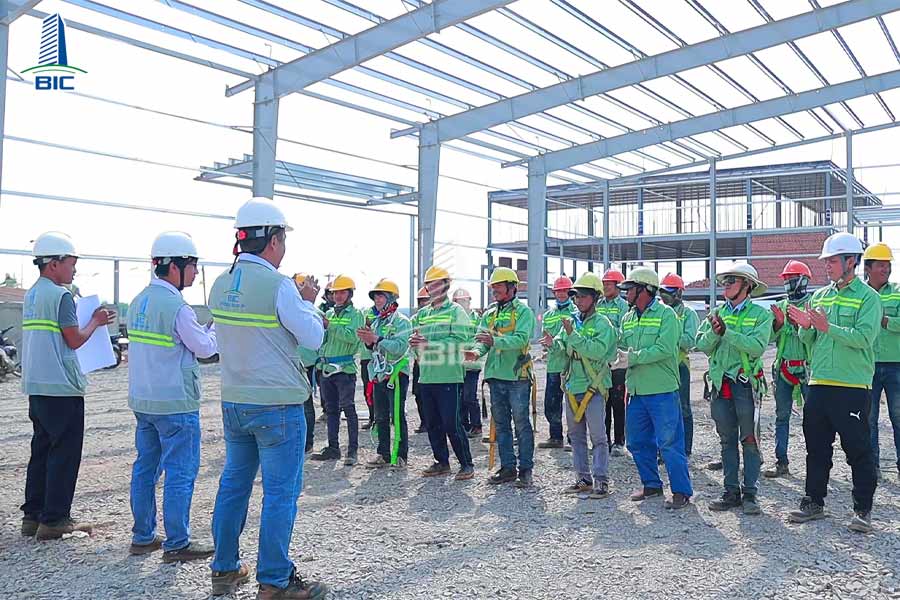
The installation process is designed based on experience and scientific principles, optimizing the construction process and minimizing material and labor waste. As a result, construction can proceed quickly, saving time and costs for the investor.
In the installation of electrical systems in pre-engineered buildings, if electricians do not follow the process, they may connect wires incorrectly, leading to short circuits, damage to electrical equipment, and the need for costly repairs.
A proper installation process ensures safety for construction workers and laborers within the industrial building. Adhering to labor safety regulations, using protective equipment, and thoroughly inspecting joints and structures will significantly reduce the risk of accidents during construction and use of the building.
The installation process for pre-engineered buildings plays a key role in ensuring the quality, safety, and efficiency of the project. Following the correct construction process brings numerous benefits to investors, contractors, and users of the building.