During the investment and construction process, many investors often focus on cost and schedule without fully assessing the role of technical regulations in factory design. However, in reality, a project that does not comply with the correct standards not only faces difficulties in licensing and acceptance procedures, but also carries many operational risks such as safety hazards, modification costs, or reduced production efficiency.
For industrial factories, where there are high requirements for structural systems, technical systems, and occupational safety, compliance with standards in construction design is no longer an option but a mandatory condition. A properly standardized design solution helps ensure stable operation, optimize long-term costs, and meet increasingly strict legal requirements as well as production standards.
In this article, BIC will help investors clearly understand the important standards in industrial factory design, thereby making the right decisions from the initial stage, minimizing risks, and maximizing investment efficiency.
In construction design, “standards” refer to a system of technical regulations issued by state authorities that must be complied with during the design, construction, and operation of a project. In Vietnam, these standards are commonly expressed in the form of QCVN (National Technical Regulations).
In addition, there is also the TCVN (Vietnamese Standards) system, which serves as detailed technical guidance to support the design and implementation process. In particular:
- QCVN: mandatory in nature, directly related to safety, environment, and fire protection
- TCVN: advisory in nature, helping optimize technical solutions
Proper understanding and full application of these systems are an important foundation in industrial factory design.
Standards play a core role in ensuring both the quality and legal validity of the project. First of all, standards help ensure safety for the entire project, from load-bearing structures to technical systems such as electricity, water, ventilation, and fire protection systems.
In addition, compliance with standards is also a mandatory condition for the project to obtain a construction permit, be accepted, and be put into operation. For factory design, especially large-scale projects, failure to meet standards can lead to legal delays and very high modification costs.
In practice, many investors easily confuse “regulations” and “standards.” However, these are two concepts with different characteristics:
- Regulations (QCVN): Mandatory provisions related to safety, environment, and legal compliance. Violating regulations may result in the project not being licensed or being subject to penalties.
- Standards (TCVN): Technical guidelines for reference, helping optimize design and improve project quality. Standards are not mandatory but are highly recommended in construction design to achieve the best results.
Clearly distinguishing these two systems helps investors better control the factory design process, ensuring both legal compliance and technical as well as cost optimization.

In industrial factory construction design, planning regulations play the role of shaping the entire layout of the project on the site. Factors such as building density, setback distance, and technical infrastructure systems (internal roads, power supply, water supply and drainage, etc.) must comply with the regulations of the industrial park or local authority.
Ensuring the correct building density helps optimize land use while maintaining ventilation and safety. Setback distances are not only related to planning but also affect fire protection and internal traffic. At the same time, the technical infrastructure system must be designed synchronously from the beginning to ensure stable operation and avoid additional costs later.
The structure is the core factor determining the durability of the project; therefore, standards on load and structural safety must be strictly complied with in construction design.
Factors such as wind load, seismic load, service load, and machinery load must all be calculated according to current standards. For industrial factories, ensuring load-bearing capacity is not only related to safety but also directly affects the lifespan and future expansion capability.
Fire protection is a mandatory item in every factory design project. Fire protection standards clearly regulate the number and location of emergency exits, safe distances between areas, as well as requirements for fire suppression systems such as sprinklers, hydrants, and automatic fire alarms.
Full compliance with these standards not only helps the project pass acceptance procedures but also ensures safety for people and assets during operation. This is one of the most strictly inspected factors in industrial factory projects.
In the context of increasingly high sustainable development requirements, environmental standards have become an indispensable part of factory construction design.
The project must meet current requirements for wastewater treatment, emission control, and noise limitation. In particular, for production sectors that generate large amounts of waste, treatment systems need to be integrated from the design stage to ensure legal compliance and avoid renovation costs later.
Meeting environmental standards well not only helps businesses operate stably but also enhances credibility and the ability to participate in the global supply chain.

In factory design, the building height and spatial organization must closely align with the characteristics of the production line, machinery type, ventilation requirements, lighting, and actual operational plans. From a technical management perspective, the architectural section cannot be separated from regulations on construction planning, fire safety for buildings and structures, and technical infrastructure systems. Therefore, determining elevation, span, and usable space must be calculated synchronously from the initial stage.
For investors, the important thing is not to make the factory “as tall as possible,” but to build it to the level actually required by the production technology. If the height is unreasonable, the project will face difficulties in equipment arrangement, poor ventilation, and additional renovation costs later; on the other hand, if excessive space is designed, the total investment and operating costs will unnecessarily increase.
A standard industrial factory must not only be correct in shape but also have a clear functional layout between production areas, warehouses, and office spaces.
In practice, the production area should prioritize production line continuity, the warehouse should facilitate goods import and export, while the office area should be relatively separated to ensure a proper working environment and management.
When functions are arranged properly from the beginning, investors can reduce internal conflicts, minimize wasted space, and improve the operational efficiency of the entire factory.
Internal traffic is a very important aspect of industrial factory architecture because it directly relates to the movement flow of trucks, forklifts, goods, and people throughout the operational process.
For investors, priority should be given to organizing convenient truck access routes, reasonable turning radii, safe forklift operating areas, and access routes that do not obstruct evacuation or firefighting access.
If internal traffic is designed well, the factory will operate more smoothly, reduce collision risks, minimize congestion during peak loading and unloading hours, and support future capacity expansion.

In factory design, the choice between steel structures and reinforced concrete structures cannot be based on intuition but must depend on production functions, required spans, foundation conditions, environmental conditions, and the applicable standards system.
In practice, steel structures are often suitable for industrial factories requiring wide spaces, large spans, and flexible layouts, while reinforced concrete structures are considered in areas requiring durability under special environmental conditions, localized loads, or long-term use.
Load-bearing capacity is the core requirement of the structural section in factory construction design.
The structure must be calculated based on all impacts such as dead loads, live loads, machinery loads, wind loads, and, where necessary, seismic loads.
For investors, this is extremely important because a factory may operate stably at present but still be unsafe if future loads such as cranes, new machinery, increased capacity, or changes in function are not properly anticipated.
A standard structural solution must not only be able to “withstand loads” but must also ensure durability and the service life of the project throughout its use.
From an investment perspective, structural lifespan directly affects maintenance and repair costs as well as the ability of the plant to operate continuously.
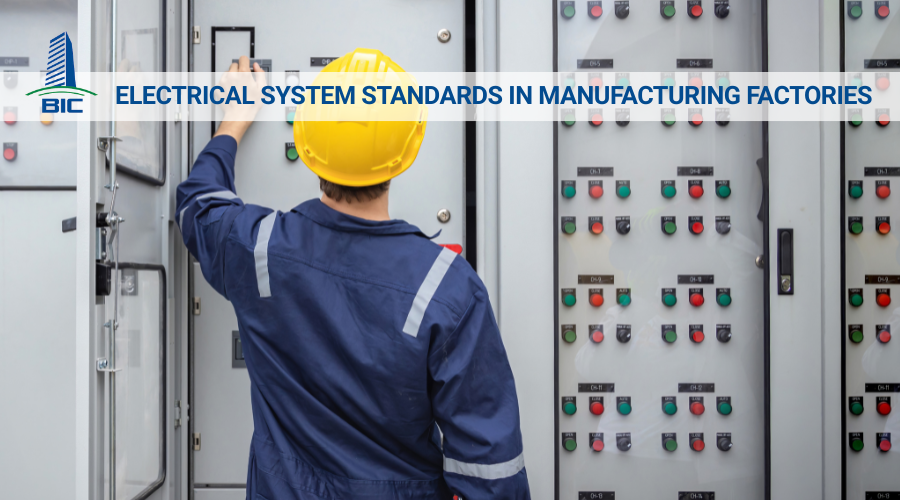
In factory design, the electrical system must not only provide sufficient capacity for production but also ensure operational safety, stability, and future expansion capability.
A compliant electrical system needs to be designed synchronously from the power source, machinery loads, lighting, lightning protection, grounding, to the plant’s continuous operation capability.
For industrial factories, the water supply and drainage system must be designed to meet production, sanitation, technical operation, and safe drainage needs for the entire facility.
For investors, the important thing is not merely “having enough water,” but organizing the system so that it is easy to operate, easy to maintain, and does not conflict with production activities.
Ventilation and cooling are especially important items in industrial factories, particularly those with high labor density or significant heat generation during production.
Investors should understand that ventilation is not only for “cooling,” but also for maintaining the working environment, reducing heat accumulation, controlling air quality, and supporting energy efficiency.
Among the entire MEP system, fire protection is the most legally controlled and mandatory component.
For investors, fire protection should not be viewed merely as a procedure to “complete the documentation,” but must be integrated from the beginning into the overall design and construction plan.

When the factory design dossier is prepared in accordance with standards and current legal requirements, the appraisal, approval, and investment procedures become much smoother.
A project designed correctly from the beginning will have a more stable operational foundation because safety, construction quality, acceptance, and maintenance requirements are already placed within a clear control framework.
Designing in compliance with standards does not make the project “more expensive”; on the contrary, it usually reduces total long-term costs.
When the design documentation is correct from the beginning, investors can avoid additional costs caused by design revisions, technical solution changes, safety upgrades, or post-construction defect remediation.
In practical investment terms, a factory designed and implemented according to standards usually has better asset value because the project has complete legal documentation, is easier to operate, easier to maintain, and more convenient for expansion or transfer.
For investors, the value lies not only in completing the construction, but in the stable and sustainable exploitation of the asset over many years.
For investors, the greatest value of complying with standards lies in long-term efficiency: the project is easier to implement, operates more stably, reduces modification risks, and limits additional costs after the factory is put into use.
From a practical implementation perspective, choosing a contractor with integrated construction design and factory construction capabilities will help investors reduce legal pressure, control costs effectively, and shorten the journey from concept to operation.