Not every factory design project can follow a one-size-fits-all formula. In reality, many industrial factories have highly specific requirements regarding production technology, load-bearing capacity, operating environment, technical standards, or site conditions. These may include factories requiring temperature control, high cleanliness standards, heavy load capacity, multifunctional integration, or renovation on an existing structure. For such projects, conventional design and construction thinking is often insufficient to fully solve the challenges of functionality, cost, and long-term operational efficiency.
For this reason, special projects require flexible and creative design-build solutions that still strictly adhere to technical standards, regulations, and real-world constructability in factory construction. A proper solution not only helps the facility operate efficiently, minimize unexpected costs, and optimize investment budgets, but also creates a solid foundation for future expansion and development. In this article, BIC will help investors clearly understand the unique characteristics of special factory projects and the appropriate design approach to transform complex requirements into an efficient and sustainable facility.
In the field of factory design, special projects refer to facilities that cannot apply standard design templates or pre-existing solutions mechanically. These are projects with unique requirements related to production technology, operating conditions, load-bearing demands, working environments, or spatial organization models.
Unlike conventional industrial factories, these projects require thorough analysis from the very beginning to develop an appropriate construction design solution. The solution must not only be technically correct but also flexible enough to meet real operational functions while minimizing issues during the factory construction phase. Therefore, this group of projects requires in-depth design thinking, a high degree of customization, and close alignment with each investor’s operational characteristics.
In practice, many types of factories are considered special projects because they cannot be handled using mass-design thinking. These include food processing factories, pharmaceutical plants, and electronics factories, where high standards for hygiene, cleanliness, environmental control, and operational procedures are required. In addition, factories requiring strict control of temperature, humidity, or air pressure to meet specific production needs also fall into this category.
Moreover, facilities with heavy load requirements, multi-story factories, renovation projects built on existing structures, or multifunctional models such as integrated production spaces with offices, showrooms, and smart warehouses are also classified as special projects. Each type presents unique challenges related to layout, structure, technical systems, and operational organization, making the design-build process significantly more complex than standard factories.
The defining characteristic of special projects is that a standard floor plan or structural system cannot be applied uniformly. Each facility has its own specific requirements related to production lines, technical standards, MEP systems, operating conditions, and even legal factors.
If handled using conventional methods, the facility can easily become functionally unsuitable, generate excessive costs, or face unstable operations after being put into use.
Therefore, these projects require creative solutions in factory design, but that creativity must be built on a solid technical foundation. The challenge is not simply to create a different building, but to simultaneously solve functionality, technical performance, investment costs, and long-term operational efficiency. This is why special projects always require a deeper, more practical, and more customized design approach than common factory models.

Unlike standard models, special projects in factory design are often associated with unique production lines that cannot use template floor plans or ordinary layouts. Every area of the facility must be organized based on the actual operational workflow, from raw material receiving, production, storage, to shipping.
In addition, personnel flow, goods flow, and technical circulation are often clearly separated to avoid overlap during operation. Many projects also require strict zoning between clean areas, technical rooms, auxiliary zones, and main production spaces.
This makes the construction design challenge significantly more complex, because even a minor layout error can affect the entire efficiency of the facility.
Another important reason these projects are more difficult is the significantly higher level of technical requirements compared to standard factories.
Depending on the industry, the facility may require strict control of temperature, humidity, air cleanliness, or environmental stability. These factors cannot be handled based on general experience alone and must be accurately calculated from the design stage.
In addition, many projects also demand high floor loading capacity, vibration resistance, ventilation, cooling, and fire protection systems.
When all these technical systems are combined at a high level of complexity, the MEP system must be tightly integrated with architecture and structure. This layering of requirements makes the design-build process require much greater experience and coordination capabilities than a standard industrial factory.
In most special projects, investors need not only a technically correct facility but also one that can be put into operation quickly to meet production and business plans.
This creates tremendous pressure on the factory construction process, especially when the project contains many unique requirements and leaves little room for mistakes.
The problem is that if the design stage is not handled carefully from the beginning, every error can lead to major issues during construction.
Having to change layouts, adjust structural systems, or add technical systems midway not only increases costs but also directly affects the handover schedule.
For special projects, the cost of a design mistake is often much greater than that of a conventional facility.
In addition to functional and technical challenges, special projects must also comply with many industry-specific regulations, standards, and legal requirements.
Factories for food, pharmaceuticals, electronics, or controlled environments often come with their own mandatory requirements that must be addressed from the outset.
Therefore, the design-build documentation for these projects must be much more synchronized.
It must not only be architecturally or structurally correct, but also ensure consistency between operational functionality, technical systems, and specific legal requirements.
This is exactly why factory design for special projects always requires a deeper, more detailed, and more practical approach than standard facilities.

One of the most common challenges in factory design for special projects is having limited land while still needing to accommodate a high level of functionality.
Many investors need to integrate production areas, warehouses, technical rooms, offices, and support spaces within a restricted site.
If arranged in a conventional way, the facility can easily become cramped, create overlapping operational flows, and become difficult to expand later.
To solve this issue, the design solution must consider optimizing building height, using mezzanine floors, or organizing multifunctional spaces efficiently.
This is not merely about maximizing area usage but balancing usability, operational efficiency, and practical constructability.
In many specialized industries, production technology can change very quickly within just a few years of operation.
If the facility is designed too rigidly and too dependent on a fixed production line, it can quickly become outdated or difficult to adapt when equipment upgrades, layout changes, or capacity expansions are required.
This is why special projects always require flexible design thinking.
A good construction design solution must not only serve current needs but also leave room for future changes.
Expandability, functional adaptability, and future system upgrades are the key factors that help preserve the long-term value of the facility.
Special projects often place investors in a difficult position: maximizing functionality, technical performance, and operational efficiency while keeping the budget within reasonable limits.
If too much priority is given to functionality, investment costs may rise significantly.
Conversely, excessive cost-cutting can make the facility impractical and lead to expensive modifications later.
Therefore, the real challenge in factory design is not doing more, but investing in the right areas.
A good solution helps investors clearly identify which items are mandatory and which can be optimized.
In special projects, the complexity of technical systems is usually much higher than in standard factories.
As a result, coordination between architecture, structure, and MEP becomes a major challenge.
If these disciplines are not synchronized from the beginning, the project can easily face technical conflicts such as insufficient space for piping, overlapping systems, structural interference, or functional inconsistencies.
These conflicts directly affect documentation quality, construction progress, and execution efficiency.
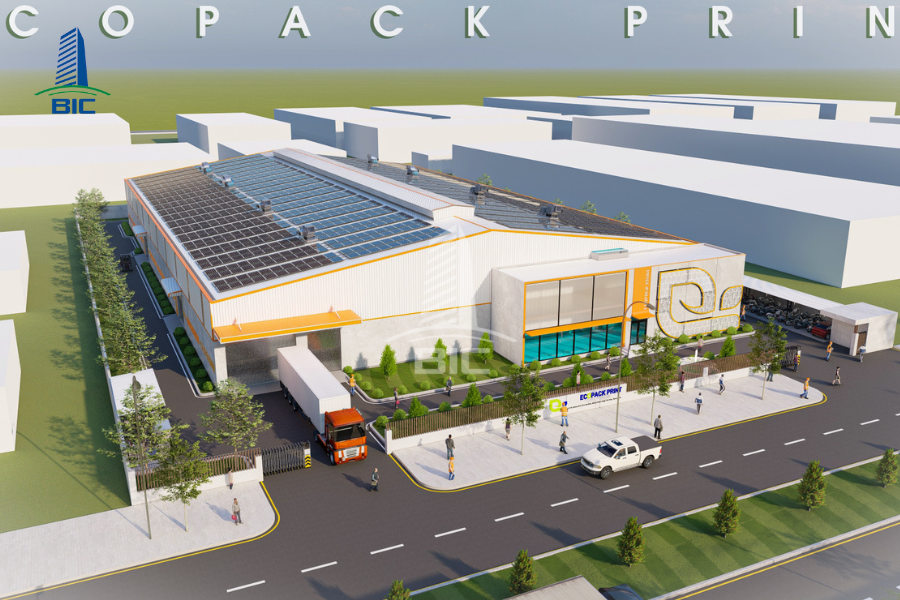
In special projects, the application of BIM in construction design offers tremendous advantages from the earliest stage.
Instead of presenting the facility only through 2D drawings, BIM allows full simulation of architecture, structure, and technical systems on a single platform.
This enables the design team to visualize the entire facility before construction begins.
The greatest value of BIM lies in its ability to detect technical clashes early, thereby minimizing errors and reducing costly changes during actual construction.
For industrial factories with complex functions, operational simulation technology plays a highly important role.
This tool allows the evaluation of human movement, material flow, finished goods circulation, forklift traffic, and technical routes within the factory space.
As a result, the layout can be optimized from the start to minimize congestion and improve space efficiency.
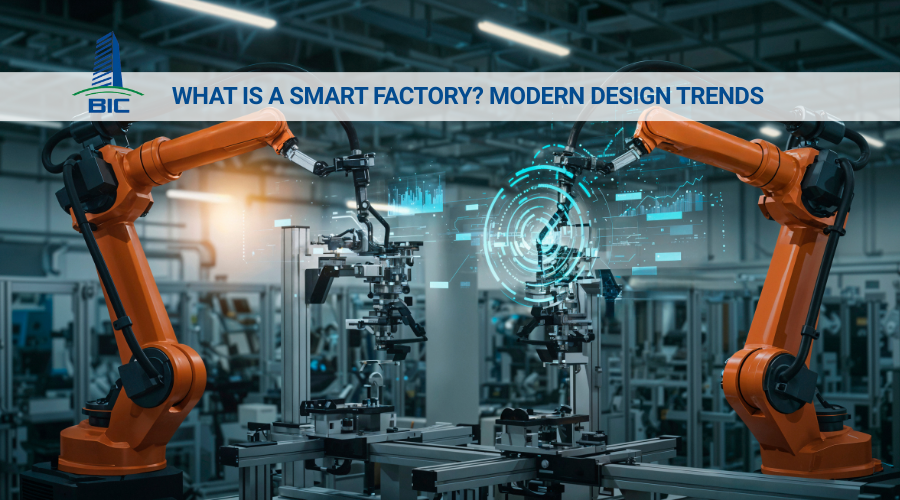
The development trend of smart factories is opening a new approach in factory design for special projects.
Rather than focusing solely on the physical structure, this solution aims to integrate energy management systems, equipment monitoring, and operational control through technology platforms.
When planned from the design stage, these smart solutions help businesses monitor performance in real time, control energy consumption, and detect abnormalities early.

From the contractor’s perspective, an effective factory design solution does not begin with drawings—it begins with fully understanding the investor’s operational requirements.
Every special project has its own unique production process, material flow, personnel flow, technical requirements, and long-term development goals.
At BIC, the design process always starts with operational reality first, then translates it into suitable spatial, structural, and technical solutions.
Rather than applying standard solutions, BIC prioritizes proposing tailored solutions for each production model, land condition, and investment objective.
With practical experience in factory design and industrial project implementation, BIC always aims to provide solutions that best fit each investor’s specific challenges, optimize investment efficiency from the earliest stage, and accompany the project from design to operation.
A correct solution today will become the foundation for a factory that operates effectively for many years to come.