According to the Commodity Exchange of Vietnam (MXV), the world iron and steel market has entered a recovery phase in the past 2 months, with the expectation that demand will improve, especially in the regions. like China and India. The rate of increase of iron and steel prices is somewhat slowing down, in the context of disruptions caused by the outbreak of the COVID-19 epidemic in China, which is hindering consumption.
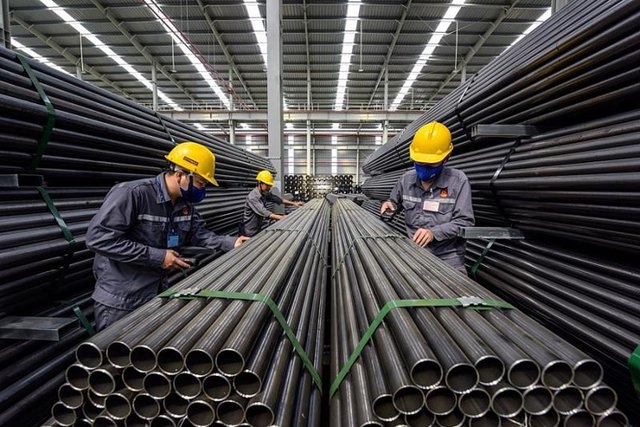
Near the 2023 Lunar New Year, many manufacturing enterprises also tend to hoard goods for operations at factories.
However, MXV believes that the strong momentum will likely return soon when the main consuming country, China, gets out of the epidemic peak and focuses on growth recovery.
Therefore, in this period, Vietnam is still benefiting from the import of iron and steel. Besides, this is also the period when many projects rush to complete the schedule, boosting the demand for iron and steel.
Statistics of the General Department of Vietnam Customs show that, in the first 15 days of December, our country imported 546.9 thousand tons of iron and steel of all kinds, equivalent to a turnover of 475.9 million USD. Meanwhile, the total export volume was only 334,500 tons, worth 222.1 million USD.
Near the 2023 Lunar New Year, many manufacturing enterprises also tend to hoard goods for operations at factories. With the gradual recovery of the world iron and steel market, domestic enterprises also need to improve their quality and competitive position in both the domestic market and international trade.
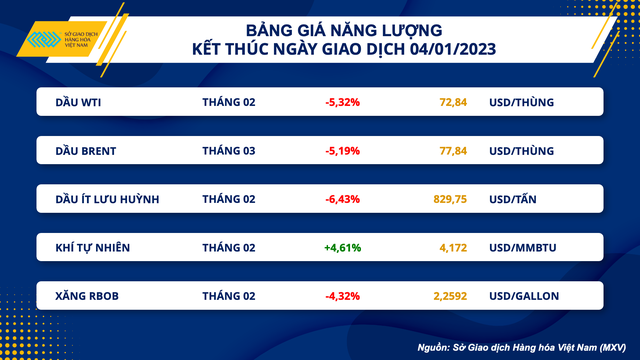
Energy price list ends on 04/01.
World oil prices plummeted for the second day in a row
Closing the trading session on January 4, crude oil had its biggest two-day drop in the first two days of the year in more than 30 years, amid concerns among investors about fuel demand as the global economy grew. Slowing growth and increasing COVID-19 cases in China.
WTI oil price fell 5.32% to 72.84 USD/barrel. Brent oil also plummeted 5.19% to 77.84 USD/barrel.
The selling force dominated almost the entire time of the session, when the problem of demand in the top importing country China was still difficult to solve in the short term. The spike in COVID-19 cases with a rapidly increasing number of casualties created a negative psychological effect that boosted selling in the oil market.
State-owned oil giant Saudi Aramco may reduce the official selling price (OSP) for its benchmark crude oil exports to Asia by about $1.50 per barrel, according to a Reuters source. February. This is partly due to pressure from the diversion of oil flows from Russia. However, this flow is also waning for the 4th week in a row to Asia, so these are all signs of slowing demand weighing on oil prices.
Early this morning, a report by the American Petroleum Institute (API) showed that US commercial crude oil inventories in the week ended December 30 increased by 3.3 million barrels, higher than market forecasts. Meanwhile, gasoline inventories increased by 1.2 million barrels, contrary to expectations for a decrease. This data may continue to cause oil prices to experience slight selling pressure in the morning session.
According to Baochinhphu.vn
Theo Baochinhphu.vn