The global economy in 2023 continues to face many unknowns, which will strongly affect commodity prices, especially iron and steel, an important input material for production and construction activities. Therefore, the Government's policy to promote public investment will greatly support enterprises producing construction materials, including iron and steel, helping to stabilize the market against macro fluctuations.
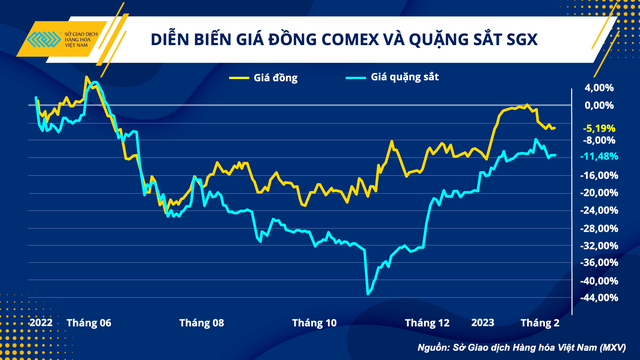
Price movements of copper and iron ore.
Commodity prices in the world continue to fluctuate
According to the Vietnam Commodity Exchange (MXV), 2022 is a volatile year for the prices of many commodities traded internationally. In 2023, pressures are likely to be eased, but stability remains difficult to achieve in the short term. Therefore, manufacturing enterprises in the world in general and in Vietnam in particular need to closely monitor the price movements of input materials in order to improve production efficiency.
Pham Quang Anh, Director of the Vietnam Commodity News Center said: "As a measure of the health of the economy, metal products such as copper or iron and steel closely reflect the growth picture. Currently, the prices of these materials are recording a significant recovery compared to half a year ago. The price of copper listed on COMEX has increased by 30% since the bottom in July last year, while iron ore on the Singapore Exchange recovered to a 6-month high, above $120/ton, the main reason for this trend was the reopening of China's top metal consuming market, which has helped consumption outlook is more positive."
However, for more than a week now, base metal prices are showing signs of pressure again. Pressure from the macroeconomic situation during the period when Western countries tightened monetary tightening, is still a big barrier to the overall picture of metal demand. In general, the price trend of input materials for construction activities in 2023, a driving force for economic growth, will depend a lot on the macro picture and consumption outlook.
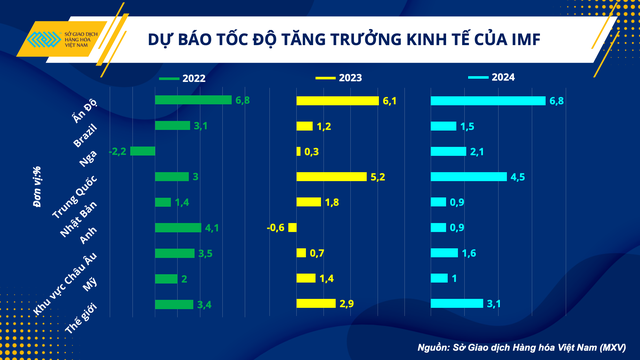
IMF economic growth forecast.
Concerned about the demand for construction steel
"Although inflation in the US and European countries has shown signs of cooling down and the scale of interest rate hikes has also begun to decrease since the end of last year, concerns about the risk of an economic recession are still lingering. This can limit the demand for iron and steel, the main resource serving the field of infrastructure investment and construction, one of the great driving forces for economic growth," said Mr. Quang Anh. Evaluate.
Recently, the International Monetary Fund (IMF) forecast that world economic growth will reach 2.9% in 2023, down from 3.4% last year, which recorded a weakening momentum from other economies. economies like the US and Europe. Also according to the IMF's forecast, Vietnam's economy will slow down at 6.2%, but this organization also considers this a relatively positive figure in the context of commodity price fluctuations and pressures. force from the world market.
For developing countries, including Vietnam, a strong export market for construction steel, weakening purchasing power from leading import markets will be a big challenge for manufacturing enterprises. Currently, the US holds 8% of our country's steel export market share, while this figure in the European market is 16%.
.png)
Disbursement rate of public investment capital and economic growth rate of Vietnam
The domestic steel industry maintains stability in the face of macro fluctuations
Pressure from major economies will make it more difficult for domestic manufacturers to promote construction steel exports. Meanwhile, heavily dependent on imported raw materials, price fluctuations will also be a factor causing many challenges for the industry.
The reopening of China, or a boom in construction in India, the world's top steel producing and consuming markets, is causing supplies of iron ore, coke, and steel. Scrap from main supplying countries such as China, Australia and Brazil is more competitive, leading to an increase in prices.
From February 7th, major domestic steel producers have announced to increase the selling price of all kinds of steel. This is the 4th consecutive price increase in less than a month, with an additional increase of 300,000-380,000 VND/ton depending on the business, to about 15.5-16.5 million VND/ton.
"Manufacturing enterprises will still need to flexibly adapt to fluctuations in the price of input materials for the steel industry, serving the construction sector, which accounts for 6.6% of the country's GDP. Steel prices at the moment. is recording a price increase again, but it is mainly due to the increase in the price of imported materials in the world, which has not really come from the push of domestic demand, "said Quang Anh.
However, the economic bright spot for 2023, especially with great support for enterprises producing construction materials, will be the policy to promote public investment, in order to strengthen the growth momentum under the direction of the Prime Minister. government.
Many important national and inter-regional projects have been implemented, key infrastructure development programs and projects, ODA-funded projects have spread, which will open up opportunities for iron and steel consumption, support businesses, creating a driving force for socio-economic development. Exchange rate fluctuations are being strictly controlled, which is a factor contributing to stabilizing the price of imported materials for manufacturing enterprises.
In general, in the context of many unknowns in commodity prices and many challenges in the world's macro-economy, flexibly promoting internal strength will pave the way for stable and sustainable growth in Vietnam. steady.
Hong Hanh (Vietnam Commodity Exchange)
Nhìn chung, trong bối cảnh giá cả hàng hoá còn nhiều ẩn số, nền kinh tế vĩ mô trên thế giới gặp nhiều thách thức, việc linh hoạt phát huy sức mạnh nội tại sẽ mở đường cho tăng trưởng tại Việt Nam ổn định và bền vững.
Hồng Hạnh (Sở Giao dịch Hàng hóa Việt Nam)