Budget control and limiting additional costs are top priorities for every investor in industrial construction projects. However, practical data from completed projects shows that more than 30% of projects experience cost overruns of 15% to 40% compared with the initial total estimate. Notably, most of this capital loss does not come from fluctuations in market material prices, but is the direct result of technical gaps in drawing documents, geometric errors during on-site erection, and delays in completing legal procedures.
A lack of experience in project management leads to a chain of mistakes, forcing businesses to stop factory construction in order to demolish, repair, or modify structural elements. In this article, BIC provides a comprehensive analysis of the most common mistakes across three stages: factory survey and design, fire prevention and fighting approval, and on-site implementation. Through this, investors will gain a clear perspective to proactively identify risks, optimize the design and construction process, and effectively protect their investment capital.
The survey and technical documentation stage is considered the foundation of the entire project. Errors or negligence at this stage always create a chain reaction, leading to serious deviations during on-site implementation and directly increasing investment costs.
A common mistake made by many investors in an attempt to reduce initial costs is cutting down the number of boreholes, reducing drilling depth for soil sampling, or, more dangerously, using assumed geotechnical data from nearby projects.
The practical consequences of this mistake are extremely serious:
- Incorrect foundation structure calculation: Without accurate data on the bearing capacity of soil layers and groundwater levels, structural engineers may propose a shallow foundation solution that is too weak, leading to settlement, floor cracking, and tilting of the industrial factory frame after heavy machinery is installed.
- Unexpected changes in construction methods: Encountering hard soil layers or abnormal underground cavities that were not identified in advance may force the contractor to stop factory construction and change from driven spun piles to bored piles. This change not only interrupts the schedule for 2 to 4 weeks, but also generates hundreds of millions to billions of VND in additional machinery and material costs beyond the estimate.
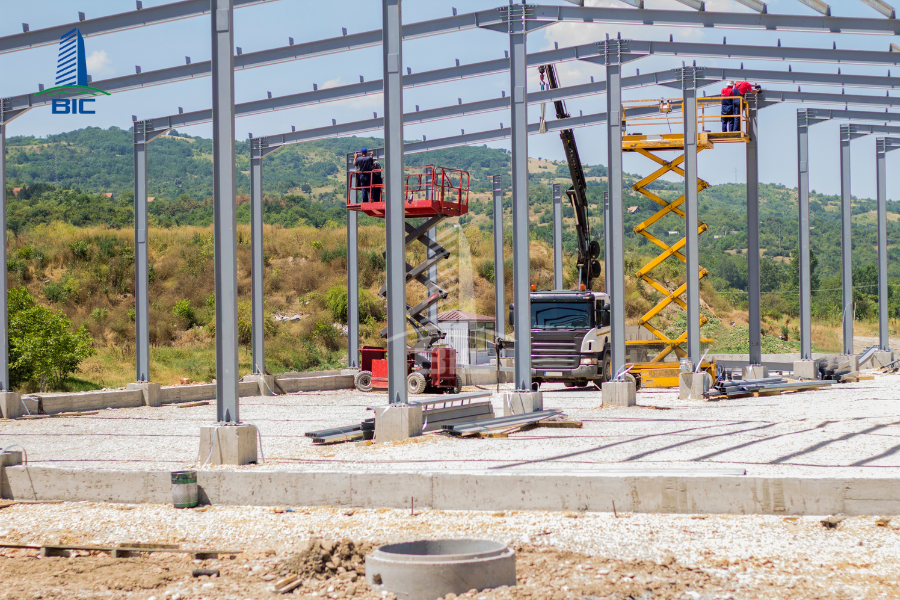
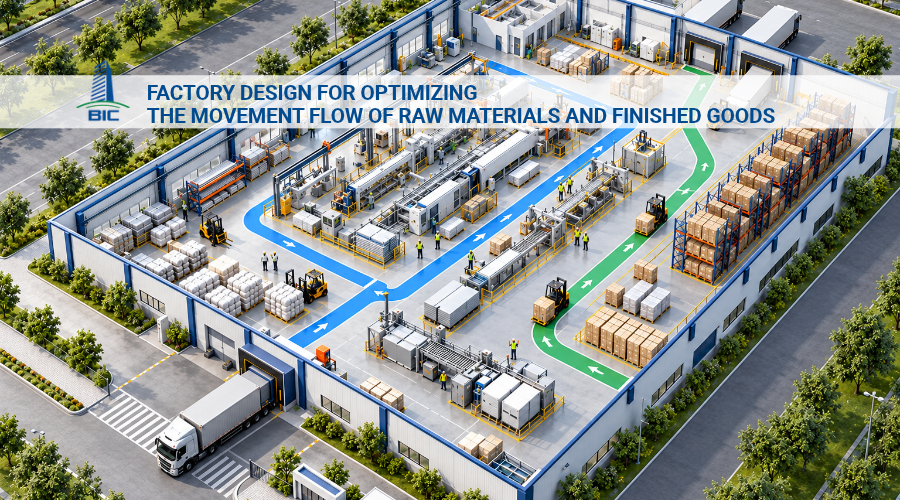
The core purpose of a factory is to serve the production line. However, many consulting units, when preparing factory design drawings, fail to deeply study the technology layout, geometric dimensions, dynamic machinery loads, and actual movement flow of forklifts.
The consequences of a design that is disconnected from function include:
- Installation space conflicts: When imported machinery arrives at the site, the investor may only then discover that the clear height of the steel rafters is too low, or that the spacing between column bays of the pre-engineered steel frame is too narrow, completely obstructing machinery installation.
- Demolition and structural modification: Because the concrete floor was not designed with compatible load-bearing capacity at locations where high-vibration machinery is installed, the contractor is forced to cut the floor and demolish previously cast concrete components to reinforce the machine foundation system. This corrective work not only reduces the monolithic quality of the floor but also creates significant additional labor and material replacement costs.
The situation in which design departments, including architecture, steel structure, and mechanical and electrical systems, work independently without data coordination is the leading cause of technical drawing conflicts.
When drawings are brought to the construction site, these coordination errors immediately become visible:
- Technical route conflicts: Large-diameter water supply and drainage pipes, HVAC duct systems, or power cable trays are designed with overlapping coordinates, cutting through the main load-bearing steel beams or penetrating ventilation walls.
- Schedule delays and additional costs: To resolve these conflicts, engineers are forced to stop factory construction on-site, organize emergency meetings, revise drawings, and recalculate the load-bearing capacity of structural components. Any modification to design and construction methods after materials have already been fabricated results in wasted cladding materials, discarded technical pipe sections, and additional labor standby costs at the construction site.
In addition to purely technical factors, legal risks and specialized documentation management are currently among the leading causes of industrial project delays, forcing changes to design and construction methods and resulting in heavy financial penalties.
Due to pressure to hand over the production site quickly or incorrect estimation of the time required to complete procedures, many investors subjectively allow contractors to begin foundation excavation or even erect the pre-engineered steel frame before obtaining the official Fire Prevention and Fighting Design Approval Document from the competent authority.
This serious mistake leads directly to cost consequences:
- Failure to meet fire-resistance standards: According to QCVN 06:2022/BXD, depending on the scale, area, and type of production industry, the main load-bearing frame system must achieve the required fire-resistance rating, such as R30, R60, or R90. If the factory design drawings have not yet been approved but the frame has already been erected, and the authority later requires architectural changes to increase fire separation distances, the investor will be placed in a passive position.
- Sudden increase in additional costs: To correct this issue and qualify for completion acceptance, the business must apply additional high-level protective measures such as fireproof mortar spraying or fireproof coating for the entire load-bearing column and rafter system. The cost of applying fireproof coating or gypsum board protection after the frame has already been erected and roofed is always 30% to 50% higher than implementing it synchronously during component fabrication at the factory.
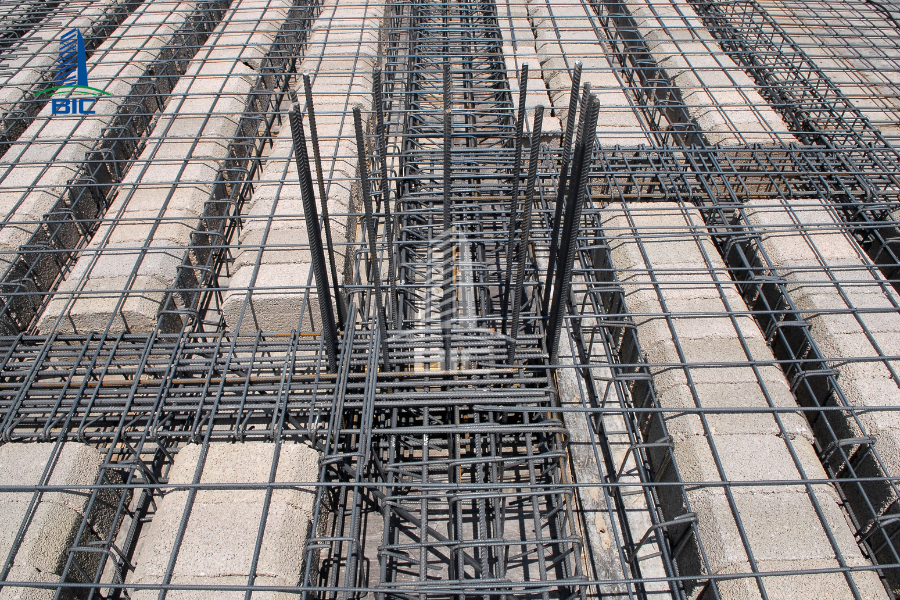
During site preparation, due to changes in production function requirements from different departments, investors often ask the construction design unit to locally adjust the location of functional zones, increase clear height, or expand the area of several auxiliary components, while skipping the procedure for adjusting the Construction Permit.
The legal consequences and economic damage include:
- Project suspension and administrative penalties: When the construction order management authority conducts an unexpected on-site inspection, any deviation in construction density, setback boundary, or gridline positioning compared with the permitted drawings may result in violation records, suspension of factory construction, and strict administrative penalties.
- Risk of being unable to complete project finalization: Unauthorized construction deviations prevent the business from completing the acceptance and completion procedures and registering ownership of the building on the land certificate. The contractor must stop work while waiting for the investor to legalize the permit, causing wasted equipment rental costs, scaffolding yard expenses, and extended project management costs for both parties.
The direct on-site construction stage is where materials are transformed into fixed assets. Every oversight in geometric supervision, cast-in-place material quality, or envelope installation methods must be paid for in cash.
The high-strength anchor bolt system embedded in concrete foundation caps is the only mechanical connection between the underground foundation and the pre-engineered steel frame above. A very common geometric error on poorly supervised construction sites is inaccurate surveying and gridline positioning using total stations, or the displacement of anchor bolt groups during foundation concrete pouring.
The technical consequences and repair costs include:
- Deviation of the entire frame system: If the coordinates of the anchor bolt group are eccentric or tilted beyond the allowable tolerance, exceeding 2mm, the pre-engineered steel columns fabricated precisely at the factory will not fit into the holes of the column base plates during erection.
- High costs for demolition, drilling, and chemical anchoring: To fix this error, the contractor must stop the entire crane erection process, demolish the concrete surface at the foundation head, use heating methods to straighten bolts, or drill and install new chemical anchor bolts. This process creates significant costs for specialized labor, expensive chemical anchoring materials, and reduces the original monolithic load-bearing capacity of the foundation cap.
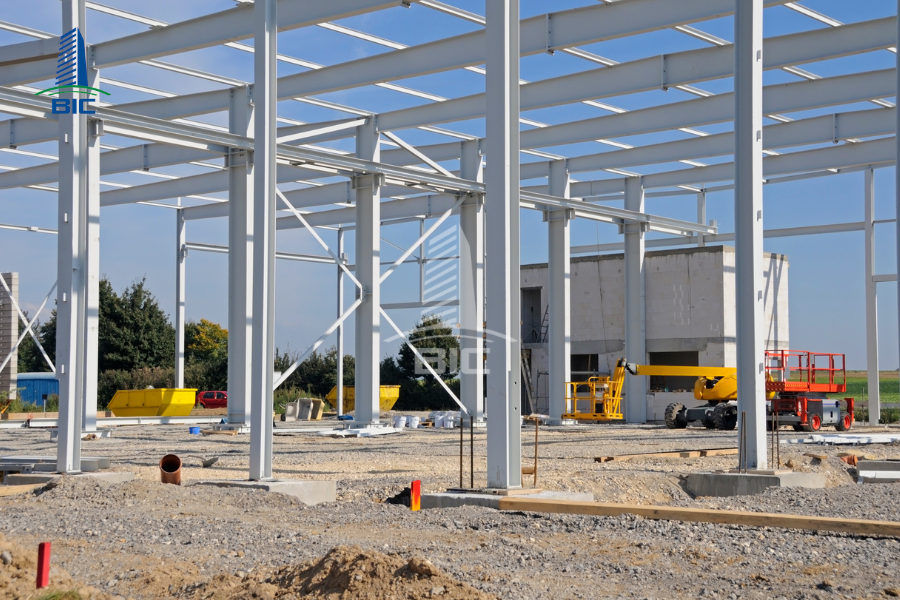
The building envelope system, including roof sheets and wall sheets, protects all assets and production machinery inside the factory from weather impacts. Choosing low-cost and inexperienced labor teams often leads to serious technical errors during installation:
- Incorrect screw spacing and installation technique: Workers fix metal sheets to purlins with screws that are not perpendicular, overtighten them and damage rubber washers, or install insufficient screw density for wind resistance.
- Substandard sheet overlap: The vertical and horizontal overlap distances of metal sheets do not meet local rainwater drainage standards. This is often combined with gutters that have insufficient cross-sectional capacity and cannot drain water quickly enough during heavy rainfall.
The consequence is leakage during the first rainy season. Rainwater leaking from the roof not only causes rust on the purlin system and damages the protective coating of steel rafters, but also seriously harms high-value electronic machinery and equipment below. As a result, the investor must spend significant additional money hiring waterproofing contractors or periodically replacing roof sheets.
The industrial factory floor is subjected daily to continuous mechanical impacts from stored goods, vibration from production machinery, and high-frequency forklift movement. The biggest mistake in floor construction is loose control over subgrade preparation and concrete material quality:
- Subgrade compaction not reaching K95 density: The soil layer underneath is not leveled and compacted to the required technical density, leading to voids and underground mud pockets.
- Defective concrete pouring process: Torn waterproof sheets cause cement paste water to seep into the ground during pouring; insufficient concrete spacers cause welded steel mesh to sink to the bottom of the slab and lose tensile resistance; or hardener powder is applied at the wrong setting time of fresh concrete.
The practical result is that after only 3 to 6 months of operation, the factory floor may develop long hairline cracks, localized deflection, broken expansion joint edges, and surface peeling under forklift wheels. The cost of grinding, injecting epoxy chemicals to treat cracks, or demolishing and recasting a damaged concrete floor bay is always many times higher than strictly controlling concrete pouring quality from the beginning.
To prevent the above mistakes and protect investment capital, business owners need to establish a strict project management process, shifting from reactive problem-solving to proactive early risk control.
The Bill of Quantities, or BOQ, is the most important legal and economic tool for investors to control cash flow:
- Detailing material types: Investors need to require the design consulting unit to issue a BOQ detailed down to each specific item. All specifications, from concrete grade, structural steel grade, steel billet thickness, bolt type, to protective paint brand, must be clearly stated with precise technical codes.
- Eliminating low-bid traps: Having an accurate BOQ helps investors easily compare and evaluate quotations from contractors. This completely eliminates the risk of being misled by contractors who deliberately understate quantities or use vague technical specifications to win bids at low prices, then continuously demand unreasonable additional costs once on-site construction has begun.
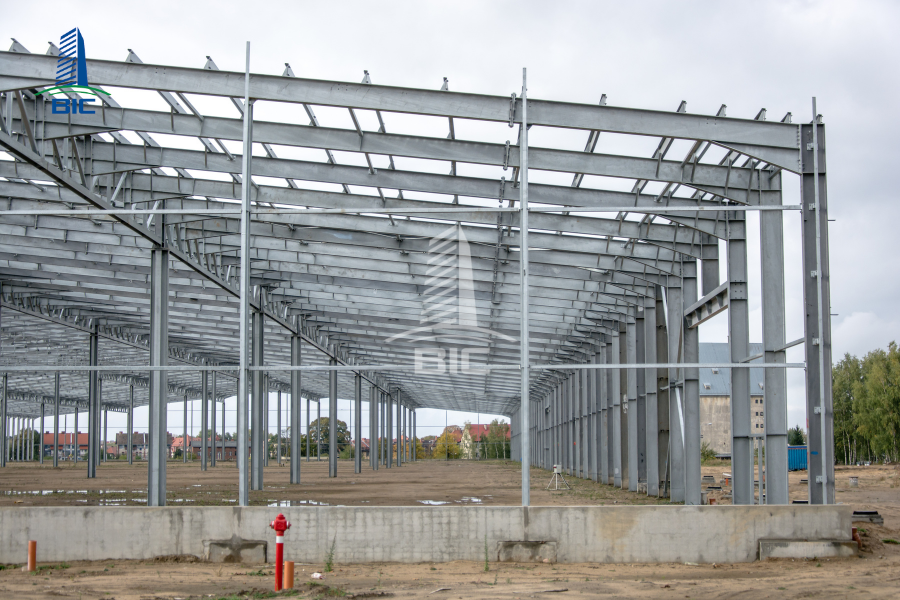
The full-package Design & Build model is becoming the mainstream trend in industrial factory construction thanks to its ability to optimize processes and minimize conflicts:
- One single point of comprehensive responsibility: Instead of having to coordinate and resolve conflicts between a separate architectural design company and an on-site construction contractor, the investor only needs to work with one legal entity: the general contractor.
- Eliminating drawing conflicts: Because the general contractor is responsible for both factory design drawings and direct construction, their engineers must coordinate all disciplines, including architecture, pre-engineered steel frame, and M&E systems, using a simulation model before implementation on-site. All dimensional errors or technical pipeline conflicts are thoroughly resolved at the office, eliminating the risk of stopping work for demolition and correction on-site.
Investors must never leave the entire construction site for the contractor to manage without independent control. Hiring an independent supervision consultant with the appropriate capacity certificate is a necessary solution to control quality:
- Controlling critical technical milestones: The supervision team will be present to inspect and approve each important stage: checking the geometric elevation of anchor bolt groups before allowing foundation concrete pouring; conducting ultrasonic testing of structural welds at the steel factory; checking K95 subgrade compaction; and testing actual concrete floor compression samples.
- Making site records transparent: Every technical deviation, no matter how minor, is detected and required to be corrected immediately before the next construction step begins. This prevents small accumulated mistakes from becoming major incidents that could waste billions of VND in future repair costs.
Building an industrial factory is a sequence of technical work packages that are orderly and closely connected. Every cost arising beyond the estimate is essentially the price paid for negligence or lack of strict control in an earlier stage, from saving a few geotechnical boreholes, hastily approving construction design documents, building before fire protection approval, to loose supervision of load-bearing concrete floor casting.
To bring the project to completion safely, within budget, and with stable long-term operational quality, the key lies in thorough preparation and the professionalism of accompanying partners. Investors should prioritize working with general contractors that have suitable capacity certificates, own independent mechanical fabrication facilities, and possess extensive practical experience in completing legal documentation. Proper investment in technical expertise during the design and construction stage is the smartest, most effective, and most sustainable cost-saving solution for the business.