Choosing a construction partner is a strategic decision that affects more than 90% of the success or failure of an industrial factory project in terms of progress, quality, and financial safety. In the context of rapid development in industrial construction, the emergence of many construction companies with uneven capabilities has created a difficult challenge for business owners. A lack of scientific evaluation criteria can easily cause investors to fall into the trap of extremely low quotations, leading to serious consequences such as poor construction quality, continuous additional costs, or project suspension due to legal violations related to fire prevention and fighting.
To protect capital and ensure that the factory is put into operation on schedule, business owners need a comprehensive and practical contractor capability assessment process. In this article, BIC shares core experience and practical evaluation criteria, from checking practice certificates and inspecting independent steel structure fabrication factories to technically managing negotiations for design and construction contracts. This information will help investors proactively screen and select a reputable factory contractor with sufficient capability to turn factory design drawings into a safe, functionally optimized, and sustainable facility.
Deciding to cooperate with a highly capable factory contractor is not simply about finding a construction unit. It is about finding a strategic partner to accompany the business throughout the entire project lifecycle. The professionalism of a contractor is clearly reflected in its ability to optimize technical solutions, control legal procedures, and protect the company’s investment capital.
In industrial construction, information gaps between the drawing preparation unit and the on-site implementation unit are the leading cause of technical errors. A professional factory contractor that can fully integrate both construction design and construction methodology will deliver practical benefits:
- Eliminating drawing conflicts: Structural, architectural, and mechanical and electrical (M&E) engineers coordinate closely from the beginning to resolve intersections between technical pipelines and the pre-engineered steel frame system on a simulation model, ensuring that the drawings brought to the construction site have absolute accuracy.
- Optimizing fast-tracking construction: The contractor can simultaneously implement off-site activities, such as fabricating steel components at the factory, and on-site activities, such as excavation and foundation concrete casting at the construction site. This synchronization helps shorten the total project schedule by 30% to 50% compared with using independent construction teams.

The legal standards system for industrial construction, especially the fire prevention and fighting regulation QCVN 06:2022/BXD, is currently applied extremely strictly. If the contractor does not understand the regulations, the investor will face the risk of having a completed facility that cannot be put into operation.
- Compliant design from the beginning: A professional contractor will proactively calculate fire-resistance ratings, fire separation distances, and fireproof coating or mortar protection solutions for steel columns and rafters directly in the initial factory design dossier.
- Ensuring smooth completion acceptance: Understanding the working process with state management authorities helps the contractor fully prepare material certificates, as-built drawings, and acceptance dossiers, enabling the business to quickly obtain written approval for fire protection acceptance and project completion ownership registration.
Transparency in financial management is a key measure of the credibility of an industrial design and construction contractor. Weak contractors often use vague quotation tactics to win bids, then pressure investors into signing appendices for additional material costs when the project is already underway.
- Detailed BOQ quantity takeoff: A reputable contractor provides a transparent Bill of Quantities (BOQ) down to each concrete grade, steel billet thickness, cladding sheet type, and fixed labor unit price.
- Protecting investment capital: Based on a synchronized technical dossier, a professional contractor can confidently commit to no additional costs throughout the factory construction process, helping investors fully take control of cash flow allocation planning and tightly control the company’s total investment.
To screen and select a reputable construction partner among many companies in the market, investors need to establish a quantitative evaluation system based on actual capability records, not commercial promises.
Legal status and practice certificates are prerequisites proving that the contractor is legally qualified to implement the project under the law:
- Checking business registration information: Assess the company’s operating period in the industrial construction sector, registered business lines, and tax obligation status to eliminate shell companies or businesses involved in legal disputes.
- Appraising the certificate grade: Review the Construction Activity Capacity Certificate issued by the Ministry of Construction or the Department of Construction. Investors need to compare the certificate grade, such as Grade I, Grade II, or Grade III, to determine whether it is compatible with the area scale and construction grade of the industrial factory project to be implemented.

Actual capability records are the most accurate evidence of a contractor’s workmanship and site management capability:
- Evaluating completed project lists: Require the contractor to provide a list of pre-engineered factories and warehouses with similar scale, span, and industry characteristics that have been handed over and put into stable operation within the last 3 to 5 years.
- Organizing site visits: The investor’s project management team should directly inspect actual projects completed by that factory contractor. This helps visually assess the quality of concrete floor construction, including flatness and cracking level, the tightness of the roof cladding system, and the aesthetic and safety quality of the M&E power network.
For pre-engineered steel factory models, the load-bearing frame accounts for more than 50% of the rough construction value. A contractor that controls its own fabrication technology has a major competitive advantage:
- Inspecting the mechanical fabrication factory: Prioritize companies that own independent steel structure fabrication factories with automated machinery systems such as CNC plasma cutting machines, frame assembly machines, and automatic submerged arc welding gantry systems.
- Controlling steel billet and surface quality: In-house production allows the contractor to strictly control input steel grades, shot-blasting surface cleaning processes that meet at least Sa 2.5 standard, and anti-rust coating and fireproof coating technologies, ensuring that components do not peel or oxidize before being transported to the site for factory construction.
An industrial project requires substantial working capital to purchase materials in advance. A contractor with weak financial capacity may cause the construction site to stall as soon as the investor delays disbursement for only a few days:
- Bank guarantee capability: The contractor must be able to provide a commitment letter for issuing a performance bond and advance payment guarantee from reputable commercial banks.
- Financial statement assessment: Review construction revenue, cash balance, and debt ratio in the financial statements of the last two years. A contractor with healthy cash flow and long-standing credibility with roofing sheet, steel, and ready-mixed concrete suppliers will always be able to ensure a continuous material supply and maintain the committed schedule regardless of market fluctuations.
Modern machinery only delivers efficiency when operated by qualified people:
- Capability of the site commander: Require the contractor to provide capability profiles, degrees, and practice certificates of the site commander, structural engineers, and health, safety, and environment (HSE) supervisors. The site leader must have experience handling heavy crane erection methods and large-area concrete floor casting.
- Quality control process: QA/QC: The contractor must demonstrate the application of quality management standards such as ISO 9001:2015 in document control, input material sample testing, and step-by-step acceptance procedures, ensuring that every work stage leaves a transparent construction log.
During the bidding process, if investors only look at the total investment figures displayed on the surface of the dossier, they can easily fall into the following common commercial traps.
This is the most common tactic used by weak construction companies to attract inexperienced investors:
- Understated quantity quotation tactics: The contractor intentionally underestimates steel tonnage, omits wind bracing systems, or designs a thinner concrete floor than actually required in the initial estimate to offer the lowest total unit price.
- Forcing additional cost appendices: After signing the contract and completing the foundation, the contractor puts the investor into a situation where they have no choice but to accept additional contract appendices for materials and equipment outside the original contract in order to continue the project. At this point, the final total cost is often much higher than the quotation from reputable contractors from the beginning.

Many investors trust large companies with strong branding and polished capability profiles, but fail to anticipate the risk of subcontract selling:
- Fully assigning work to informal teams: After signing the contract, the large company only retains a management commission and then assigns the entire construction site to small subcontractors or local teams, allowing them to decide on on-site implementation methods.
- Loss of quality control: Subcontract selling leads to a situation where the project has no specialized supervising engineers, workers are not equipped with proper personal protective equipment, materials are cut down, and the rough construction quality of the industrial factory seriously declines.
To reduce intellectual service costs and shorten preparation time, some design and construction consulting units reuse old drawings from previous projects and impose them on the investor’s new site.
The consequences of template-based construction design drawings include:
- Wasted foundation structure: The load-bearing foundation design is not based on actual geotechnical survey data, resulting in an oversized foundation on good soil conditions and wasting hundreds of millions of VND on reinforced concrete.
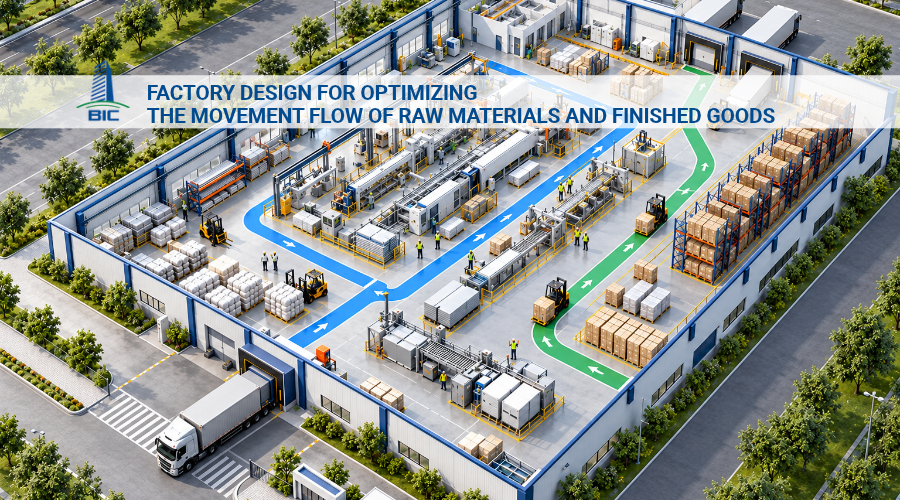
- Operational function conflicts: Architectural drawings are not compatible with the company’s production technology layout and specific machinery dimensions, obstructing forklift movement routes and reducing labor productivity when the factory begins operation.
After screening and selecting a factory contractor with suitable capability, the next step that determines the safety of the investor’s capital is negotiation and the concretization of terms in the economic contract. A strict and transparent contract is the strongest legal tool to bind the responsibilities of the design and construction contractor.
The project handover schedule directly affects the company’s machinery installation plan and order commitments. Therefore, timeline clauses must not be stated vaguely:
- Detailing progress milestones: The contract must clearly define the completion deadline for each major on-site item, such as the completion date of foundation concrete casting, the completion date of pre-engineered steel frame erection, the date when roof cladding is completed, and the completion date of the factory floor.
- Applying delay penalties: A specific financial penalty should be defined based on a percentage of the contract value, usually from 0.05% to 0.1%, for each day of delay caused by the contractor’s subjective fault. This clause creates economic pressure that forces the contractor to concentrate manpower and equipment to complete the project on time.

To avoid the risk of a contractor receiving a large advance payment and then slowing progress or abandoning the site, investors need to strictly control payment cash flow:
- Dividing disbursement into smaller payment phases: Payment should be divided into multiple phases, usually from 5 to 7, corresponding to completed on-site milestones.
- Payment based on accepted work quantities: Every payment phase, except for the initial mobilization advance, must be accompanied by a Work Quality Acceptance Minute signed and confirmed by the independent supervision consultant. Investors must never disburse an amount exceeding the actual value of work that has been constructed and inspected on-site.
Industrial factory buildings often reveal technical defects, if any, such as concrete floor cracking, roof leakage, or subgrade settlement after the first one or two rainy seasons:
- Defining the warranty period: Investors should negotiate a minimum warranty period of 2 to 5 years for the main load-bearing frame system and the roof envelope.
- Retaining warranty money: Retain 3% to 5% of the total final contract value throughout the warranty period. This amount may be replaced by a warranty bond issued by a commercial bank. If the contractor delays or refuses to correct technical issues arising during operation, the investor has the right to use this retained amount to hire an independent unit for repairs.
The journey of finding and choosing the right factory contractor is a key factor that helps investors lay the first solid foundation for a successful industrial construction project. Thoroughly assessing legal capacity, visiting actual completed projects, and inspecting the independent mechanical fabrication factory system will help businesses completely eliminate weak contractors and prevent additional cost risks from the beginning.
A reputable contractor with full-package design and construction capability and a transparent BOQ quantity takeoff process not only delivers a factory that meets rough construction quality and fire safety standards, but also helps optimize capital efficiency for the investor. By establishing a strict economic contract and scientifically allocating payment cash flow according to actual acceptance progress, business owners can fully control the project, ensuring that the factory is completed safely, within budget, and ready to activate maximum production capacity for the business. Contact BIC for detailed consultation.