The construction density in any industrial park is based on the standards on construction techniques and construction planning. For this, both the investor and the contractor need to understand the parameters such as land use coefficient, construction density... before planning the construction design.
The density of construction in industrial zones and the land use coefficient often go hand in hand, which is an important basis for businesses to build both production needs and legal requirements. From there, it is possible to estimate the size of the construction factory and how much it will cost to invest.

Construction density in an industrial park is roughly understood as the ratio of land that construction works occupy to the total area of the entire land lot.
Each place has its own construction urban density and is regulated in accordance with national technical regulations on construction planning- QCVN 01:2019/BXD. This helps investors and people to make construction planning in accordance with the law.
There are 2 types of building density that are:
+ Net construction density: this is the ratio of the occupied area of the construction works on the area of the land lot, excluding the occupied area of the ornamental landscape of swimming pools, parking lots and outdoor sports fields. God.
+ Gross construction density of an urban area: is the ratio of the land occupied area of the previous constructions to the area of the whole area, the area of the whole Khuddaats may include green areas, open spaces, courtyards and roads. and non-construction areas
The land use coefficient is the ratio of the total construction floor area to the total area of the land lot. Total floor area is the total area built up by the investor with the aim of being used for production or storage… Including the floating floor, the roof and the basement. The area of the land lot is the total area of land that the enterprise owns or rents in accordance with the law.
The land use coefficient is calculated according to the following formula:
Land use coefficient (Hsd) = Total building floor area / Total lot area
Unit: (times)
For example:
Enterprise A owns a land plot of 2000m2, the construction company constructs a factory with 4 floors, the area of each floor is 1400m2, the remaining area of 600m2 is used for planting trees and the system of roads. Therefore, we have the land use coefficient of enterprise A as:
Hsd = (4*1400) / 2000 = 2.8 (times)
To use and build in industrial park land, investors should note the following 4 points
- Land for construction of industrial parks and clusters of industrial zones must be planned in accordance with the potential for industrial development, the master plan for socio-economic development and relevant development strategies.
- The proportion of land types in the industrial park depends on the type and nature of the mooddun industrial park, the area of the land plots for construction of warehouses and factories, but it needs to be consistent with regulations.
- Net construction density in the land lot for factory construction when the maximum capacity is 60%
At the same time, it is necessary to meet the national technical regulations on construction planning QCVN 01: 2019/BXD. This standard specifies the limits of the specification and regulatory requirements that must be complied with. Applied in the process of formulation, appraisal, approval and adjustment of planning. Organize the implementation of the development management planning according to the approved planning. To serve as a basis for construction of national standards and local regulations in the field of construction planning.
The construction density will depend on the height of the building & the area of the lot. The taller the buildings, and the larger the area, the lower the construction density.
Areas inside factories and industrial parks also need to have a separate minimum construction area limit according to regulations. Specifically:
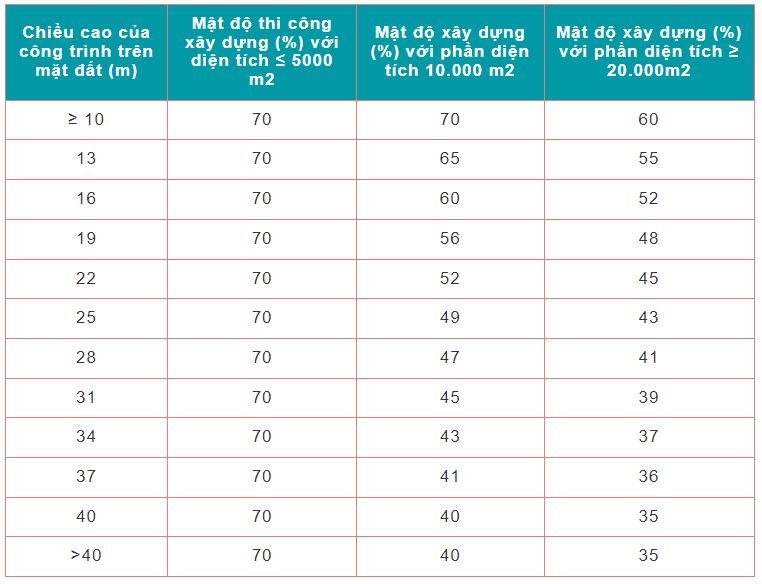
According to the regulations on the density of the factory building above, to create a balance and harmony between the construction works and the surrounding landscape. At the same time, providing a comfortable, ideal environment for officials and employees to work.
Lookup table of density of works, subdivisions inside the factory

In addition to regulations on factory construction density, when constructing, enterprises need to meet other requirements, specifically:
Some general requirements according to regulations on density of factory construction
Must ensure the requirements for environmental protection & safety according to construction standards in industrial parks. This helps to minimize the negative impacts on the urban environment.
For production facilities and warehouses with hazardous levels of level I, II and III, they need to be located far away from civil areas. Toxic level & distance ATMT comply with regulations of the Ministry of Science and Technology or must be determined by environmental impact assessment tool or based on similar projects.
In case there is no environmental impact assessment or similar projects, the values in Appendix 3 of TCVN 4449-1987 can be referenced.