The latest fire protection design standard TCVN 5760:1993 applies to the design, installation and use of fire fighting systems equipped for buildings such as factories, factories, warehouses, offices, houses... General requirements for design, installation and use of fire fighting systems according to TCVN 5760:1993
Construction and installation of factory fire protection system plays an important role in ensuring the safety of life and property of enterprises. Each factory has its own fire protection system suitable to its scale, production characteristics and financial budget.

However, any factory fire protection system must fully meet the standards prescribed by the authorities. This includes the following standards:
TCVN 2622-1995 “Fire prevention and fighting for houses and works
TCVN 5738-2001 “Fire alarm system – Technical requirements”
TCVN 5760-2001 “Fire-fighting systems- General requirements for design, installation and use”
TCVN 3256-89 “Fire safety- General requirements”
TCVN 3890-2009 “Fire prevention and fighting means for houses and works
QCVN 06: 2010/BXD “National technical regulation on fire safety for houses and buildings”
QCVN 08: 2009/BXD “National Technical Regulations” Urban Underground Works
TCVN 4513 – 88 “Internal water supply – Design standards”
Fire fighting system is a combination of specialized technical equipment, pipes and extinguishing agents used to extinguish fires.
Fixed fire extinguishing system is a fixed installed fire fighting system.
Semi-permanent fire-fighting system is a fire-fighting system in which part of the system is permanently installed and the rest is fully connected when fighting.
Automatic fire extinguishing system is a fire fighting system that is automatically controlled when a fire occurs.
A manual fire extinguishing system is a manually controlled fire extinguishing system.
A volumetric fire extinguishing system is a fire extinguishing system that creates a non-combustible environment in the volume to be extinguished.
Surface fire extinguishing system is a fire extinguishing system used to cover the surface of a combustible substance.
A water-based fire-extinguishing system is a fire-extinguishing system in which the substance used to extinguish the fire is water.
Foam extinguishing system is a fire extinguishing system where the substance used to extinguish the fire is foam.
Powder fire extinguishing system is a fire extinguishing system in which the substance used to extinguish the fire is powder.
A gas fire-extinguishing system is a fire-extinguishing system in which the substance used to extinguish the fire is a gas.
Steam extinguishing system is a fire extinguishing system in which the substance used to extinguish the fire is steam.
Sprinkler fire fighting system is a fire fighting system with oil and gas spray that is always in the standing mode, the nozzle is opened when the specified temperature is reached and only localized fire fighting on a certain area.
Drencher fire fighting system is a fire fighting system with open nozzles, when there is a fire the entire area below the nozzles is sprayed with extinguishing agent.
Wall fire fighting system is a fire fighting system installed on the wall inside the works.
Controllers are devices that control the operation of the fire suppression system.
The fire-extinguishing agent supply and storage unit is the equipment used for extinguishing and transmitting fire-extinguishing substances.
The fire-extinguishing agent distribution unit is a combination of technical equipment used to distribute, conduct and transfer fire-extinguishing substances.
According to the building process that is applied in most factories
+ Construction and installation of wall fire protection system: mainly workshops and mechanical warehouses, printing workshops... with low fire and explosion risk.
+ Construction and installation of automatic fire protection systems in factories, warehouses, chemical warehouses, textiles... with high risk of fire and explosion.
+ Construction of semi-automatic fire protection is simple with only fire fighting equipment such as valves, coils, fire boxes...
A fire protection design drawing of a factory must meet the following requirements:
+ Quickly detect the exact fire
+ Alarm to the processing department
+ Anti-interference
+ No problems when a fire occurs
+ Not affected by other installations
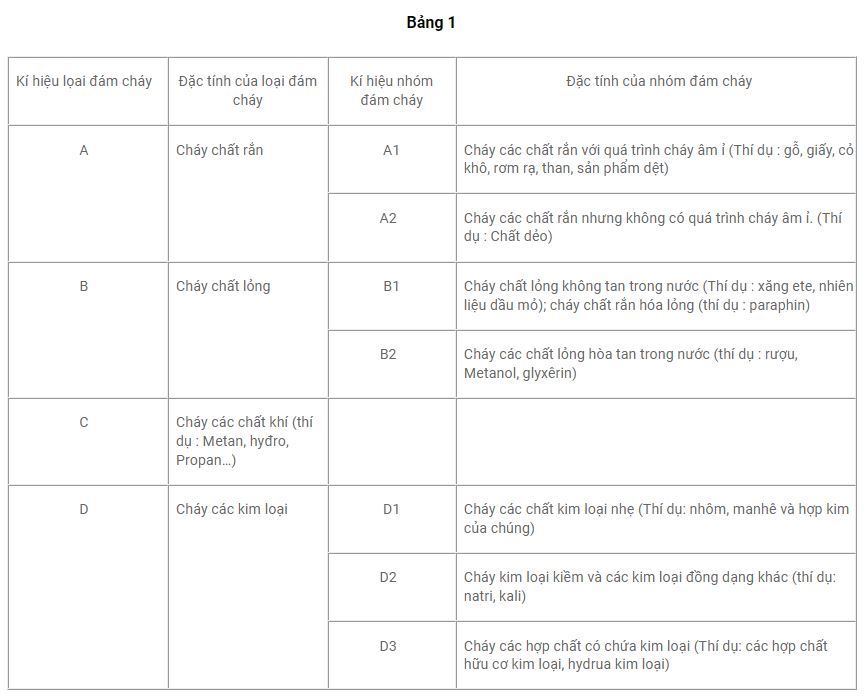
Depending on the state of the combustible material and combustible material, fires are classified into four types: solid fires denoted A, liquid fires denoted B, gas fires denoted C and metal fires denoted D. Each type is also grouped to ensure high efficiency when using the fire suppression system.
Types and groups of fires are specified in Table 1.
The fire type icon helps users to use fire fighting equipment and tools suitable for each type of fire. Each fire fighting equipment and tool must be affixed with the above symbol in accordance with regulations.
Note: For equipment and tools that can extinguish many different types of fires, all types of prescribed symbols must be attached.
Design requirements
When designing a fire fighting system, it must be based on the type of fire, the nature of fire danger and the volume of combustible substances present in the building and the fire fighting efficiency of the systems.
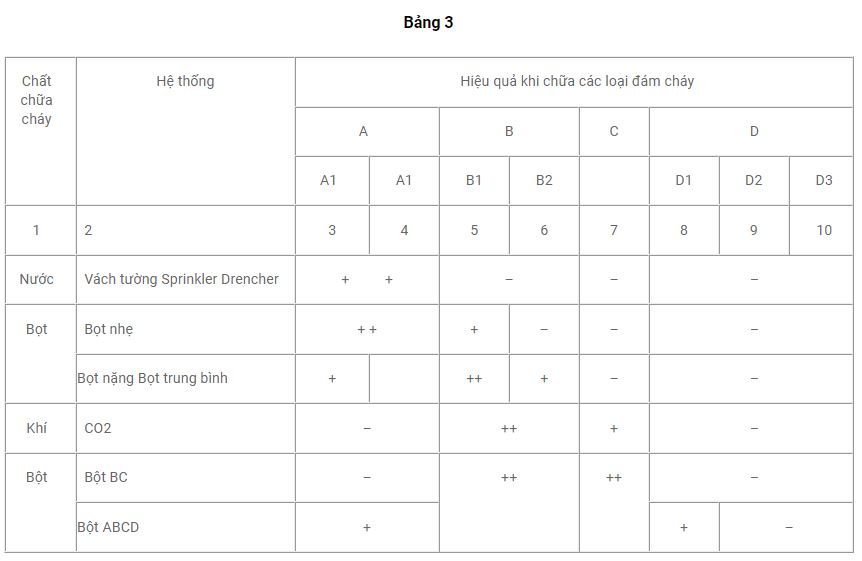
Effectiveness of extinguishing fires when designing fire extinguishing systems see Table 3.
Note:
Sign “++” – Very effective.
Sign “+” – Suitable fire fighting.
Sign “-” – Inappropriate fire fighting. Lightweight Foam – Foam with a high expansion multiple.
Medium Foam – Foam with medium expansion multiples
Heavy Foam – Foam with a low expansion multiple.
BC powder – Powder used to fight fires with symbols B, C
ABCD powder – Powder used to fight fires with symbols A, B, C and D.
The fire suppression system includes:
Alarm unit.
Control unit.
Supply and storage of fire extinguishing agents.
Dispensers of extinguishing agents and nozzles, nozzles.
Pipe parts.
Power supply unit.
In manual and semi-permanent fire extinguishing systems, it is possible to reduce each part deemed unnecessary in the system.
The design gas of the fire fighting system must ensure the flow of extinguishing agent. The flow of extinguishing agent depends on the type of extinguishing agent, combustible substance, area and volume to be extinguished.
The fire fighting system must ensure sufficient pressure to bring the extinguishing agent into the fire place.
Parts that supply and store fire extinguishing agents must ensure regular operation and must have adequate reserves for each type of fire fighting system according to the standards of TCVN 2622: 1978 and TCVN 5307: 1991.
The extinguishing agent distribution part, the nozzle and the nozzle must ensure that the extinguishing agent is completely covered on the surface of the combustible substance, the fire fighting area and the required percentage when fighting volumetric fires.
Must use nozzles, nozzles suitable for each type of fire fighting system.
The alarm device must ensure normal operation. When fighting a fire, an alarm signal must be issued.
The power supply part must ensure adequate power supply for the fire fighting system to operate. There must be a backup power supply to promptly replace when the main power is cut off.
When designing a fire fighting system for a building, it is necessary to have:
Explain the structure and operating principle of the system.
Technical parameters.
Document calculation and specification of specifications.
System functional test manual and technical maintenance manual.
Technical drawings.
When designing a fire fighting system, it is necessary to consider the structural characteristics of the building to ensure its effectiveness when used.
Only design SPRINKLER fire fighting system for buildings with ceiling or roof height from l0m or less. The distance from the nozzle, nozzle to the combustible substance and burning object must be from 0.5m or more.
DRENCHER fire suppression systems are designed for buildings with no ceiling or roof height restrictions. When designing the DRENCHER fire fighting system, it is necessary to divide each area to avoid spreading fire.
When designing foam and gas fire extinguishing systems, consideration must be given to the possibility of excess air release in order to reduce residual pressure in the building.
The fire-extinguishing agent storage unit is designed either inside the building or outdoors depending on the specific conditions of the building.
Requirements for installation TCVN 5760:1993
Only install or change the fire fighting system according to the design documents approved by the fire prevention and fighting agency.
When installing fire fighting systems, equipment must ensure tightness and durability, especially systems containing pressurized extinguishing agents.
The unit that supplies and stores fire-extinguishing substances located outside the house must have a roof to avoid rain and sun.
After the complete installation of the fire extinguishing system, it must be tested, evaluated the quality and technical parameters of the system and must be recorded in the acceptance report.
Requirements for using TCVN 5760:1993
Only fire extinguishing systems with quality assurance and design specifications are allowed to be put into operation.
Each fire extinguishing system must have a log book to record information about that system. The logbook is maintained and recorded by the operator.
The fire fighting system must be periodically maintained according to the instructions of the manufacturer.
In case of repair or replacement when there is a breakdown or damage, it must also be done according to the instructions.
After using the fire extinguishing system for fire fighting or practice, the direct management agency must quickly replace and repair it if necessary.
The operator of the fire extinguishing system must have a certain level of knowledge and understanding of the operating procedures according to the instructions of the manufacturer.
The operator should always regularly check the fire readiness of the system according to the manufacturer's manual and other relevant documents. When detecting defects, they must immediately notify the responsible person of their unit to fix.
Persons who perform technical maintenance, repair or replace each part of the repair system must have professional qualifications and must be decided by a competent authority.
The above is TCVN 5760:1993 applied to design, installation and use of fire extinguishing systems equipped for buildings (factories, factories, warehouses, headquarters, offices, houses, etc.) ) is updated by Vietmysteel latest. Through this article, we hope to have provided readers with some useful information.
For any information that requires consulting support on fire fighting systems and related issues, please contact us immediately for the fastest and completely free support.