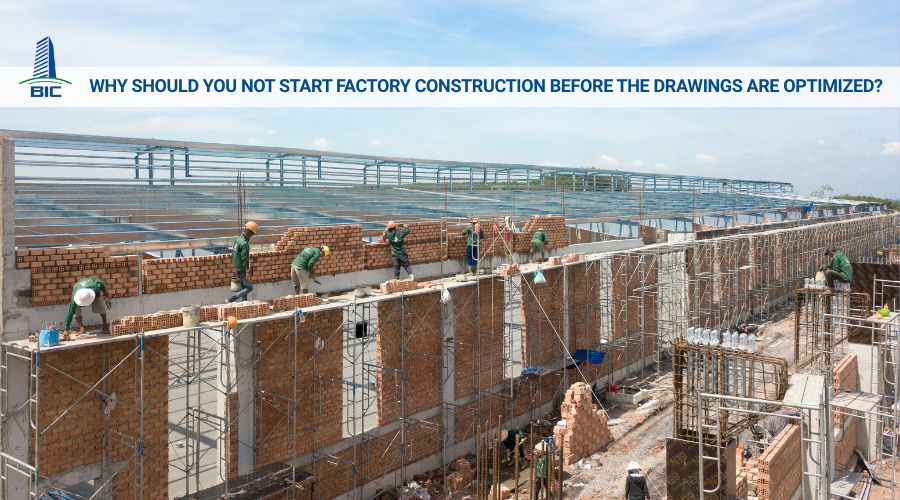
The bracing system in the steel structure of the factory has the effect of transmitting the wind load and the crane braking force along the factory to the foundation. The bracing system also ensures that the construction and erection of the structure is safe and convenient. Many investors who build a factory for the first time will feel unfamiliar with the bracing system.
+ Ensure the shape invariance and spatial rigidity of the bearing structure.
+ Bearing the load acting in the longitudinal direction, perpendicular to the plane of the draft wall, the braking force of the crane
+ Stabilize the compression members of the structure, making the erection convenient and safe.

- Detailed roof bracing system includes: 3 main components which are upper wing bracing system, lower wing bracing system, vertical bracing system. The roof bracing system of the industrial factory usually uses a light steel frame and is arranged in two horizontal gables, the top of the temperature blocks and in a number of middle spaces depending on the length of the workshop so that the distance is ensured. between the braces arranged under 5 column steps
The belly plate of two side-by-side crossbars is connected by cross braces

The diagonal braces are arranged with angle steel, round steel or galvanized theps cable with a diameter of less than 12mm. Besides, it is necessary to arrange more longitudinal steel struts at places such as roof top, beam top, roof foot ...
In case the factory has a crane, install a cross brace along the top of the column to increase the rigidity of the horizontal frame vertically and transmit horizontal loads such as wind load, crane braking force to nearby frames.

Consists of horizontal cross bars and longitudinal struts located in the plane of the wing bars on the truss.
The effect is to reduce the calculated length for the upper wing of the truss.
Arranged horizontally across the house at the two gables, the top of the temperature block and in the middle of the house, so that the distance between them is not more than 60m.
Lower wing brace:

Consists of cross bars located in the plane of the lower wing of the truss vertically and horizontally;
The lower wing bracing system: is arranged in the compartments with the upper wing bracing system, together with the upper wing bracing system to form a rigid block at the two gables and the top of the temperature block. The horizontal bracing system at the gable is the support for the gable column, bearing the wind load blowing on the gable wall, so it is also called the wind bracing system.
Lower wing longitudinal bracing system: arranged at the ends of columns along the length of the house, creating the rigidity of the house, this bracing system has the effect of transmitting local forces (the braking force of the crane) to distribute to neighboring frames. .
Vertical brace:

Consisting of cross bars located in the plane of the vertical bars of the truss, vertically the house is arranged at positions with upper and lower wing braces to create an invariable rigid block.
- Column bracing system: has the role of ensuring the geometrical invariance and rigidity of the building in the longitudinal direction, bearing the vertical load and ensuring the column stability. In each longitudinal axis a temperature block should have at least one rigid plate, the other columns supporting the rigid plate by longitudinal struts. The rigid plate consists of two columns, the crane girder, the cross bars and the cross bars.
With heavy roofs

The upper column bracing system is arranged on the upper column axis, vertically the house is arranged at the gable, the temperature block and in the middle of the house;
The lower column bracing system is arranged in two column branches, vertically the house is placed in the middle of the temperature block so as not to obstruct the temperature deformation of the longitudinal structures, the distance from the gable to the bracing system is ≤75m, distance between two bracing systems in a temperature block ≤50m;
The column brace system is composed of a cross-cross system, the reasonable angle of the tie rod with the horizontal is from 350÷550, the thinness of the tie rod is λmax≤[λ]=200.

With a light roof
When the industrial building does not have a crane or a light crane Q≤15T, a column brace system can be arranged at the two gables to quickly transmit the gable wind load to the foundation. The reason is that the tie rods are relatively thin so there is no significant temperature stress;

When the length of the house is L≤100m, it is possible to arrange bracing columns in the two gables of the house.
Lower wing bracing system
Calculated as a parallel two-wing stationary truss, the crossbar system has the same cross section. The main applied loads are the support reaction due to the wind load acting on the gable wall frame and placed on the truss nodes;
Due to the nature of the load changing sign (wind load), when choosing the cross-section of the tie rod, it is often selected according to the section of the tension rod, during the working process when a compressive force occurs, consider the compression bar to be unstable. This only has the pull bar working;
Lower wing longitudinal bracing system: calculated according to the continuous truss diagram on the elastic support determined according to the transverse displacement of the top of the frame.

Construct bracing system in the wall and hard fault to create stability for the frame. On the bwangf surface, the vertical bracing system is arranged in two directions according to the principle of not arranging the vertical bracing system at the temporary partition, the external bracing system is properly combined with the facade architecture; The bracing system needs to be combined with the internal traffic planning at each floor
The upper wing bracing system should be arranged horizontally at the two gables, in the middle of the house and at the top of the temperature block. During the construction of the factory, the wing brace system is arranged to ensure that the distance between the positions does not exceed 60m .
The lower wing bracing system consists of cross bars located in the plane of the lower wing of the truss. The wing bracing systems are in the longitudinal and transverse directions.
The horizontal lower wing bracing system is arranged at the position where the wing bracing system forms an invariable space rigid block at the two gables and the thermal block head. Horizontal bracing system as support for return columns and load bearing.
The vertical lower wing brace system is arranged at the top of the pile along the length of the workshop to create vertical rigidity for the factory and uniformly transmit local forces to the whole factory.
Column bracing system combined with crane girders, two columns to create vertical stability
When there is a large external force, the force will be transmitted from the column to the crane compactor to the column bracing system and transmitted to the foundation to limit the impact force on the steel frame of the workshop.
The column bracing system consists of diagonal bars arranged in the upper and lower columns where the roof bracing system is located. The size of cross bracing chooses a suitable location based on whether the factory has a crane or not to increase the bearing capacity.