TCVN 13067:2020 is compiled by the Institute of Transport Science and Technology, proposed by the Ministry of Transport, appraised by the General Department of Standards, Metrology and Quality, and published by the Ministry of Science and Technology.
The following referenced documents are necessary for the application of this standard. For referenced documents with the date of publication, the above version applies. For undated referenced documents, the latest version, including amendments and supplements (if any), applies.
TCVN 197-1:2014 (ISO 6892-1:2009), Metallic materials - Test methods at room temperature.
TCVN 198:2008 (ISO 7438:2005), Metallic materials - Bending test.
TCVN 1595-1:2013 (ISO 7619-1:2010), Vulcanized or thermoplastic rubber - determination of indentation hardness- Part 1: Method using a durometer (SHORE hardness).
TCVN 1916, Bolts, screws, studs and nuts - Specifications.
TCVN 2229:2013 (ISO 188:2011), Vulcanized or thermoplastic rubbers - Accelerated aging and thermal endurance tests.
TCVN 2263-1:2007 (ISO 2768-1:1989), General tolerances - Part 2: Tolerances for long and angular dimensions do not indicate specific tolerances.
TCVN 2263-2:2007 (ISO 2768-1:1989), General tolerances - Part 2: Geometric tolerances for elements do not indicate specific tolerances.
TCVN 2752:2017 (ISO 1817:2015), Vulcanized or thermoplastic rubbers - Determination of the degree of impact of liquids.
TCVN 4509:2013 (ISO 37:2011), Vulcanized or thermoplastic rubber - Determination of stress - elongation properties in tension.
TCVN 5320-1:2016 (ISO 815-1:2014), Vulcanized or thermoplastic rubbers - Determination of residual strain after compression - Part 1: Test at ambient or elevated temperature.
TCVN 8998:2018 (ASTM E415-17), Carbon steel and low alloy steel - Method for chemical composition analysis by vacuum emission spectroscopy.
TCVN 11525-1:2016 (ISO 1431-1:2012), Vulcanized or thermoplastic rubbers - Ozone crack resistance - Part 1: Static and dynamic strain tests.
TCVN 12109-2:2018 (ISO 16143-2:2014), General purpose stainless steels - Part 2: Semi-finished products, steel bars, rods and sections subjected to corrosion.
ASTM A123/A123M, Standard Specification for Zinc (Hot-Dip Galvanized) Coatings on Iron and Steel Products.
ASTM A153/A153M, Standard Specification for Zinc Coating (Hot-Dip) on tron and Steel Hardware.
ASTM A240/A240M, Standard Specification for Heat - Resisting Chromium and Chromium - Nickel Stainless Steel Plate, Sheet, and Strip for Presure Vessels chromium-nickel and chromium-heat-resistant stainless steel).
Expansion Joint
The expansion joint on the bridge ensures that the span structure can move freely under the action of live load, temperature change, creep and shrinkage of concrete. In other words, the expansion joint has the following effects: ensuring the axial displacement of the beam, ensuring the rotational displacement of the cross section at the beginning of the span, ensuring the smoothness of the vehicle, avoiding noise and preventing surface water from overflowing through the opening. bearing and abutment structure below.
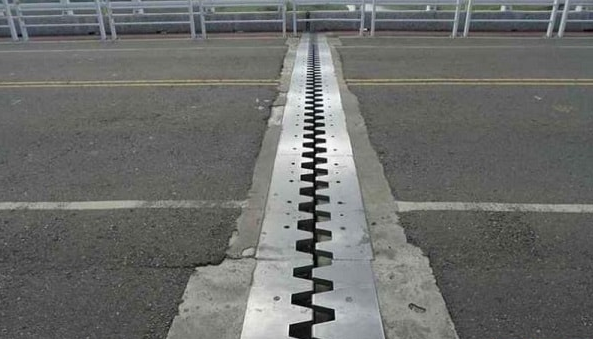
Steel Finger expansion joint
Comb tooth expansion joint consists of combed or serrated or composite sinusoidal steel plates anchored on each side of the gap and interlocked to close the gap. The comb tooth expansion joint is hereinafter referred to as the comb tooth expansion joint.
Closed Finger expansion joint
The comb tooth expansion joint has a sub-surface water-stop consisting of a rubber sheet or a stainless steel trough...to prevent stagnant water, brick debris from penetrating the structure below the bridge deck.
Open Finger expansion joint
The comb tooth expansion joint is designed to allow water and debris to pass through.
Contraction joint standards
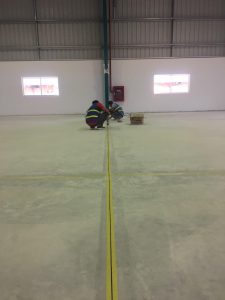
Regulations on construction of joints
- Insert wooden or styrofoam slotting materials before application.
- After pouring concrete, there must be a trowel to create a slot.
- After 6-8 hours, when the concrete has reached a certain hardness, cut with a cutter (should not be more than 24 hours).
Regulation of distance for shrink joints (Lmax)
Lmax from 6 - 9 meters: Applied to reinforced concrete structures subject to direct climate impacts.
Control joint standards for concrete
Regulations on construction of expansion joints
- Control joint slot spaced from 35 - 40 meters. Thanks to that, expansion joints are distinguished from joints with a distance of 5 - 6 meters.
- If the standard is to cut the expansion joint of the concrete road with the joint being a part of the thickness, the expansion joint will cut the entire thickness, separating the concrete slab into two separate parts.
Regulation of distance for expansion joints (Lmax)
- Lmax from 6 - 9 meters: Applied to non-reinforced or reinforced concrete structures that are directly affected by the environment.
- Lmax 18 meters: Used for unreinforced concrete structures or steel structures, shielded from sunlight.
- Lmax 35 meters: Applied to reinforced concrete structures subjected to direct impact under the sun.
- Lmax 50 meters: Reinforced concrete structure is shielded under the sun.