When embarking on the construction of a new industrial factory, many investors face an invisible trap: struggling to coordinate dozens of subcontractors, dealing with headaches when actual construction differs from the drawings, and, most alarming of all, the recurring problem of “cost overruns and schedule delays.” Clearly, having to steer the business while directly supervising and balancing conflicts between the factory design unit and the construction team on-site is an overwhelming burden for business owners.
For that reason, the turnkey factory construction model, also known as Design & Build, has emerged as a comprehensive “turnkey” solution that helps investors completely relieve management pressure. By assigning responsibility from construction design to on-site completion to a single point of contact, this solution not only optimizes costs but also ensures strict operational timelines. In the article below, BIC will thoroughly break down the benefits and process of turnkey design and construction, giving you a solid basis to make the smartest, safest, and most effective investment decision.
To optimize investment efficiency, business owners first need to clearly understand the nature of this operating method instead of simply relying on attractive advertising claims.
In modern construction, the turnkey model, also known as Design & Build, is simply understood as a “turnkey” solution. Instead of having to piece together, search for, and work with each separate unit on your own, you only need to hand over your expectations and budget to one single entity: the general contractor.
The general contractor will take 100% comprehensive responsibility for the entire lifecycle of the industrial factory project, including:
- Conducting geotechnical surveys and preparing preliminary solutions.
- Developing detailed factory design documents, including architecture, structure, and M&E mechanical and electrical systems.
- Representing the investor in handling complex legal procedures, such as applying for construction permits, fire prevention and fighting design approval, and environmental impact assessment.
- Directly fabricating steel components at the factory and transporting them to the site for erection.
- Completing interior and exterior architectural works and handing over the finished project so the business owner can put it into production.
In simple terms: With this solution, the investor’s only actions are to define the production requirements at the beginning and step into factory operation at the end.

To help investors have an objective view and make the most accurate decision for their capital, let us compare the traditional separated-contracting method with the turnkey Design & Build solution:
|
Criteria |
Traditional Model: Separated Contracting |
Turnkey Model: Design & Build |
|
Management point of contact |
Extremely complicated. The investor must directly manage and coordinate 3 to 5 independent contractors, such as the design unit, foundation construction contractor, pre-engineered steel contractor, M&E contractor, and others. |
Maximally simplified. You only work with, sign a contract with, and assign responsibility to one single general contractor. All internal coordination is their responsibility. |
|
Conflicts and risks |
Very high. When errors occur on-site, cross-blaming often happens: the factory construction team blames the construction design drawings for being unreasonable, while the design unit blames the contractor for incorrect technical execution. The investor is caught in the middle. |
Virtually none. The general contractor is responsible from A to Z. If drawing errors lead to construction defects, the general contractor must bear the cost of correction and has no right to ask the investor to cover the loss. |
|
Cost control |
Easily becomes uncontrollable. Due to the lack of synchronization between ideas on paper and actual materials in the market, this model easily generates “unexpected” additional costs, continuously pushing the budget higher. |
Transparent and fixed from the start. Costs are optimized and accurately committed right at the contract signing stage. Additional cost risks are tightly controlled thanks to system-wide synchronization. |
Looking at the comparison above, it can be seen that the turnkey model is an inevitable step forward that helps business owners eliminate risk variables as much as possible, transforming a complex construction process into a controllable and measurable roadmap.
It is no coincidence that the turnkey Design & Build model is becoming a sweeping trend in the global industrial construction sector. For a business owner, every unit of capital invested must serve a profit-generating or cost-optimizing objective. Below are the four most convincing answers explaining why this solution delivers superior benefits to you:
In the traditional construction process, architects often pursue aesthetic ideas in construction design drawings, but sometimes these ideas are detached from actual construction capabilities or the availability of materials in the market. As a result, when the contractor brings the drawings to the site, they cannot be implemented and the project must stop for document adjustments.
With the turnkey solution, the factory design engineers and the construction team sit in the same office and belong to the same management system. From the very first drawing line, the feasibility of construction methods, material characteristics, and safety factors are calculated simultaneously. This continuous interaction and technical alignment ensure the complete elimination of the situation where “the drawing says one thing, but the site does another,” allowing the project to move smoothly from theory to actual execution.
One of the greatest fears of investors is that the initial estimate is only the “tip of the iceberg,” while additional costs during construction become the massive hidden portion that sinks the company’s working capital.
When choosing a turnkey factory construction general contractor, the bill of quantities (BOQ) is locked together with the economic contract based on a synchronized design. The general contractor is responsible for managing risks related to fluctuations in material prices in the market. If any errors arise due to design faults or construction technical mistakes, the general contractor must cover the correction costs themselves. The investor is fully protected from unreasonable additional costs, allowing you to proactively allocate capital to other business plans such as purchasing machinery or recruiting personnel.
In manufacturing, time is money. A factory handed over one month earlier means the business gains one additional month of revenue, enters the market sooner, and optimizes opportunity costs.
The turnkey model allows the project to be implemented using the “fast-tracking” method. This means the general contractor does not have to wait until 100% of the detailed drawings for the entire project are completed before starting work. Instead, as soon as the foundation drawings are approved, the site team can begin excavation and pile driving. At the same time, at the steel structure factory, engineers can rely on production drawings to cut and weld the structural frame system for the industrial factory. When the foundation is completed and the concrete reaches the required curing age, the steel frame is also ready to be transported to the site for erection. This parallel operating process helps shorten the total timeline by 20% to 30% compared to the previous sequential method.
Imagine that after the factory has been in operation for a few months, the metal roof suddenly leaks during heavy rain. If you hired two independent units, the construction contractor may blame the design unit for calculating poor drainage slope, while the design unit may blame the construction team for improper screw installation or using poor-quality sealant. In the end, the factory still leaks, production is interrupted, and the investor does not know who should be held responsible.
The turnkey model completely eliminates this cross-blaming scenario. There is only one responsible point of contact: the general contractor. Regardless of where the fault occurs, whether in structure, architecture, or the M&E system, you only need to call one hotline number. This “one-stop” information reception process allows warranty and maintenance work to be carried out immediately, minimizing disruptions to the company’s supply chain.
Below is the next section that provides detailed content for the most important component of the article: on-site construction items. This section is written with technical depth but presented from a management perspective so that investors can easily supervise quality and progress.
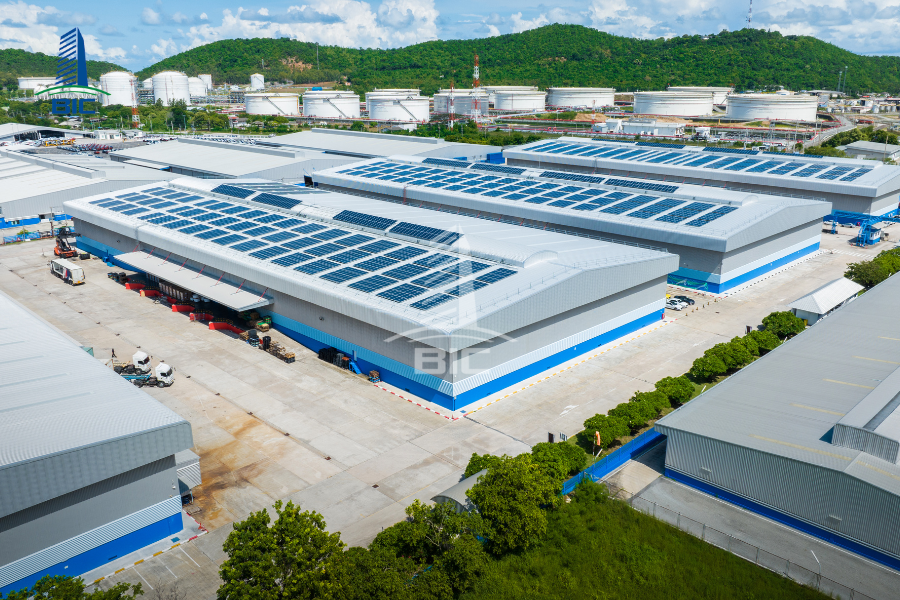
To ensure capital is disbursed effectively, investors need to clearly understand each stage of on-site implementation. The on-site factory construction process is like a precise mechanical assembly line, divided into the following four core stages:
The foundation is the support base for the entire factory, determining the safety and lifespan of the project. For an industrial factory, the foundation bears extremely high pressure from production machinery loads and the continuous movement of forklifts and trucks.
- Site leveling and compaction: The ground is excavated, filled, and compacted to meet the required compaction standard, usually $K \ge 0.95$, to prevent localized settlement.
- Positioning and foundation construction: Depending on the previous factory design documents, the contractor will carry out reinforced concrete pile driving for weak soil conditions, or construct isolated footings or strip foundations.
- Underground systems: This stage must include the installation of underground rainwater drainage systems, wastewater systems, and main electrical cable conduit routes before the foundation is backfilled.
This is the stage that most clearly demonstrates the advantages of pre-engineered steel building solutions. The process is divided into two parallel branches:
- Component fabrication at the factory, or off-site: While the site is undergoing foundation work, engineers at the mechanical workshop already begin cutting and automatically welding columns and rafters from steel plates. After shaping, the steel is shot-blasted to clean the surface, coated with anti-rust primer, and especially covered with fireproof paint that meets the standards required by the fire prevention and fighting approval documents.
- On-site erection: Steel components are transported to the project site. The contractor uses specialized cranes combined with anchor bolts and high-strength bolts to position and connect the load-bearing frame. This process requires absolute precision down to the millimeter to ensure that the frame is not twisted or subjected to incorrect load distribution.
Once the structural frame is stable, the contractor proceeds to “dress” the factory to protect the interior space from weather impacts.
- Roofing and wall cladding: Heat-resistant roofing systems are used, such as three-layer metal roofing, PU-insulated roofing, or panel systems. The key point investors need to supervise here is that roof overlap positions and roofing screw systems must be treated with specialized waterproof sealant to avoid future water leakage that could damage goods.
- Factory floor concrete casting: Factory floors usually use reinforced concrete, with steel mesh or dispersed steel fibers, to withstand heavy loads. After pouring, the concrete floor is finished with hardener powder to increase hardness and abrasion resistance, or coated with epoxy to prevent dust accumulation and resist chemicals in accordance with the original construction design orientation.
No matter how good the structural shell of a factory is, it cannot operate without its technical “circulatory system.” This stage is carried out intensively to prepare the project for handover.
- Power and lighting systems: Installing the transformer station, pulling power cables to the main distribution switchboard and workshop distribution boards, and arranging factory lighting systems that meet illuminance standards for workers.
- Ventilation and air-conditioning system, or HVAC: Installing roof exhaust fans, ventilation louvers, or central air-conditioning systems to ensure air circulation and maintain an ideal temperature for machinery and personnel.
- Fire prevention and fighting system: This is the key component that determines project acceptance. The contractor installs the fire pump assembly, water pipelines, automatic sprinkler heads, and smoke and heat detector systems in accordance with the approved design.
To ensure their rights and effectively control progress, investors should require the contractor to follow a closed and transparent working process through the following five steps:
Step 1: Survey, consultation, and basic design: The general contractor receives the production requirements, conducts geotechnical measurements, and develops a preliminary layout concept for the investor’s approval.
Step 2: Bill of quantities preparation and contract signing: After the architectural solution and materials are agreed upon, the general contractor prepares a detailed cost estimate for each item. Both parties finalize the price and sign the turnkey design and construction contract with clear clauses on schedule penalties and quality commitments.
Step 3: Completion of legal procedures: The general contractor represents the investor in submitting applications for construction permits and fire prevention and fighting design approval to the competent authorities.
Step 4: On-site construction implementation: Foundation work at the site and steel fabrication at the factory are carried out in parallel, followed by erection and completion according to the four core stages mentioned above.
Step 5: Completion acceptance, handover, and warranty: The general contractor coordinates with the investor and competent authorities to carry out fire protection acceptance and project completion acceptance. The keys are handed over so the business can officially put the factory into operation, while the long-term warranty policy is activated.
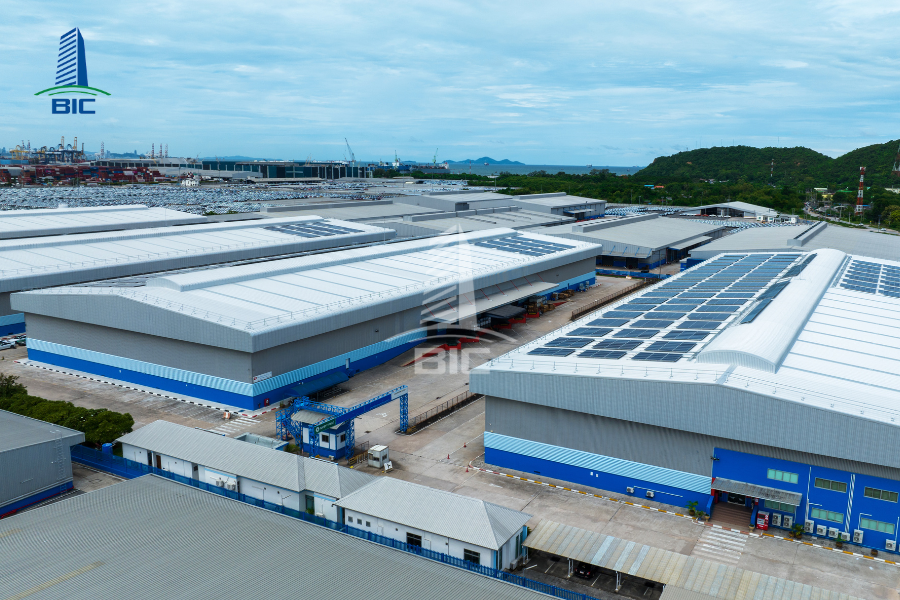
The turnkey Design & Build model is only truly optimal if you find a general contractor with both integrity and capability. Conversely, choosing the wrong unit can turn the turnkey solution into a massive risk trap. To protect their investment capital, business owners should rely on the following three strict filters:
Do not evaluate a company’s capability only through glossy profiles. Ask the contractor to take you to visit similar industrial factory projects that they have previously implemented and that are already in operation. There, you can observe the quality of structural welds, the flatness of the epoxy floor, and how the M&E mechanical and electrical systems are arranged.
In particular, for pre-engineered steel buildings, investors should prioritize companies that own their own steel structure fabrication factories instead of relying on intermediary fabricators. This ensures two factors: the general contractor is 100% proactive in the supply schedule of components, and they can control the input quality of steel billets, avoiding the risk of subcontractors substituting raw material grades.
In a fiercely competitive market, investors are easily swayed by unusually cheap quotations. However, investors should note that material and labor costs always have a general market price level. An unreasonably low price is often a cost trap that can lead to the following two negative scenarios later:
- The contractor continuously finds reasons to “create” additional items outside the contract.
- The contractor quietly cuts materials, lowers the concrete grade, reduces the thickness of metal sheets, or reduces safety standards in the fire prevention and fighting system design.
A professional factory construction quotation dossier must provide a transparent BOQ down to the smallest details: the steel brand used, the thickness of wall cladding, the type of electrical cables, and more. All clauses on progress, disbursement schedule, and penalties for schedule delays must be clearly stated in legally binding documents.
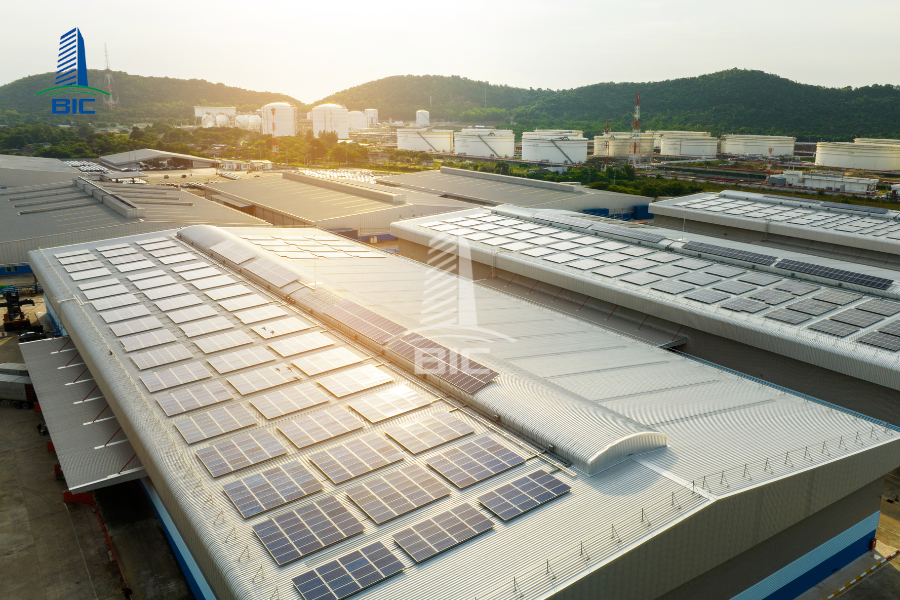
Industrial construction is a field that requires extremely high legal compliance and safety standards. The selected general contractor must have a Construction Activity Capacity Certificate, issued by the Ministry of Construction or the Department of Construction, appropriate to the grade of the project you plan to implement.
In addition, ask the contractor to present safe construction methods and the competency profiles of the site commander and supervising engineers. A construction site that has a labor accident or safety violation will not only cause the project to be suspended indefinitely, but also seriously affect the reputation and operational “feng shui” of your own business.
When facing an investment decision worth tens or hundreds of billions of VND, choosing the turnkey factory construction method is not merely a technical solution, but a strategic management decision. This model helps business owners simplify their management structure, tightly control financial planning, and free up maximum time to focus on core strategies such as market development or supply chain optimization.
The success or failure of a project depends entirely on the capability of the partner accompanying you. Choosing the right general contractor with the ability to comprehensively cover factory design, legal procedures, and on-site completion is the most solid step toward turning ideas on drawings into a safe, productive, and sustainably developing factory.
If your business is planning to expand its production space and needs a solution that optimizes every unit of cost, contact BIC today. Our experienced team of specialists is always ready to conduct site surveys, provide free consultation, and tailor the most complete construction design and turnkey construction solution for your project.