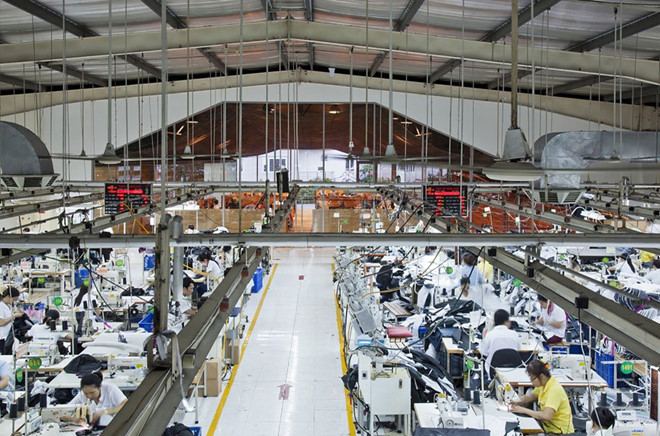
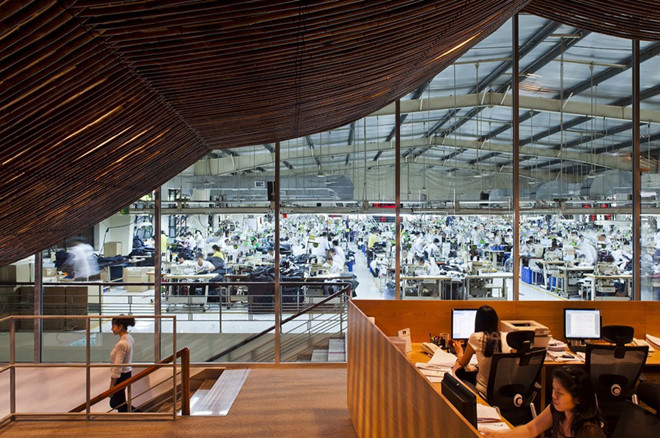
Factory layout design is a way of installing equipment and means of production in a reasonable sewing line or workshop for good production, high productivity and labor safety. In the layout plan of the garment factory, conventional symbols are used to draw and note equipment symbols, occupancy dimensions, and aisle void sizes.
+ The shortest path to semi-finished products, for the fastest product delivery time
+ Takes up less space to save machines and workers
The person who designed the layout of the garment factory clearly understands the size and structure of the factory. The premises are based on technology regulations, the working positions are arranged reasonably, ensuring production organization
The garment factory must be large, airy, full of photos to the convenient transportation route

The production sites are not too far apart. Layout plan of the sewing factory, adding tables for semi-finished products, tables for products, inspection tables ..
Each position is marked and numbered according to the order of the sewing process. There is a notation with the symbol at the bottom of the original drawing with the number of machines and workers.
Layout plan of the sewing factory to design the area for the machine to reserve when changing the new product code
From the drawing of the layout diagram of the garment factory, it is necessary to check carefully before installing equipment and machinery.
Conditions for considering ground layout
Number of workers and employees (male and female)
Machines (size, quantity, weight)
Doors, doors (size, width, position, quantity)
Executive and management office (location)
Warehouse (location, area)
Area of each production location: 4.96 - 6.6 m2
Toilets, changing rooms, canteens, places to store bags…
Canteen: 1 m2/CN .
Changing room: 0.56 m2/CN .
Men's restroom: 1 house for 30 Sun (or less).
Women's restroom: 1 house for 20 Sun (or less)
Calculation of the area of 1 sewing position Type 1:
Calculate position length Dvt.
Dvt = Rm + Rg + k1 + Rt (mm, m)
Dvt = 700 + 350 + 200 + 350 = 1600
Calculate position width Rvt
Rvt = Rm (mm, m )
Rvt = 1200 mm
Calculate the area of the location Svt
Svt = Dvt . Rvt (mm2 ,m2)
Svt = 1.6 . 1.2 = 1.92 m2
Calculation of the area of 1 sewing position Type 2:
Calculate position length Dvt
Dvt = Rm + Rb1 + Rb2 (mm, m)
Dvt = 700 + 600 + 600 = 1900 mm
Calculate position width Rvt
Rvt = Rm + Rb2 + Rb3 (mm, m )
Rvt = 1200 + 300 + 300 = 1800 mm
Calculate the area of the location Svt
Svt = Dvt . Rvt (mm2 ,m2)
Svt = 1.9 . 1.8 = 3.42 m2
Calculation of sewing line area
Calculate the transmission length Dc (mm, m)
Dc = xvtd .Dvt + (xvtd-1) kd + 2.Rb + 2.kb
= (5 . 1.6) + (4 0.6) + (2 .1.5) + (2 .1.5)
= 16.4 m
Calculate the pass width Rc(mm,m)
Rc = xvtn..Rvt + (xvtn -1) kn
= (5 . 1,2) + (4 . 0.6)
= 8.4 m
Calculate the pass area Sc
Sc = Dc . . Rc ( m 2 )
= 16.4 . 8.4
= 137.76 m2
Calculating the area of the garment factory
– Calculate the length of the workshop Dxm (mm, m)
Dxm= xcd .Dc + ( xcd -1 ) k1 + 2 .k2
= (2 . 16.4) + (1 . 2.5) + (2 .1.5)
= 38.3 m
-Calculate the workshop width Rxm(mm,m)
Rxm= xcn .Rc+ ( xcn-1 ) k3+ 2 .k4
= (2 . 8.4) + (1 . 2.5) + (2 . 1.5)
= 22.3 m
Calculate the area of the garment factory Sxm ( m 2 )
Sxm= Dxm . . Rxm ( m 2 )
= 38.3 . 22.3
= 854.09 m2
Production positions, aisles, and gaps are drawn in the same scale (1/50, 1/100 )
Arrange production locations on existing premises or new premises → floor plan
Draw more doors, columns, management positions, toilets, stairs....
Draw more moving arrows for semi-finished products, note the names of the positions (or symbols), the size of the positions, etc.
Determine the length and width of the floor plan
Construction structure in the layout plan of the garment factory
Single-storey houses are the best, multi-storey houses reduce the required area but take up more space for stairs, elevators, corridors, and columns.
High ceiling: 3.5 – 5.5 m
House columns: large and small depending on the number of floors…
Stairs: 2 or more for multi-storey buildings
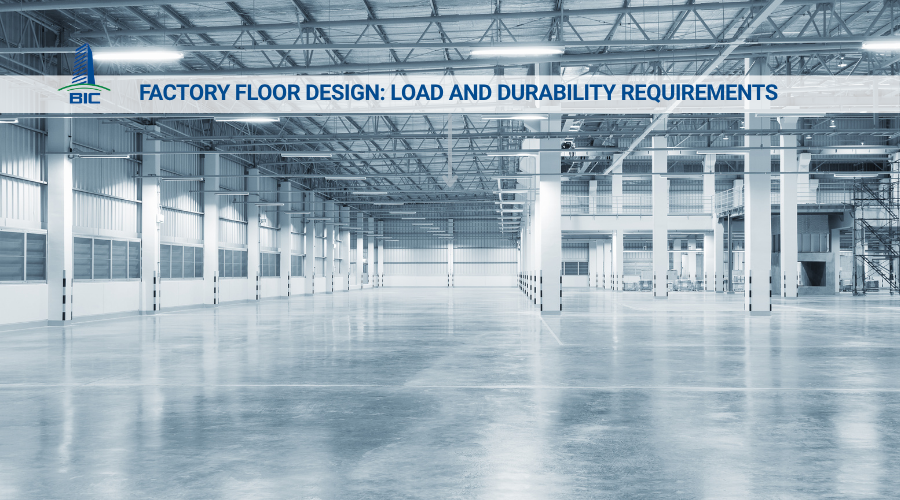
Floor: flat and bear the weight of machinery
Light: the widest window in the style of 2-3 floors
Path: the straighter the better
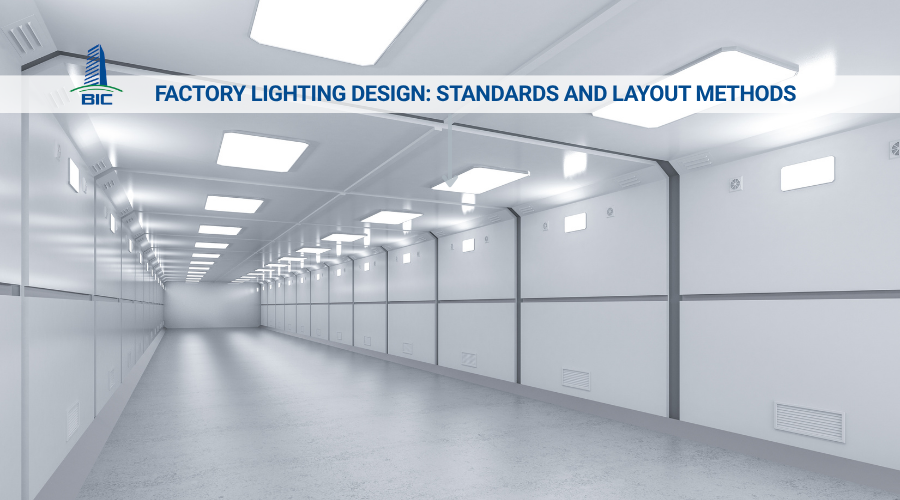
Illumination level: ironing intensity 200 lux, cutting 300 lux, sewing 200 - 1000 lux, testing 2000 lux. 1 tube lamp 40 w illuminating 3.3 m2
Ventilation: by air conditioners or blowers, exhaust fans
Important Note
In our country, the design of the premises of the sewing factory and sewing line is often ignored, but often keeps the installation of equipment from the beginning. The movement of goods carried by workers from one location to another, the installation of equipment out of order in the process, does not affect the production line much In advanced countries, the transportation is automated By conveyor, the installation of equipment needs to follow the process, especially the vertical line
Sewing machine with 1 needle, 2 needles, threaded, buttoned..: 1200mm x 600mm
Overlock machine, buttonhole, ironing board…: 1200mm x 700mm
Tables for semi-finished products, tables for cutting threads and products, tables for checking the beginning and end of the line:3200mm x 1500mm
Containers for semi-finished products on site, seat size (long bench) 1000mm x 350mm
Table for semi-finished products at position 600 mm x 600 mm
JFS large glue press: 3330 mm x 1300 mm
Small press: 1200 mm x 1200 mm
Heat press neck rolling machine: 1200 mm x 600 mm
Automatic bag dissection machine: 1500 mm x 1100 mm
Self-floating table: table width 1000 mm. * Size of aisle, distance of machines, lines
Path between workshop: 2500 mm
The path at both ends and on both sides passes 1500 mm
The path between two rows of machines in the line is 600 – 800 mm
Distance from wall to machine is 2300 mm
Dimensions of workplaces:
Workshop foreman and employees 5000mm x 2500 mm = 12.5 m2
Product room after sewing 4000mm x 2500 mm = 10 m2
Dimensions in suspension:
– Standard distance between production sites: 1500 mm
– The mount moves clockwise
Miniature drawing (Japanese style)
Sewing machine has a scale of 1/50 in the drawing
BIC is a company specializing in the design and construction of high-quality factories, pre-engineered steel buildings, industrial warehouses. In addition, BIC also designs and constructs office buildings, participates in surveying, testing,...
BIC has participated in many construction projects across the country. We have a lot of experience in building large-scale projects of famous investors from countries around the world such as Japan, Korean, Taiwan, America (USA), Singapore,...
BIC's reputation has been strengthened more and more as we are known more for its professional attitude, seriousness, integrity and honesty in business. BIC is now a trusted brand name for well-known investors in the Vietnamese market.
Benefits of Customer:
We have been implementing large-scale factory projects from 70,000 square meters to more than 200,000 square meters of foreign enterprises investing in Vietnam such as: Korean, Japan, Taiwan, .... We more and more efforts to become one of the leading brands in terms of prestige, project implementation capacity in Vietnam, reaching out to markets in countries in Southeast Asia and the World.
BIC is committed to providing customers with the best building service, office building, high-rise apartment building. By the enthusiasm and unrelenting efforts of all officials and employees. Especially, we have conquered many big projects and gained the confidence and satisfaction of the "Big Men" in the world who came to Vietnam to invest in the construction.
BIC is very pleased to serve you with the spirit: "COOPERATE TO DEVELOP TOGETHER"
BIC CONSTRUCTION ARCHITECTURAL JOINT STOCK COMPANY
Ho Chi Minh Branch: 7th Floor, Gia Dinh group, 566 National Highway 13, P.Hiep Binh Phuoc, Thu Duc District, Ho Chi Minh City
☎️ Hotline: 0901.815.069
Mail marketing: marketing@bicons.vn
Hanoi Branch: 4th Floor, HUD3 Tower, No. 121-123 Pho To Hieu, Ha Dong District - Hanoi.
☎️ Hotline: 0243.91.92.789
Mail: bic@bicons.vn - Fax: (028) 38 800 892
Mail marketing: marketing@bicons.vn
Website: bicons.vn - bicjsc.com