Bolt connection in steel structure is an indispensable component used to connect components into block system, truss frame. Bolts use the principle of friction between the threaded rings of the bolt and the nut to clamp the details together.
The bolt body is a circular section of steel with a diameter denoted d and with dimensions from 12: 48 mm. Bolts used for connection in thepps structure are about d= 20:30mm. Special case with anchor bolts bolt body diameter can be up to 100mm.
The inside diameter of the threaded part is denoted by (do=0.85đ)
DIN 931 mezzanine thread turning bolt The length of the threaded part denoted lo lo is equivalent to 2.5d. The length of the non-threaded part must be less than 2:3mm less than the thickness of the steel plate when installing the through bolt connection.
DIN 933 threaded bolt the length of the main thread is the bolt length, denoted I, with sizes from 35:300mm
Bolt caps are used hexagonal with beveled bases
The diameter of the bolt head's circumscribed circle is denoted by D (D = 1.7d).
The thickness of the bolt head is denoted by h and h = 0.6d .
The diameter of the inscribed circle of the bolt head is denoted by S, usually an even number: S = 12,14,16,18..
Nuts are usually hexagonal with holes drilled and thread-like threads of the body have the same pitch. Thickness of nut h>= 0.6d
The washer has a circular shape to distribute the pressure of the nut over the face of the base steel structure. Dimensions lo, do, D and h are all specified according to the bolt body diameter d, the larger d is, the larger the dimensions are required.
tho bolt, normal bolt
This type of bolt is manufactured from Carbon by forging and beating. The accuracy is low, so the bolt body diameter must be made smaller than the wood diameter 2:3mm. Holes of this type of bolt are made by ddoouctj or drill each plate separately. Punching when the hole surface is not flat, the steel around the 2:3mm hole is brittle because of cold hardening. Due to the low accuracy, when joining the set of steel plates, the holes are not completely centered, the bolts cannot make close contact with the hole wall.

Bolts are usually cheap, quick to manufacture and easy to put into holes, but are not of high quality. There is a lot of variation. Should not be used in important works. They should only be used in truss bearing or to position components when assembled.
Fine bolts are bolts made from low-alloy steel carbon steel by high-precision turning. The hole diameter is not more than the bolt diameter not more than 0.3mm. All parts must be machined. There are two types of fine bolts that are usually installed in holes with a gap and those that are installed in a hole without a gap, the second type has a diameter of the threaded part smaller than the diameter of the non-threaded part.
The gap between the body and the small bolt hole is tightly connected and the initial deformation of the small link is high, the bearing capacity is high.
Made from alloy steel then heat treated to achieve the required tightening and pulling force. High-strength bolts are made of high-tensile steel, so the nut can be tightened very tightly, causing the bolt body to be in tension and exerting great pressure on the connecting steel plate.
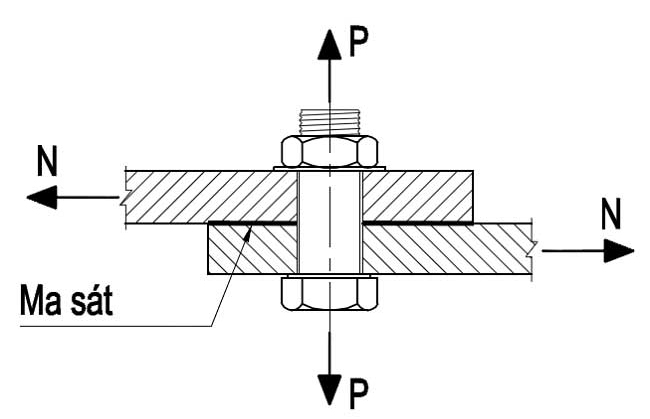
Bearing forces between the contact surfaces of the steel plates have a large frictional force against the relative sliding between them. The force transmitted from one member to another is mainly due to frictional force.
High-strength bolts have large bearing capacity and low deformation connection, so they are widely used and substituted for riveted connections in structures subject to heavy loads and dynamic loads.
After fabrication, they are heat processed, so they have high strength. Create a large pulling force in the bolt body to squeeze the steel plates, creating frictional force with high bearing capacity.
Shear link
The shear resistance (transmission of shear) of a bolted connection is formed through the friction between the connecting plates due to the force of the bolt. In the shear connection, the force is perpendicular to the bolt body, the bolt body is cut and the hole plate is pressed.
Advantages of shear bonding:
Simple shear link
Easy to build
Strong endurance
Cons: easy to slip due to the hole bigger than the bolt body.
With the shear connection type, the high strength bolt tightening force does not need to be too tight, too strong, just using the torque generated from the standard Cle is enough.
Non-slip link
Bearing forces perpendicular to the bolts, but the bolts are tightened very tightly to cause friction between the steel plates, preventing sliding. This link is used for structures that do not allow sliding such as bridges, crane girders, connections. structure subjected to dynamic loads… High strength bolts in this connection must be tightened to the specified design tension.
Tensile bolt connection
In a connection where the force is in the direction of the bolt, the bolt is in tension (for example, a flange connection, a beam connection of a house frame). The TCVN standard does not require how to tighten the tension bolt, but the standards of the countries (USA, Europe, Australia…) all require the bolt to be tightened to a force greater than the force it will withstand when working under load. , so that the flanges do not separate.
How to arrange bolts in steel structure
Bolts should not be arranged too close, the connecting steel plate is easily torn and destroyed due to face pressure.
The arrangement of bolts with a distance too long consumes loose bonding materials, which easily rusts the steel plate between the two bolts, and does not ensure stability when under compression.


The smallest layout distance to save materials, compact links, but still ensure enough bearing
Arrangement of bolts for section steel
The positions of bolts are specified according to the size of each type of steel section. For angle steel
+ When the width is less than 100 mm: arrange 1 row of bolts
+ When the width is from b>100 mm: arrange 2 rows of bolts