Industrial factory construction is a chain of interconnected technical processes, including multiple sequential stages from legal preparation, foundation treatment, and steel structure fabrication to MEP system completion. Any interruption or delay in a single work item will immediately create a chain reaction, extend the completion time of the entire project, and cause uncontrolled investment cost overruns.
Delays not only force investors to bear additional management costs and bank loan interest, but also cause lost business opportunities when the factory is put into operation later than planned. Thorough preparation of a synchronized construction design dossier from the beginning, combined with the management capability of a reputable general construction contractor, is the key solution to controlling schedule milestones, protecting cash flow, and ensuring the project reaches completion safely and on time.
The industrial factory construction process requires absolute accuracy in timing because work items are closely linked to one another. A schedule breakdown at any link can lead to heavy financial losses and disrupt the company’s entire operating plan.
When factory construction time is extended, the costs of maintaining the construction site increase rapidly. Investors must bear additional costs for the project management team, security, industrial electricity and water, as well as rental fees for machinery and construction equipment waiting on-site.
In addition, schedule delays significantly increase financial pressure from bank loans. Loan interest incurred while the building has not yet entered operation and is not generating revenue directly erodes working capital and reduces the project’s return on investment.
Putting the factory into operation later than planned causes the business to miss the golden timing for entering the market or expanding supply capacity. Disruption in the factory construction schedule breaks the production plan, causing the company to be unable to deliver goods as committed to partners.
As a result, the business may face costly penalties for commercial contract violations and may even risk losing long-term strategic orders.
Industrial technology equipment and production lines are often ordered from overseas suppliers according to the completion schedule of the factory floor. When the project is delayed, imported machinery may arrive at the port but cannot be moved into the factory, resulting in extremely costly storage and yard fees.
At the same time, the schedule of foreign technical experts coming to install and transfer technology is completely disrupted, forcing investors to pay additional extension consulting fees and accommodation expenses.
A prolonged factory construction project not only reduces the company’s credibility with financial institutions and investment funds, but also negatively affects its brand reputation in the market.
In addition, when the investor has already recruited workers and factory management personnel in advance but the building is not ready for handover, personnel fall into a waiting state. This not only wastes monthly salary budgets, but can also lead to the loss of high-quality human resources.
An industrial project goes through many sequential stages. Accurately identifying potential bottlenecks helps investors proactively develop risk prevention plans.
Legal procedures are the first link and can easily delay the entire project if they are not carefully prepared. Delays often occur during the preparation of the environmental impact assessment report and fire protection design approval with competent authorities.
The core cause comes from the initial factory design dossier not closely following required technical standards, lacking synchronization between architecture and fire safety solutions, forcing the investor to revise and resubmit the dossier multiple times.

Underground construction is the stage containing the most complex variables on-site. Incomplete geotechnical survey results or complicated ground conditions with multiple weak soil layers or underground cavities can make the initial foundation solution unsuitable.
Stopping the site to adjust construction design drawings, change the type of driven piles, or add foundation treatment solutions consumes significant time and delays the transition to superstructure construction.
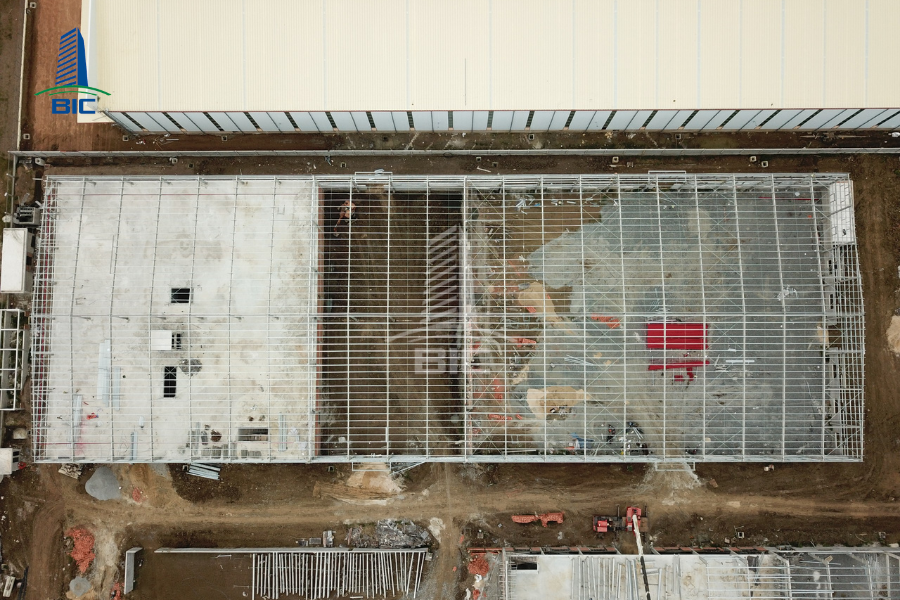
The steel structure is the skeleton that determines the form and progress of an industrial factory. Factory construction progress at this stage can be affected by shortages of imported steel materials or delays in component fabrication at the workshop.
In addition, adverse weather conditions such as prolonged storms directly obstruct the safe lifting and erection of steel frames on-site.
MEP and fire prevention and fighting systems act as the nervous system of the building. Delays during the finishing stage often originate from spatial conflicts among water supply and drainage pipelines, ventilation ducts, electrical cable trays, and fire sprinklers.
When specialized construction design drawings are not coordinated from the beginning, overlaps occur, forcing workers to dismantle and adjust multiple times. Finally, the on-site inspection and issuance of the fire protection acceptance record will be prolonged if actual construction does not match the approved dossier.
To ensure the project is completed on time, investors need to apply proactive and scientific schedule management solutions from the beginning of the project.
An accurate factory design dossier with complete technical details is a prerequisite for continuous construction. Standardizing architectural, structural, and MEP solutions from the earliest stage helps minimize mid-project design changes.
Synchronized calculation among technical work items helps construction teams implement work smoothly and eliminates obstacles arising on-site.

Investors should require the construction unit to prepare a detailed schedule diagram that clearly identifies work sequences on the Critical Path Method, or CPM. These are the work items that must be completed on time because any delay in them will delay the entire project.
A flexible overlapping schedule helps optimize the use of labor, machinery, and materials, ensuring that work items are implemented in parallel effectively.
Building Information Modeling, or BIM, is an advanced technology solution that simulates the entire building in a three-dimensional space. With BIM, the consulting and construction teams can detect and thoroughly resolve technical clashes between structural and MEP systems on the computer before implementation on-site.
In addition, applying project management software helps investors monitor progress in real time and promptly introduce adjustment plans when delay risks appear.
Choosing a general construction contractor with sufficient technical capability and management experience is a decisive step in ensuring project schedule success.
When applying the turnkey Design and Build model, the general construction contractor takes full responsibility from preparing factory design drawings to directly organizing construction. This model completely eliminates responsibility shifting or waiting time for agreement between the design consultant and construction unit.
All technical issues arising on-site are handled quickly within the general contractor’s internal team, helping maximize implementation time savings.

A reputable general construction contractor always has a stable material supply chain and a network of strategic suppliers, ensuring that concrete, steel structures, and MEP equipment are delivered to the site on schedule.
In addition, the general contractor can flexibly mobilize skilled labor and specialized machinery, and is ready to organize overtime work or divide the site into parallel work zones to recover progress in case of adverse weather.
The general construction contractor’s commitment is clearly reflected in turnkey contract terms with specific schedule milestones. Transparent delay penalty mechanisms and compensation obligations are clearly defined to increase the contractor’s responsibility.
This creates a strong legal basis to protect the investor’s financial interests, ensuring the building is handed over as committed and ready for commercial operation.
Strict control of the factory construction schedule is a decisive factor in protecting investment cash flow, optimizing costs, and realizing business opportunities. Accurately identifying technical bottlenecks from permitting and foundation treatment to fire protection acceptance helps investors remain proactive in risk management.
Serious investment in preparing a synchronized construction design dossier from the beginning and choosing to work with an experienced general construction contractor are strategic solutions that help the building be completed on time, ensure quality, and be ready for efficient operation. Contact BIC for factory construction solution consulting.