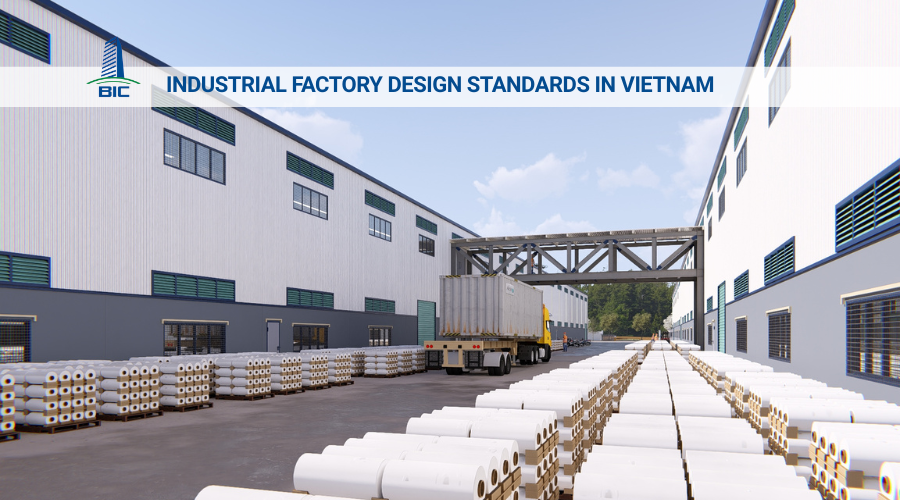
BIC updates in detail the necessary factory design standards for investors who are planning to invest in building industrial factories in Vietnam in 2023.
At the present time, the legal basis for regulations on factory construction standards to ensure the construction and put the factory into operation is regulated through documents that clearly define design standards for the factories. Investors, design contractors and construction contractors must strictly comply with: Vietnam Construction Regulations according to Decision No. 682/BXD-CSXD dated December 14, 1996 of the Minister of Construction, approved by the Minister of Construction.
In addition, the standard is also based on Vietnam's construction standards under Decision No. 439/QD-BXD dated September 25, 1997 of the Ministry of Construction.

Strict control of the design standards of the foundation and the foundation of the workshop will require the drawing of the foundation structure according to the provisions of TCVN 2737:1995 to ensure the requirements of the impact load technology and the geological conditions of the construction site. construction, geology.
The design of the factory floor on soft ground must have fixed cost measures adapted to the construction site
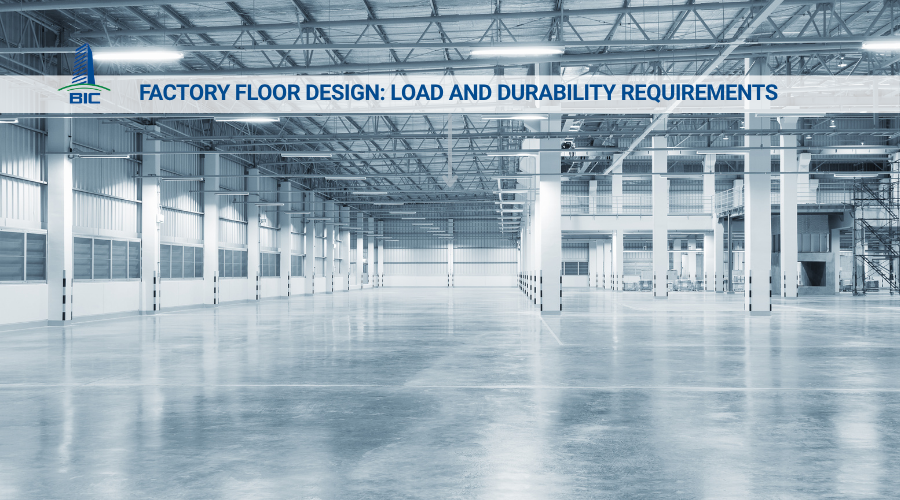
The design of the factory floor ensures that according to the technology requirements and the conditions of use, to choose the appropriate foundation structures according to the type of the factory floor.

For factory floors made of concrete: concrete or reinforced concrete, concrete with steel billets to withstand impact, resistant to acid and alkali corrosion, asphalt concrete. The factory floor is made of steel, the floor of the factory is tiled with cement tiles, the floor of the factory is paved with plastic wood planks...
The design of the workshop floor for the warehouse and yard areas where the viaduct is used for loading and unloading bulk materials must be flat.
The factory floor surface must have a hard lining and a fast drainage system to avoid water stagnation on the floor
The concrete workshop floor must be divided into each cell and the length of each dimension of a dark cell is 0.6m, between the circuits of the foundation cells must be inserted with bitumen. Concrete lining has a minimum thickness of more than 0.1m and the width of the pavement is required from 0.2m to 0.8m and the slope is 1-3%
Standards on design drawings of workshop foundations and underground technical systems must be consistent with the physical and mechanical properties of the ground. Foundation standards when designing foundation drawings must comply with regulations. The design of the foundation has a lower elevation of the foundation surface than the ground surface with the difference: for reinforced columns, the difference is 0.2m. For columns with wall insert frames, the difference is 0.5m. For reinforced concrete columns, the difference is 0.15m
The height of the reinforced base of the viaduct corridor supporting the pipes between the workshops must be at least 0.2m higher than the leveling height. The design of the column foundation with expansion joints and the workshops with the expected expansion needs to be designed for two adjacent columns.

The factory foundation under the brick wall, if it is a frameless house, the foundation depth is less than or equal to 15cm. The design of the wall support beams and the top surface of the beams should be at least 3cm lower than the ground level when finished
The design of the foundation in the part subjected to high temperature impact must use a protective layer of heat-resistant material, the foundation subject to corrosion must have a design of anti-corrosion material.
Slope standards are carefully calculated according to the material depending on the choice of roofing material.
The factory uses asbestos-cement roofing sheets with a slope of 30% - 40%
Standard slope of corrugated iron roof with corrugated iron roof slope from 15%-20%
Factory designed with slope roof from 50% - 60%
Industrial factory design reinforced concrete roof with slope from 5% - 8%
If the roof slope of the factory is below 8%, it is mandatory to arrange a heat gap in the waterproof concrete layer and the distance between the heat joints should be greater than 24m.

The design of roof drainage depends on the roofing material and technology requirements that will design the roof of the factory inside or outside.
Workshops with roof doors or roofs with two roof deviations greater than or equal to 2.4m must have water troughs and drains. In case the deviation of the two roofs is less than 2.4m, it is not necessary to make the beam, but there must be a reinforced construction method.
The design of a mixed-use factory with lighting and ventilation functions must be designed with vertical glazing and only tilted when there is an argument. The length of the roof should be greater than 84m and should be set back and 1 step away from the gable column. The roof door must have a device that gives off steam or heat, if any, it must not be a roof door.
Factory design in case of specializing in producing heat and moisture, requiring ventilation, rainproof roof without glazing, but only leaving a gap with a clearance height of 0.15m - 0.3m.
The base to prevent rain from falling into the inside is not more than 15 degrees for a rain-resistant factory. The space for the male layout of the southern slope to prevent rain from hitting the roof of the upper roof can be increased to 45 degrees. The shutters are not made of fragile materials.
The roof door requires fixed glazing, the lower part has the roof, and the glass thickness is greater than or equal to 3mm. If the construction drawing has a crane, the roof door must be installed under the glass guard with a minimum net width of 0.7m, the glass is installed vertically and equal to the projection of the door frame when the door frame is tilted or horizontal. If the reinforced glass does not need a protective mesh
Factory design, choosing the type of roof, factory drawing, serrated M-shaped dome... will depend on technology and workshop orientation.
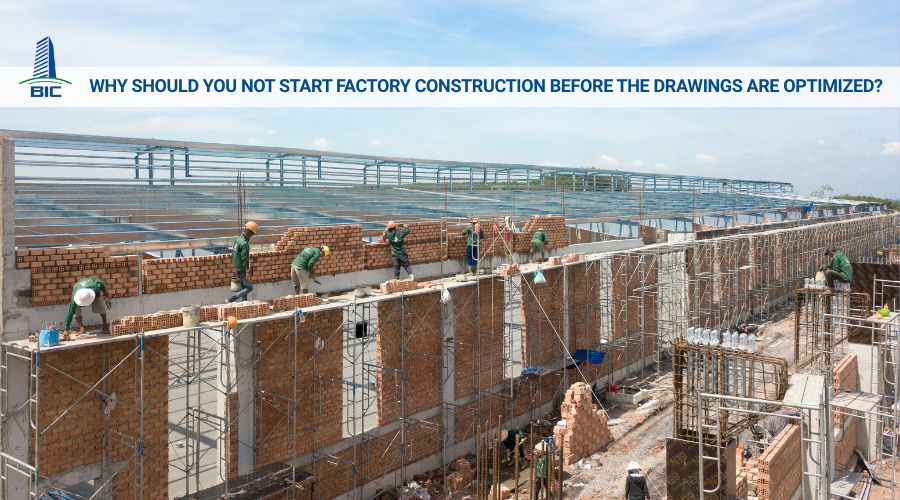
This item depends on the characteristics of the scale of use to choose suitable factory walls, load-bearing walls, self-loading walls, frame insert walls, ... Besides brick, natural stone materials, reinforced concrete slabs. The skirting design should be brick or concrete and be at least 3cm above the top when finished

The base of the brick wall has a moisture-proof layer of rain-waterproofing with 20cm-thick grade 75 cement mortar placed horizontally on the floor when finished. Workshop walls should be designed to be easily disassembled. The design of the factory wall has a maximum span of 12m and a large column height of 6m .
It is necessary to ensure the maximum door height of 2.4m from the product and must be able to open and close. Window height greater than 2.4m must be fixed into a fixed frame to prevent storms and it is necessary to install a door with a firm clamp and mechanical opening and closing.
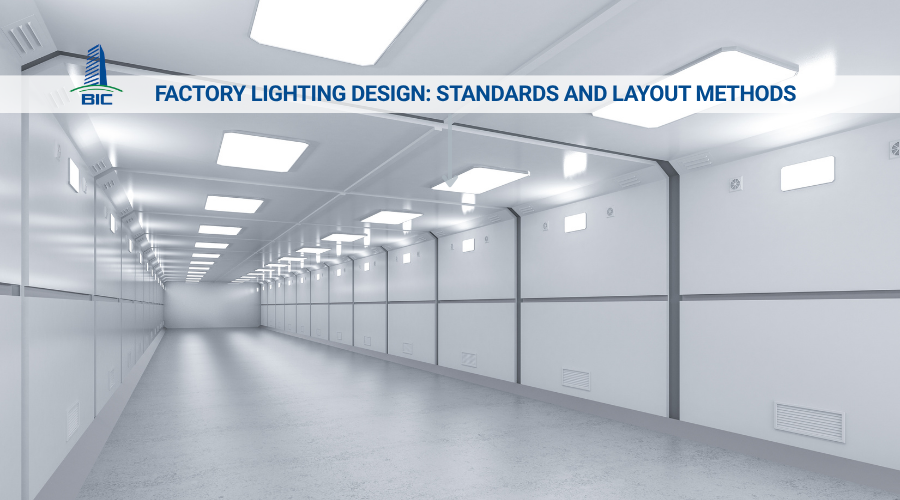
Electrical standards require design drawings of lighting and power systems to meet reasonable demands. Drawings of lights, drawings of electrical outlets, drawings of internet layouts, drawings of cable television and telephones, detailed layout diagrams of smart electricity
Standard against external weather impact
In addition to the above standards, investors also pay attention to space feng shui and location selection.