sA common mindset among many investors when starting a project is the desire to shorten the design phase as much as possible. They often aim to save on initial consulting fees and allocate the majority of their budget toward purchasing steel, cement, and other construction materials while accelerating site preparation and foundation work. However, the implementation of thousands of projects has consistently proven a completely different financial reality.
Fluctuations in material prices or labor costs are not the primary reasons projects exceed their budgets. The leading cause of budget overruns almost always originates from incomplete, fragmented, and impractical design drawings. What may seem like minor mistakes on paper often become the direct source of demolition, rework, and construction errors on site, resulting in enormous financial losses.
To protect investment capital, businesses need to reconsider the role of design drawings from a risk management perspective. Investing time, expertise, and financial resources in the design phase is not an expense, it is a strategic investment.
In this article, BIC will analyze the practical reasons why a well-prepared design package is one of the most effective tools for controlling budgets and minimizing construction costs in industrial factory projects.
To manage project finances effectively, investors must first change the way they view technical drawings. A professional design package provides far more value than a collection of geometric sketches; in essence, it is a financial planning system presented in visual form.
Many businesses still view factory design drawings merely as a mandatory administrative requirement for obtaining construction permits. This misconception often leads them to select consultants based solely on the lowest quotation, regardless of experience or practical expertise.
Applying a copied design to a site with different geological conditions or unique production requirements is similar to wearing a suit that does not fit. Such an unsuitable starting point creates significant financial risks later in the project.
Practical experience in industrial design and construction demonstrates that all critical decisions regarding material selection, foundation capacity, structural load-bearing capability, and steel component specifications are determined during the design stage.
Once management approves the design package, more than 80% of the total investment cost of an industrial factory project has effectively been established.
A fundamental principle must be acknowledged: modifying a structural solution on an engineer’s computer costs virtually nothing. However, correcting an error that requires cutting steel beams or demolishing concrete structures on-site can increase construction expenses by dozens or even hundreds of times.
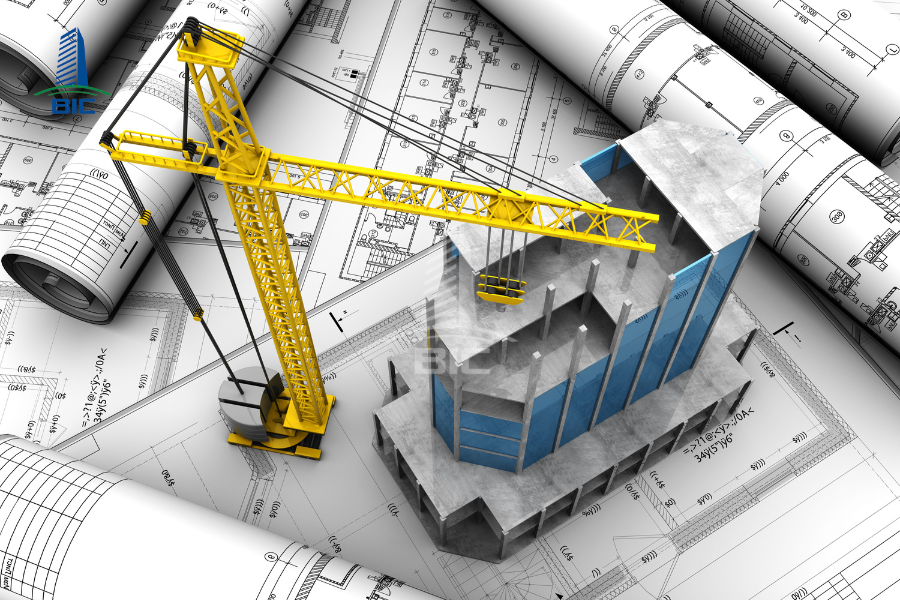
Steel and concrete account for the largest share of expenses in industrial construction projects. Therefore, reducing construction costs without compromising structural integrity depends heavily on optimizing the structural design from the outset.
Many people assume that larger columns, heavier steel sections, and thicker concrete automatically make a building safer. In professional construction, however, a skilled structural engineer is not someone who simply makes a building stand at all costs. Instead, they design a structure that achieves maximum strength with the minimum amount of material.
Overusing steel due to poor calculations or excessive caution by inexperienced designers significantly increases the building's dead load. As a result, investors may spend hundreds of millions—or even billions—of additional Vietnamese Dong on unnecessary steel quantities that provide little practical value.
An intelligent factory design calculates column spacing and roof geometry with precision. A well-designed structural grid not only creates open floor space for forklift movement and production operations but also reduces stress on primary structural members. As overall steel consumption decreases, structural construction costs are reduced proportionally.
A high-quality design package always includes intelligent material specifications tailored to the factory's operational requirements and local site conditions.
Compared to traditional reinforced concrete systems, pre-engineered steel structures offer superior economic efficiency. Steel components are manufactured in factories according to standardized modules and delivered to the site ready for assembly, significantly accelerating construction progress.
Pre-engineered steel structures are considerably lighter than reinforced concrete systems. This reduced structural weight decreases the load transferred to the soil, allowing engineers to optimize foundation systems by reducing pile depths or using strip foundations and isolated footings where geological conditions permit. Such strategic decisions made during the design stage can save investors substantial foundation construction costs.
The use of thermal-insulated roofing sheets and insulated wall panels instead of conventional masonry walls not only reduces building weight but also lowers labor costs. This demonstrates how modern design-build approaches focus on optimizing both short-term and long-term project expenses.
One of the greatest nightmares for investors during construction is the conflict between technical systems.
When architectural drawings and MEP (Mechanical, Electrical, and Plumbing) drawings are not properly coordinated, the cost of resolving conflicts can be significant.
This issue frequently occurs in projects where design documents are developed separately.
Examples include HVAC ducts passing through structural beams or rainwater drainage pipes conflicting with electrical cable trays.
When construction teams discover these conflicts on site, work must stop for redesign, or worse, newly completed concrete elements must be demolished to accommodate technical systems. This not only generates material waste but also results in substantial labor losses.
A high-quality design package with close collaboration between architects and MEP engineers effectively eliminates these risks. Today, 3D modeling technologies enable engineers to visualize the entire factory before construction begins. Potential clashes between fire protection systems, ventilation systems, drainage systems, and structural components can be identified and resolved digitally before reaching the construction site.
The placement of transformer stations, compressor rooms, and fire-water tanks requires careful consideration to balance safety and operational efficiency. An optimized layout can eliminate hundreds of meters of medium-voltage cables and large-diameter industrial piping. Considering the high cost of industrial electrical cables and specialized piping systems, reducing routing distances is one of the most direct ways to control construction costs.
In industrial investment, time is directly linked to money. Construction delays increase management expenses, equipment rental costs, site overheads, and exposure to material price fluctuations. A clear and detailed technical package serves as the foundation for efficient project execution.
A poor factory design package often contains only basic elevations and sections. As a result, site teams must constantly interpret missing details or wait for clarifications from consultants.
A high-quality design package includes detailed welding specifications, bolt spacing, column anchoring methods, and waterproofing solutions. When technical information is clearly defined, construction crews can work continuously without interruption.
Clear drawings enable project managers to coordinate material deliveries, labor resources, and lifting equipment efficiently. This eliminates situations where machinery waits for materials or materials wait for installation teams, ultimately improving cost control throughout construction.
Many projects experience costly delays due to non-compliance with government regulations.
Design documents prepared by experienced engineering teams strictly follow regulations regarding fire safety distances, emergency exits, and environmental protection requirements for industrial facilities.
Compliance with legal standards allows businesses to pass inspections and obtain completion approvals more efficiently. Earlier operational startup enables factories to generate revenue sooner, accelerate capital recovery, and eliminate financial losses caused by delayed production schedules.

To successfully transform design intentions into physical reality, project delivery methodology plays a critical role. Information gaps between design and construction phases often create major challenges for project owners.
When project owners separate design and construction contracts, disputes frequently arise regarding design errors or quantity discrepancies. Contractors may argue that the design is impractical, while designers may claim the contractor lacks execution capability. Ultimately, the investor bears the financial consequences. The Design & Build model was developed to eliminate these issues.
When a single organization is responsible for the entire project lifecycle—from conceptual design to final completion—architects and construction engineers collaborate from the beginning. Construction methods, structural feasibility, and material procurement strategies are integrated into the design package, ensuring practical implementation in the field.
An experienced Design & Build contractor with strong quantity surveying capabilities can confidently offer a fixed-price contract for the entire project.
Any quantity shortages or technical discrepancies become the contractor’s responsibility. Investors are protected from unreasonable variation orders and can maintain full control over their financial plans.
With a single point of responsibility, management teams spend less time coordinating multiple parties and can concentrate on commercial activities, market development, and production preparation. Paying for professional expertise during the design phase is not an expense, it is one of the highest-return investments in any construction project.
A quality design package does far more than define the appearance of a factory. It serves as a powerful financial safeguard, helping businesses eliminate hidden waste and maintain strict control over construction costs from the very beginning.
Rather than saving a small amount on design fees only to face costly delays, change orders, and site rework later, smart investors should seek experienced design-build partners from the outset. The thorough preparation invested in design today becomes the strongest foundation for the long-term success, safety, and profitability of the entire facility in the future.