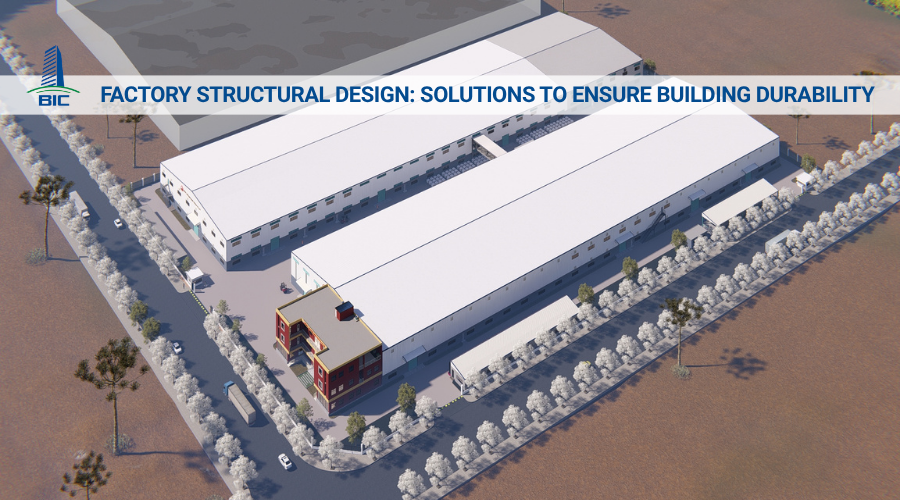
The load-bearing frame and foundation system can be considered the backbone that directly determines the lifespan, operational safety, and sustainable commercial value of an industrial factory. In large-scale construction, even a small deviation in internal force distribution calculations or an incorrect assessment of subgrade compaction can lead to serious consequences such as beam and slab cracking, steel frame deformation, or settlement of the entire building. Therefore, properly investing in factory structural design right from the technical documentation stage is the core solution for investors to optimize steel billet quantities, ensure the building can withstand unfavorable load combinations, and reduce long-term repair costs.
To protect capital and tightly control the budget, business owners need to clearly understand critical structural components and the load verification process according to current technical standards. In this article, BIC provides an in-depth analysis of the strategic role of rough construction design, breaks down the mandatory load groups that must be calculated, including dead loads, live loads, wind loads, and dynamic loads, and explains how to synchronize design and construction documents with on-site implementation methods. This practical information will help investors improve supervision capability, proactively coordinate with general contractors, and ensure that factory construction quality achieves maximum durability.
The rough construction technical dossier is the backbone that determines the geometric stability and long-term operational capacity of the entire industrial construction project. An accurate factory structural design solution not only protects the safety of people and machinery inside the building, but also delivers direct economic benefits to the business by optimizing initial investment capital.
The industrial production environment continuously subjects the building frame and foundation to high-intensity loads:
- Resisting unfavorable load combinations: The structural system must be calculated to simultaneously withstand fixed dead loads from the self-weight of steel components and roof cladding systems, combined with variable live loads such as maintenance personnel walking on the roof, as well as maximum wind pressure and suction forces caused by storms in each geographical region.
- Eliminating vibration from dynamic loads: In zones where stamping machines, compressors with strong vibration, or high-frequency movement routes of heavy-load forklifts are located, the foundation and floor structure must be capable of distributing internal forces evenly. This prevents the building from deforming, sagging, or cracking in load-bearing beams and slabs, ensuring the production line always operates in an absolutely safe condition.
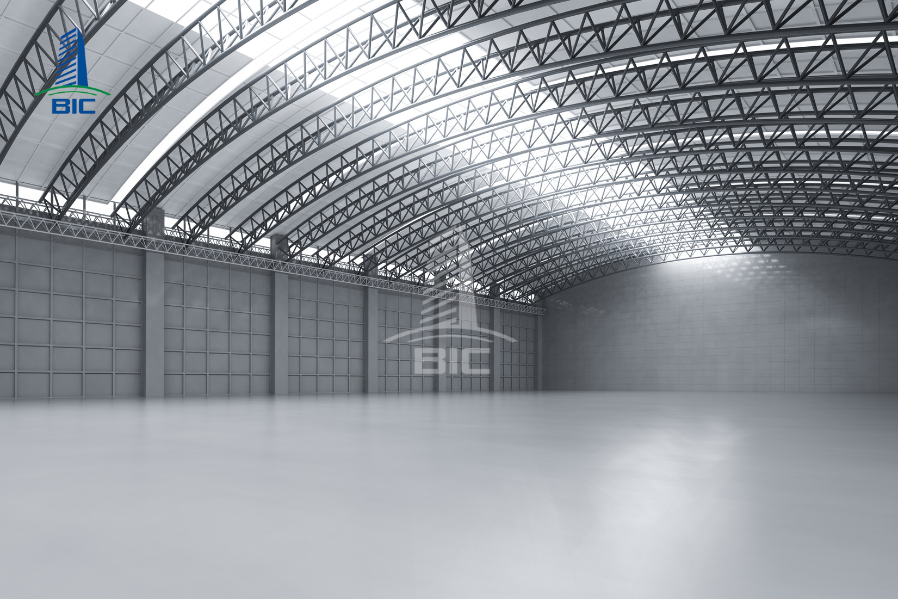
In the total investment structure of an industrial factory, the cost of structural steel billets and rough concrete always accounts for the largest proportion, from 40% to 60% of construction value:
- Eliminating overdesigned steel quantities: Professional structural engineers use modern simulation calculation solutions to optimize component sections. Designing tapered components and reducing base plate thickness in areas subjected to lower bending moments helps completely eliminate steel wastage, saving investors hundreds of millions to billions of VND in material costs.
- Preventing underdesigned load-bearing capacity risks: Conversely, reducing material quantities without a technical basis in order to chase extremely low unit prices will weaken the building’s load-bearing safety factor. A qualified structural dossier provides the perfect balance between economy and engineering, ensuring long-term durability without wasting investment capital.
The ultimate purpose of factory architectural and construction design is to serve the operational functions of a manufacturing business:
- Advantages of pre-engineered steel frame structures: Factory design using steel structures allows outstanding large-span capability, from 30m to more than 60m, without the need for intermediate column rows inside the factory.
- Maximizing usable area: A fully freed-up clear space allows business owners to easily arrange long conveyor networks, plan warehouse zones scientifically, or change the production technology layout at any time without being obstructed by traditional concrete column systems. This flexibility helps businesses optimize productivity and prepare for future expansion plans without demolishing or modifying the main load-bearing structure.
A complete factory structural system is a close connection between the foundation, the main load-bearing frame, and auxiliary spatial bracing systems. The stability of the entire building depends on the design quality of each of these structural components.
The foundation is the component that receives the entire load of the building and transfers it directly to the soil:
- Foundation solution based on geotechnical conditions: Based on surveying data, engineers will specify the appropriate foundation solution. For good soil with high bearing capacity, shallow foundations such as isolated footings or strip foundations are prioritized to save costs. For weak and settlement-prone soil such as riverside areas or muddy ground, deep foundation solutions using driven reinforced concrete spun piles or bored piles must be applied to reach the firm soil layer below.
- Reinforced concrete pedestals: This component acts as the support base, transferring force from steel column bases to the underground foundation system. It is also where anchor bolts are positioned to fix the base of the load-bearing steel structure.
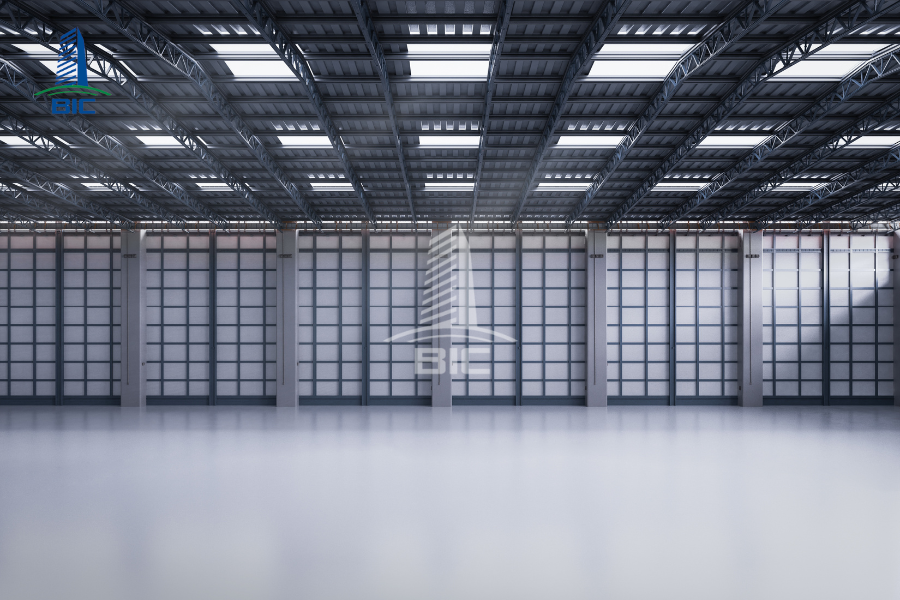
The main frame system is considered the skeleton that supports the entire roof and wall envelope of the industrial factory:
- Steel column components: These bear vertical compression and longitudinal bending forces caused by wind pressure acting on the walls. Steel columns are usually designed as built-up H-shaped or I-shaped steel sections with variable, tapered sections to optimize load-bearing capacity at locations with maximum bending moments.
- Roof rafter system: Rafters are firmly connected to column tops using high-strength bolts and thick connection plates. Steel rafters support purlins, metal roofing, and roof maintenance live loads, while ensuring large-span capability that frees up space inside the factory.
Without bracing systems, the main frame can easily lose local stability or tilt under the impact of storms and strong winds:
- Spatial bracing system: This includes roof bracing, diagonal bracing members made of round steel or angle steel, and column bracing. These components connect independent main frames into a rigid three-dimensional structural system, evenly distribute longitudinal wind loads, and resist mechanical torsion forces.
- Roof and wall purlins: These are usually made of galvanized C-shaped or Z-shaped steel. Purlins serve as the direct members for fixing cladding sheets with screws while also acting as longitudinal restraining members that stabilize the compressed flange of the main rafter frame.
The floor is where all production and business activities take place and is subjected daily to abrasion and impact from machinery and forklifts:
- Reinforcement and thickness calculation: The concrete floor thickness, usually from 150mm to 250mm, is calculated based on uniformly distributed loads from goods and concentrated loads at forklift wheels. The floor is arranged with a two-layer welded reinforcement mesh to resist tensile stress and prevent surface cracking.
- Dust-prevention surface treatment: Structural drawings always specify the application of hardener powder during fresh concrete power troweling or the application of a high-quality epoxy coating, helping the industrial factory floor remain smooth, flat, highly load-bearing, and resistant to chemicals and industrial oils.
For a factory structural design dossier to pass verification and qualify for construction permitting, the consulting unit must comply with the following strict technical data processing process.
All upper-structure calculations become meaningless if they are not based on accurate on-site soil data:
- On-site soil sampling drilling: At least 3 to 5 boreholes are drilled deep into the ground at critical locations of the factory to determine soil layer elevations, moisture content, cohesion, and internal friction angle of the soil.
- Determining statutory bearing capacity: The geotechnical survey report provides the bearing capacity of the soil and groundwater level. Based on this, engineers have a scientific basis to calculate the geometric dimensions of the foundation and foundation embedment depth, avoiding the risk of building tilt after the facility is put into operation under heavy loads.
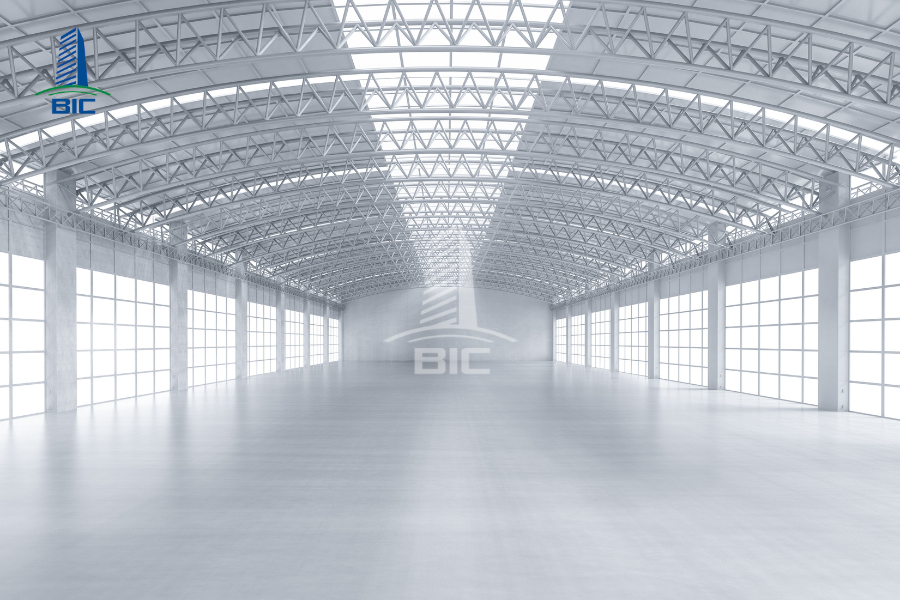
Modern industrial architecture no longer relies on manual calculations, but applies advanced digital engineering software solutions:
- Creating a 3D structural model: The entire pre-engineered steel frame, foundation system, and machinery loads are input into specialized software such as SAP2000, ETABS, or Robot Structural Analysis.
- Combining the most unfavorable scenarios: The software analyzes bending moment diagrams, shear forces, deflection, and lateral displacement of frame nodes under the most dangerous load combinations, such as dead load, roof live load, and maximum storm wind load. This method helps engineers immediately identify overloaded components and reinforce steel sections in time, ensuring the maximum safety factor for the building.
Current fire safety regulations, especially QCVN 06:2022/BXD, impose strict requirements on the fire-resistance limits of main load-bearing components in industrial factories:
- Determining statutory fire-resistance ratings: If unprotected, a pre-engineered steel frame will lose load-bearing capacity, deform, and collapse after only 15 to 20 minutes of exposure to fire temperatures above 500°C. Therefore, construction design drawings must clearly specify thermal protection solutions for steel columns and rafters, achieving fire-resistance limits such as R30, R60, or R90 depending on fire compartment classification.
- Applying protective wrapping materials: Practical measures include spraying new-generation fireproof mortar, wrapping with specialized fire-rated gypsum boards, or using certified fireproof coatings approved by competent authorities, ensuring the building meets requirements for smooth completion acceptance.
Structural design only fully delivers value when it is accurately transformed on-site through strict fabrication, erection, and technical synchronization processes.
Anchor bolts are critical connections that transfer the entire load from steel columns to the underground concrete foundation:
- Positioning with specialized surveying equipment: During foundation concrete pouring, an electronic total station must be used to position the gridlines and elevation of anchor bolt groups, with allowable geometric tolerance below 2mm.
- Ensuring component compatibility: If anchor bolt positioning is incorrect, steel column bases prefabricated at the mechanical factory will not fit into the foundation properly. This forces demolition and repair work, seriously affecting the factory construction schedule and weakening the original load-bearing capacity of the column base connection.
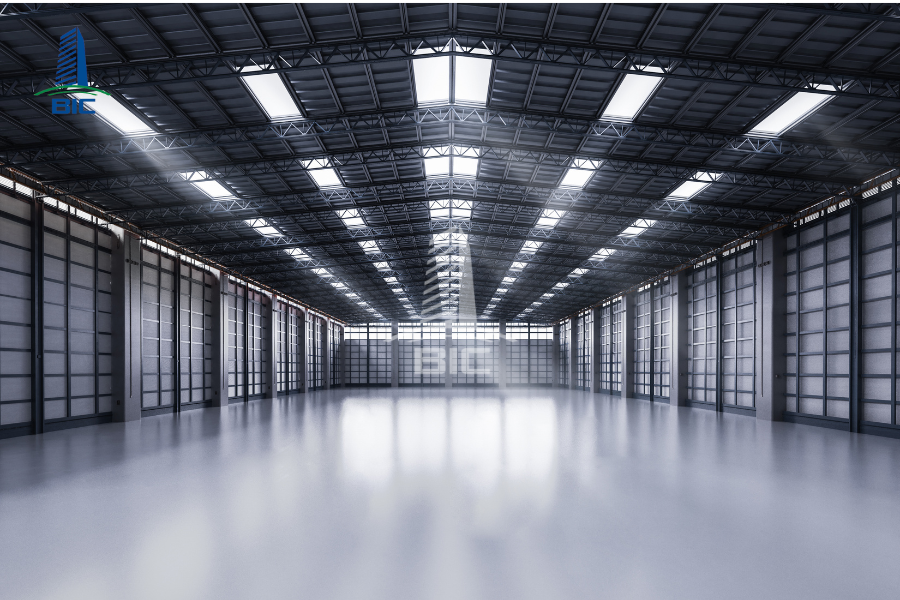
Unlike cast-in-place reinforced concrete, the pre-engineered factory frame system is manufactured in a closed process inside a mechanical fabrication workshop:
- Automating the production process: High-strength steel plates are precisely shaped using CNC plasma cutting machines, assembled into sections, and automatically welded using high-pressure submerged arc welding gantry technology, ensuring even weld penetration without slag inclusions.
- Anti-oxidation surface treatment: After welding is completed, all components must pass through a shot-blasting surface cleaning line to at least Sa 2.5 standard to completely remove rust layers and create optimal surface roughness before applying anti-rust primer and finishing paint. This protects the steel frame from corrosion caused by harmful chemical production environments.
Overlapping drawings between structural engineers and M&E engineers are always a leading cause of costly on-site corrections:
- Integrated 3D spatial simulation: BIM technology allows the load-bearing steel frame drawings to be accurately overlaid with power cable trenches, fire protection water pipelines, and HVAC ventilation ducts in a single digital model.
- Eliminating on-site demolition errors: BIM helps detect spatial conflicts early on the computer, such as a compressed air pipeline penetrating a wind bracing system or load-bearing beam. Engineers can proactively resolve these issues by designing reinforced openings in steel beams at the fabrication factory, completely eliminating the risk of workers arbitrarily cutting steel with torches on-site and preserving the original load-bearing capacity of the structural system.
Factory structural design is the core step that determines up to 90% of building durability, long-term operational safety, and the ability to preserve investment capital for manufacturing businesses. An accurate structural dossier, based on actual geotechnical data and scientific calculation of mandatory load groups using specialized software, not only ensures absolute safety for people and expensive machinery lines inside, but also helps investors optimize steel billet quantities and completely eliminate rough material waste.
In addition, the strict integration of statutory fire safety standards under QCVN 06:2022/BXD and the application of advanced BIM modeling technology will help businesses proactively prevent technical conflict risks, shorten on-site erection time, and ensure that completion acceptance and building ownership procedures proceed smoothly. To transform theoretical drawing documents into a solid industrial factory with the highest economic efficiency, business owners should prioritize working with reputable general contractors with full-package design and construction capability and extensive practical experience, enabling full control over project quality from mechanical factory fabrication to safe on-site implementation methods.