The preparation stage determines most of the success or failure of a factory construction project. Entering the site when legal documents, factory design, and resource plans are not fully ready will almost certainly lead to cost overruns and schedule delays. In contrast, thorough preparation helps lock the project scope, lock the budget, and maintain stable progress from day one.
Proper preparation involves far more than completing permits and fire protection approvals. It is a tightly linked sequence of tasks from site and geotechnical surveys, finalizing construction-ready designs, preparing cost estimates and budgeting structures, developing transparent tender documents, to planning schedules and temporary site layouts. Simultaneously, safety planning and fire protection measures for the construction phase must be activated early to safeguard people and property. When these prerequisites are standardized, factory construction becomes streamlined, predictable, and easier to control.
In this article, BIC provides a step-by-step preparation framework and key KPIs to help investors proactively manage risks, optimize costs, and put the project into operation on schedule.
During the pre-construction stage, all legal documentation must be standardized to eliminate the risk of work stoppages. Core items include the construction permit, fire prevention & fighting (FPP) design approval, and environmental documentation as required by current regulations.
The FPP dossier must include design explanations and calculations, evacuation layout drawings, fire detection and firefighting solutions, equipment lists, and operation scenarios. Environmental documentation typically includes an Environmental Impact Assessment (EIA) or Environmental Protection Plan, depending on project size. All documents must align with the approved factory design in terms of layout, function, and production line.
The 1/500 detailed master plan serves as the framework for controlling technical indicators. Building density, land-use coefficient, maximum height, setbacks, and infrastructure protection corridors must be reviewed and accurately reflected in the construction drawings. If a partial planning adjustment is required, the investor must complete the procedure before applying for permits to avoid repeated revisions and shorten approval time.
In parallel, written confirmation of utility connections from management authorities must be obtained. Medium–low voltage power, water supply, stormwater drainage, and wastewater drainage must have clear capacity indicators, connection points, and technical requirements. These serve as the basis for MEP design, including transformer sizing, pump station capacity, pipeline sizing, and wastewater treatment configuration. Once these approvals are complete, the construction scope and groundbreaking schedule are secured.
The legal status of the land is the foundation of all investment decisions. Investors must verify land-use status, permitted usage, lease terms, extension conditions, transferability, and relevant restrictions. The dossier should include cadastral maps, boundary markers, and confirmation that the site does not fall within protection corridors of infrastructure such as high-voltage lines, pipelines, or drainage channels. This prevents layout changes during construction.
The control elevation and anti-flooding strategy must be defined early. Finished floor elevation relative to surrounding roads, drainage direction, and the receiving system’s capacity must be calculated based on local design rainfall. In flood-prone areas, higher-than-minimum floor elevations and enhanced drainage systems (trenches, manholes, pumps) should be considered. When land rights are clear, the control elevation is appropriate, and infrastructure protection zones are respected, the project is legally ready for construction.
A topographic survey lays the foundation for all design decisions. The survey team must prepare an existing-condition map at an appropriate scale, detailing boundaries, structures, natural elevations, internal roads, and utility connection points (power, water, stormwater, wastewater). Coordinates and elevations must follow local standards to ensure seamless integration among architectural, structural, and MEP disciplines.
A stable coordinate and elevation control grid must be established around the site. These benchmarks support axis setting, building positioning, and deformation monitoring during construction. Survey results should include longitudinal and cross-sections of internal roads, key elevations, and infrastructure intersections.
Topographic risk assessment must identify low-lying areas, natural drainage paths, and flooding risks based on local rainfall characteristics. This ensures accurate elevation design and stormwater solutions. The final deliverables include a signed topographic map, benchmark records, flood-risk assessment, and recommended control elevation. If possible, UAV or point-cloud scanning should be conducted to support BIM coordination and early clash detection.
Geotechnical results provide critical input for foundation and industrial floor design. Borehole density must match project scale and soil complexity—typically placed at main column locations, crane runway areas, underground tanks, and along water boundaries. Drilling depth must extend through weak layers to reach stable bearing strata for settlement analysis.
Testing includes field tests (SPT/CPTu, plate load test, groundwater monitoring) and laboratory tests (Atterberg limits, moisture content, unit weight, consolidation, shear strength, lateral swelling). These determine bearing capacity, deformation modulus, subgrade coefficient, internal friction angle, cohesion, and settlement parameters.
Based on the geotechnical report, engineers choose foundation types: shallow foundations if soil is adequate, or piles where weak layers are thick or loads are high (especially crane columns and heavy equipment bases). Ground improvement options may include preloading with wick drains, cement–soil mixing, sand piles, localized reinforcement, or large-panel floors with surface hardening. Industrial floor requirements for flatness and expansion joints must align with soil conditions and forklift traffic.
Mandatory deliverables include drilling logs, soil profiles, testing tables, design parameters, foundation recommendations, settlement analysis, and groundwater control guidelines. With complete and reliable geotechnical data, design decisions become solid, field risks are reduced, and construction schedules are protected.

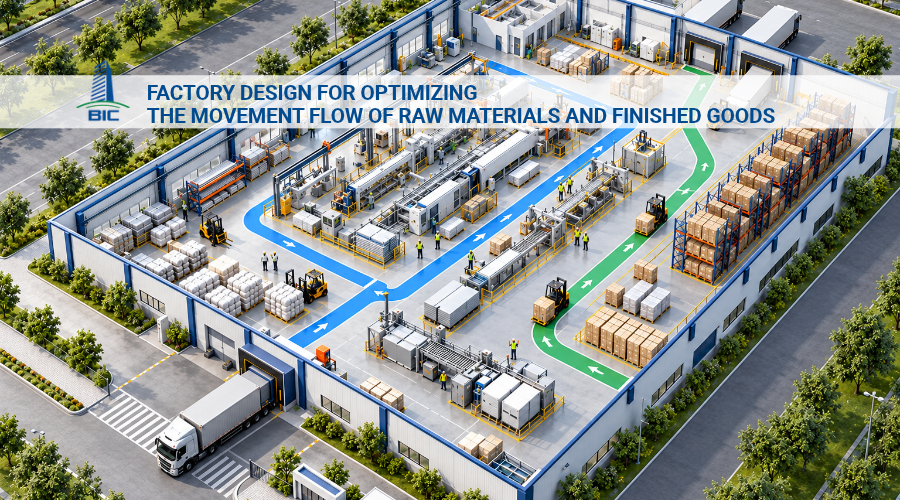
The goal is to convert operational needs into safe and efficient circulation patterns. The layout must clearly separate three flows: pedestrians, forklifts, and trucks.
Truck routes should run directly from the gate to loading zones, minimizing interference with production. Container yards must be near warehouses with proper lane width and turning radius. The goods flow from gate to warehouse, warehouse to production lines, and lines to finished goods must follow a clean and logical path.
Conflict zones require speed bumps, convex mirrors, line markings, and signage. Pedestrian paths must be protected by safety rails and have the shortest escape routes to safe zones. Proper planning ensures smooth construction and reduces collision risks in operation.
Foundation design is based on approved geotechnical results, determining shallow or pile foundations, control elevation, and soil improvement methods. Industrial floors require decisions on concrete grade, hardening layers, flatness criteria, and expansion joints. Crane bases and heavy equipment areas require stiffened pedestals and anchoring details to control settlement and vibration.
Forklift zones require checking slab thickness, concrete strength, and joint reinforcement to prevent edge chipping. All criteria must appear clearly in drawings and specifications to ensure accurate construction and quality control.
Structural design must consider complete load combinations: dead, live, wind, crane loads, and suspended equipment. Drawings must show load-transfer diagrams, spans, deflection limits, lateral drift limits, and detailed connections (gusset plates, anchor bolts, stiffeners). Materials and corrosion protection requirements must specify surface preparation, coating thickness, adhesion tests, or galvanizing criteria.
Erection conditions such as sequencing, temporary bracing, crane alignment, and final torque checks must also be documented. Once finalized, construction proceeds with fewer clarification requests and redesign risks.

Electrical design must define medium–low voltage configurations, transformer capacity, redundancy level, generators, and ATS panels. Lightning protection and grounding systems require route drawings and grounding resistance criteria.
Water supply and drainage must specify flow rates, pressures, tank/pump locations, and main pipeline sizes. Compressed air or process gases require network layouts, compressor locations, vertical shafts, and condensate drains. Ventilation and cooling require heat and moisture load calculations and suitable equipment selection (fans, cooling pads, rooftop units).
FPP design must finalize hydraulic calculations, pumps, tanks, ring main hydrant systems, sprinkler density/coverage, hose reels, and equipment cabinets. Escape routes, signage, and emergency lighting must be designed with clear specifications.
When MEP and FPP designs reach construction-ready status, tendering, procurement, and commissioning can proceed on schedule.
Internal infrastructure supports smooth construction and stable factory operation. Gate locations, entry lanes, roadload capacity, turning radii, and yard access must be finalized. Site grading must ensure proper stormwater drainage with trenches and manholes sized to design rainfall.
Outdoor lighting, CCTV, guardhouses, and access control must be positioned for full visibility and fast response. With infrastructure aligned to the construction design set, the site is fully ready for factory construction.
A reliable estimate begins with an accurate Bill of Quantities (BoQ) for all disciplines: architecture, structure, MEP, FPP, and site infrastructure. Each item must have clear measurement rules, quantity boundaries, and acceptance criteria. A unified coding system minimizes overlaps or omissions across drawings, BIM models, and cost estimates.
Reference prices should be based on supplier quotations (with delivery conditions), market data from independent organizations, and local labor rates. For volatile materials such as steel, cement, cables, and firefighting pumps, price-lock mechanisms and tolerances must be defined.
Contingencies must be quantified, not guessed:
- Technical contingency for design variations (3–5% of construction cost).
- Escalation contingency based on indices for materials and energy.
- Site-condition contingency for unforeseen ground improvement, drainage changes, or utility connection adjustments.
Cost dossiers should include financial policies:
- Price adjustment formulas tied to published indexes.
- Payment conditions tied to acceptance milestones.
- Equivalent material protocols to prevent uncontrolled price increases.
The goal is a BoQ aligned with drawings/models, unit prices with evidence, and transparent contingencies, suitable for fair tendering and contract negotiation.
Total investment must separate construction cost, equipment, consultancy, project management, approvals, insurance, taxes, and contingencies. Investors should evaluate 10-year life-cycle costs to understand long-term financial impact.
OPEX components include energy, water, chemicals, preventive maintenance, major repairs, consumables, insurance, security, cooling, and lighting. When industry benchmarks are available, costs should be normalized per square meter or per product unit.
A proper TCO approach includes three scenarios—baseline, optimistic, conservative—with clear assumptions for machine utilization, energy prices, and maintenance frequency. Cash flows must be discounted to compare options objectively.
Typical savings levers include:
- Controlled value engineering while maintaining safety and technical standards.
- Right-sizing MEP systems, using VFDs for pumps/fans, high-efficiency LEDs, and strategically placed skylights.
- Reducing energy costs through roof/wall insulation, natural ventilation, and solar-ready structures.
- Modular layouts to minimize demolition during expansions.
A TCO comparison table should show:
- CAPEX by package and annual OPEX for each option.
- Expected energy savings and payback periods for measures such as insulation, skylights, solar.
- Cost per product unit and per square meter under three operational scenarios.
This approach strengthens budget planning, ensures transparent bidding, and optimizes total ownership cost without sacrificing safety or quality.
BIC is ready to accompany you from site and geotechnical surveys, design standardization, and fire protection approvals to preparing tender documents, bid evaluation, and construction management. Contact us for tailored guidance on an optimized preparation plan for your project, including design document review, safety and scheduling plans, and cost- and risk-optimization strategies aligned with your investment objectives.