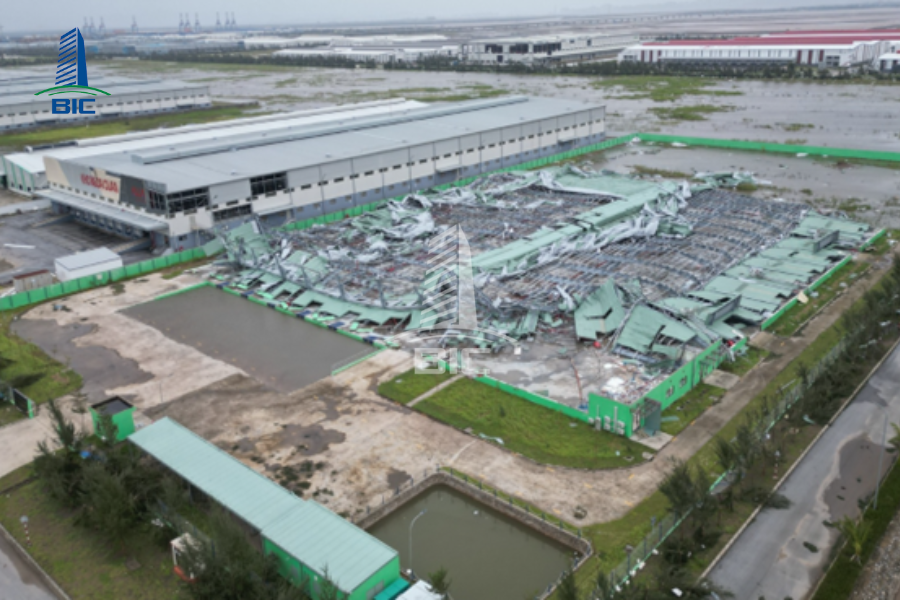
After every major storm, industrial facilities face simultaneous risks: safety hazards, production downtime, and the financial pressure of restoration. A single day of delay can extend machine stoppage for weeks. Therefore, a well-structured factory renovation plan must be activated immediately handling urgent damage while upgrading storm-resilience for future seasons.
In this article, BIC provides a practical action plan for investors from isolating hazards, conducting on-site assessments, and preparing insurance documentation, to structural inspection, MEP and fire protection restoration, roof and cladding upgrades, and stormwater drainage optimization. Supported by proper factory design standards and a rigorous construction design process, the renovation plan shortens downtime, ensures worker safety, and optimizes total ownership cost. For cases requiring major changes, the article also suggests criteria to compare between repair, full renovation, and building a new factory.
The ultimate goal is to bring the plant back into safe, fast, and sustainable operation, while using the renovation period as an opportunity to reinforce wind resistance, optimize energy use, and prepare for extreme weather events in the future.
The top priority is preventing secondary risks and protecting people. A designated incident commander is assigned as soon as the team arrives on site, with all staff following a unified communication channel. Power supply is cut off and locked out/tagged out to prevent unintended energizing. Electrical cabinets, generators, ATS systems, and flooded cable routes must be inspected before restoring power. Gas valves are shut, compressed air and process-gas lines are isolated, and pressure is safely released per manufacturer instructions. Areas handling chemicals, paints, or solvents must be cordoned off with spill trays, absorbent materials, forced ventilation, and handheld vapor detectors.
Restricted zones must be established around unstable structures, peeled-off roofing, cracked walls, and areas with settlement risk. Temporary evacuation routes are set up along with mobile emergency lighting and signage. An outdoor assembly point is arranged with headcount tracking. Mandatory PPE includes helmets, safety-toe boots, gloves, goggles, and masks suitable for each zone. Access to the roof is strictly prohibited during high winds or before temporary bracing is installed. Re-entry is only allowed after confirming the absence of electrical leakage, excessive solvent vapors, and ensuring temporary supports are secured.

Damage assessment must be based on layered data to avoid omissions. At ground level, capture wide and close-up photos with geo-tags, record videos of corridors, warehouses, production areas, and utility stations. Document cracks, deformations, mud deposits, and collapsed sections. For elevated structures, UAVs are used to map roofing, skylights, trusses, and drainage systems. Drone outputs produce orthophotos to quantify broken panels, identify joint failures, and determine wind direction causing uplift.
For complex structures, perform laser scanning or handheld point-cloud surveys to identify column deviations, beam deflections, and structural distortions, supplemented by total-station measurements at control points.
All data is compiled into a multi-layer damage map categorized by structural elements, cladding and roofing, MEP, fire protection, and internal infrastructure. Each damage point is assigned a location code, priority level, temporary repair method, and long-term solution. A damage log for insurance purposes is developed with descriptions, before/after photos, equipment serial numbers (if applicable), repair/replacement estimates, expected downtime, and loss-prevention costs. Technical data such as cable insulation resistance, sprinkler pressure test results, material moisture levels, and groundwater height are included as appendices for renovation design.
Within 24–72 hours, produce a rapid assessment report outlining safe zones for re-entry, zones needing temporary reinforcement, and plans for detailed surveys. This documentation forms the basis for prioritizing work orders, coordinating with insurers, and finalizing a safe and effective renovation plan.
In post-storm factory renovation projects, the more complete the claim file, the faster the processing time. Once hazards are isolated, the investor issues a loss notification to the insurance provider, including the time of incident, affected areas, and emergency mitigation measures taken.
A standardized documentation package should include: an incident report signed by legal representatives, geo-tagged panoramic and close-up photos, a preliminary damage quantity list, temporary quotations for urgent works (e.g., bracing, leak control),downtime logs, loss-prevention cost reports.
Meeting schedules with assessors should be finalized early to avoid disrupting cleanup and temporary reinforcement. Clear timelines should be proposed, including site inspection dates, deadlines for preliminary assessment reports, and confirmation dates for temporary compensation quantities.
If the insurance contract includes an advance payment clause, request partial disbursement to execute emergency items such as leak-proofing, collapse prevention, dehumidification, and replacement of moisture-damaged cables. Removed materials must be stored and labeled for cross-checking during final assessment. Continuous updates to the damage quantity list allow the design team to quickly convert data into technical solutions and detailed cost estimates.
Post-storm renovation usually falls into two categories: non-structural repairs and structural alterations. For routine repairs such as replacing roofing sheets, gutters, and MEP components, the investor only needs to submit repair notifications to authorities and the industrial park management.
However, structural changes, such as reinforcing columns/trusses, adding bracing, adjusting floor levels, modifying stormwater layouts, or reorganizing escape routes require appropriate permits and adjusted fire protection approvals.
Before construction, coordinate with the fire department to re-verify firefighting plans, water supply for firefighting, and fire truck access. Work with environmental authorities regarding waste handling during dismantling, especially insulation panels, oils, solvents, and extracted concrete cores. Proper legal preparation ensures smooth progress and reduces risks of construction stoppages due to administrative issues.
Since foundations and industrial floors are essential to safe operations, systematic inspection is required. Begin with settlement monitoring at column bases, comparing differential settlement with allowable limits. Map floor cracks, inspect expansion joints, and check high-load areas such as equipment bases and forklift routes. For suspected structural degradation, extract core samples to assess concrete strength, permeability, and hardening layer thickness. Plate loading tests and flatness/levelness surveys may be added depending on industrial floor requirements.
Inspection results determine technical solutions:
- Minor localized settlement → pressure-grout leveling, base-plate shimming, or localized hardening.
- Active cracks → epoxy injection with dowel installation for load transfer.
- Weak foundation zones under cranes or heavy equipment → deep reinforcement using micro-piles or cement-soil stabilization, plus strengthened topping with fiber reinforcement.
All solutions must include clear acceptance criteria regarding flatness, deflection, floor loading, and maintenance cycles to ensure compliance from the first inspection onward.
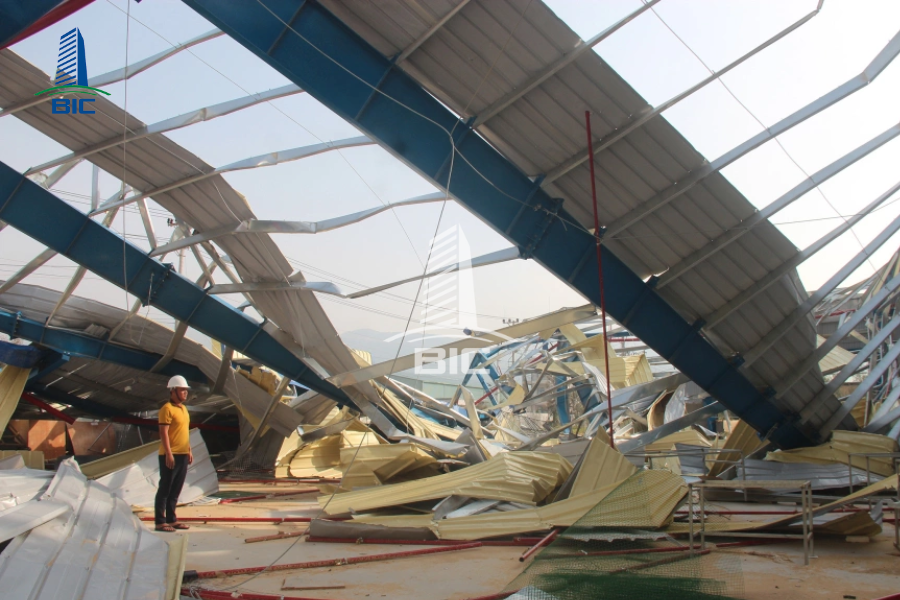
Roof frames experience the highest wind loads. Inspection includes measuring column verticality, truss deflection, torsion, and local instability. Base-plates and anchor bolts are checked by sampling, torque testing, and assessing plastic deformation or weld cracks. Roof and wall bracing systems are thoroughly inspected for broken members or loose bolts, especially at end bays where wind suction is highest.
After saltwater flooding or exposure to sea-spray rain, corrosion assessment must include coating and zinc thickness measurements, adhesion tests, surface contamination levels, and pitting percentage. Solutions include repainting with anti-salt coatings, replacing components beyond corrosion limits, or upgrading to higher-grade corrosion-resistant bolts and connectors.
For metal roofs (screw-fix or seam roofs), inspect fasteners, expansion joints, edging panels, and boundary connections. Replace damaged sheets entirely rather than patching. Add reinforced plates and anchoring pads in high wind-load zones.
Inspection reports must clearly conclude safety levels, list components requiring replacement, ones requiring reinforcement, and include detailed drawings of recommended solutions. Proper assessment lays the foundation for a smooth renovation design process with reduced risks and downtime.
Roofing is typically the most storm-damaged element and must be assessed systematically. Inspect ridge lines, eaves, and roof penetrations, documenting uplifted joints, torn sheets, broken ribs, and missing fasteners. For seam roofs, inspect seam integrity, weld lines, and perimeter clips. Skylights must be evaluated for brittleness, cracked screw holes, and UV degradation, as they are common leak points.
Technical solutions prioritize wind uplift resistance and long-term watertightness: use fasteners with anti-tear washers, reinforce edge trusses and windward zones, replace fully damaged sheets, rebalance skylight ratios for natural lighting without excessive leak risk, ensure ridge caps, side flashings, and trims follow manufacturer standards, perform water-testing before acceptance.
Storm drainage must be recalculated based on local extreme rainfall conditions. Clean gutters, replace perforated sections, add debris mesh, and verify actual slope. Downpipes must be bracket-reinforced, checked for wall-penetration waterproofing, and replaced if damaged. Add emergency overflow drains in low areas to avoid roof ponding.
Outside the building: adjust site grading to direct water to channels, add catch basins, upgrade pump capacity in chronically flooded zones, install check valves and traps to prevent backflow during combined rainfall and high tide.
Proper drainage restoration significantly reduces future leaks and localized flooding.
All electrical equipment exposed to humidity or submersion must undergo insulation testing using a megger before re-energizing. Electrical cabinets, MCCs, and ATS units must be dried, cleaned, and have corroded breakers replaced. Power and control cables must be tested for insulation resistance; any below safety threshold must be replaced.
Transformers, generators, and governors require oil testing, insulation checks, and no-load operation before synchronization. Grounding and lightning protection systems must be tested for earth resistance, corroded joints replaced, and activated surge protectors replaced with new units.
Flush water lines until clarity and microbiological safety indicators are restored. Clean and disinfect water tanks; inspect pump seals and bearings. For compressed air systems, change oils, filters, separators, and check dryer dew point to prevent moisture ingress. Conduct pressure tests on pipelines and drain condensate traps.
General ventilation and spot cooling must be enhanced during the drying period. Use exhaust fans and industrial dehumidifiers in high-moisture areas, and monitor moisture levels in floors, walls, and materials to determine appropriate finishing times.

Test sprinkler pipelines for pressure and leaks; flush sediment at low points. Test fire pumps under both recirculation and discharge modes; verify jockey pump pressure. Replace sprinkler heads that are activated, dented, or rusted; re-inspect alarm valves, isolation valves, and flow switches. Wall hydrants and outdoor hydrants must be flow-tested for range and coverage.
Clean smoke, heat, and gas detectors to avoid false alarms. Replace batteries in emergency lights and exit signs if below voltage thresholds. Re-validate and document PCCC (fire protection) acceptance for all systems before resuming operations.
Storms reveal weaknesses in buildings and procedures. Update emergency plans based on lessons learned: add missing temporary evacuation routes, increase fire extinguisher quantity at high-risk spots, update signage after layout changes, conduct new emergency drills simulating strong winds, localized flooding, and extended power outages.
The bidding package must demonstrate the contractor’s capability to carry out renovation works under emergency conditions while production continues in parallel. First, require contractors to submit a mobilization plan within 24 to 72 hours, along with a list of key equipment such as certified scaffolding, boom lifts, electrical testing devices, and pressure-testing equipment. Their capability profile must show experience in similar post-storm projects involving roofing, structural works, MEP, and fire protection systems, together with a list of completed projects including scale parameters, shutdown periods, and methods for maintaining operations.
Safety is a non-negotiable, exclusionary criterion. Require the contractor to have an ISO 45001 management system, accident statistics from the past three years, a training plan for working at height, lockout–tagout procedures for maintenance, and safe hot-work protocols. Sample safety logs, risk-assessment matrices, and the safety-team organization chart must be included in the bid. Construction personnel must hold relevant trade certificates—electrical work, fire protection, lift operation, and steel structure installation. The site manager and site engineers must submit technical résumés, professional certificates, and a commitment on their working hours and on-site presence.
For technical and quality requirements, the bidding documents must specify material standards, acceptance criteria, and equivalency rules. Detailed method statements should be required for each scope of work—seam roofs and skylight panels, reinforcement of trusses and columns, restoration of substations and sprinkler networks, and industrial floor and subgrade treatment. Temporary structural-stability solutions must include calculations, erection checklists, and monitoring plans. The contract should include clauses defining responsibilities in production zones, night-shift or weekend work windows, noise and dust limits, as well as penalties for delays and incentives for early completion. Warranty and maintenance obligations must be defined separately for each system roofing, structural works, MEP, and fire protection. Construction insurance, third-party liability insurance, and worker accident insurance are mandatory.
Digitizing existing conditions significantly shortens timelines and reduces variations during factory renovation. Require a scan-to-BIM process using UAV and laser scanning to generate a georeferenced point cloud aligned with the building grid. The contractor must model all critical systems at an appropriate level of detail, frames and connections, roof and guttering, low-voltage routes and MCC panels, water supply and drainage lines, compressed air systems, looped networks, and sprinkler systems. The model must follow naming rules, information layers, and attribute structures that support quantity take-off, verification, and acceptance.
Based on the model, perform clash coordination before construction, especially at structural/MEP interfaces. Apply 4D simulation to model phased construction sequences by zone and to assess conflicts with ongoing production; apply 5D to extract quantities directly from the model, link them with pricing tables, and update deviations caused by design changes. All technical issues and modifications must be managed within a common data environment with issue codes, responsible parties, and deadlines.
The digital handover package must include a validated IFC model, NWD or BCF files for clash-checking, a material list extracted from the model, as-built drawings, and essential operational data for maintenance. When BIM requirements are embedded and scored within the bidding documents, investors can better control quantity, schedule, and quality while reducing production downtime throughout the renovation process.
Post-storm factory renovation is a complex project involving both technical and legal challenges, where speed, safety, and disciplined management determine the final outcome. By following a proper renovation strategy and selecting a competent contractor, investors can minimize downtime, control costs, and enhance storm-resilience standards for future seasons. The application of BIM and digital condition surveys creates a clear advantage in quantity take-off, phased construction coordination, and variation reduction, ensuring a streamlined and transparent renovation process.