As manufacturing activities continue to expand and operational demands become increasingly complex, industrial factory buildings are no longer simply places to install machinery or store goods. They have become a core component of a company’s investment strategy. A professionally planned factory not only supports efficient production but also directly impacts operating costs, labor productivity, scalability, and long-term asset value.
However, in reality, many investors still do not have a comprehensive understanding of what an industrial factory building truly is, or which factors create a well-functioning facility. Misunderstanding the concept from the beginning can lead to choosing the wrong model, incorrect scale, or poor coordination between construction design, factory design, and the actual factory construction process later on.
Therefore, before starting a project, investors need to understand the bigger picture: what an industrial factory building is, its main characteristics, its essential functional areas, and why investing properly from the beginning is so important. In the article below, BIC will clarify these core aspects so investors can establish a stronger foundation for decision-making and project implementation.
An industrial factory building is a structure developed to support activities such as manufacturing, processing, assembly, fabrication, storage, or industrial production operations. Unlike buildings that merely provide shelter or serve standalone purposes, industrial factory buildings are designed as integrated operational spaces where people, machinery, goods, and technical systems function together within a unified process.
In practice, an industrial factory building is not limited to the main structure itself. It also includes synchronized systems such as electrical supply, water systems, ventilation, fire protection, internal traffic circulation, loading and unloading zones, and auxiliary facilities supporting production activities. Therefore, when investing in a factory project, investors should not view it simply as constructing a building, but rather as creating a long-term operational infrastructure for the business.
The biggest difference between industrial factory buildings and civil buildings lies in their intended purpose. Civil buildings mainly serve residential, office, commercial, or public service functions, while industrial factory buildings are specifically created to support production activities and maximize operational capacity.
This distinction leads to entirely different technical requirements. Industrial factories generally require higher load capacities, wider structural spans, more advanced internal logistics systems, stronger power supply systems for machinery, enhanced ventilation, heat treatment systems, fire protection systems, and more sophisticated MEP systems. In addition, the process of industrial factory construction design must closely align with manufacturing functions, production workflows, and future expansion plans rather than focusing mainly on user space, as is common in civil construction projects.
Many investors tend to confuse industrial factory buildings with warehouses or small workshops, but these are fundamentally different facility types.
Warehouses are primarily designed for storing goods, raw materials, or finished products, so their technical focus is generally on storage area, floor load capacity, and goods handling operations.
Small workshops, on the other hand, often support limited-scale manufacturing activities with simpler functional layouts and technical systems.
Industrial factory buildings, however, require a much higher level of integration and coordination—not only within the production area but also in internal logistics, technical infrastructure, operational systems, and the interaction between multiple functional zones within the same project. In other words, if warehouses are mainly for storage and small workshops are for compact-scale production, industrial factory buildings are comprehensive facilities designed for businesses to operate production systematically, efficiently, and sustainably over the long term.
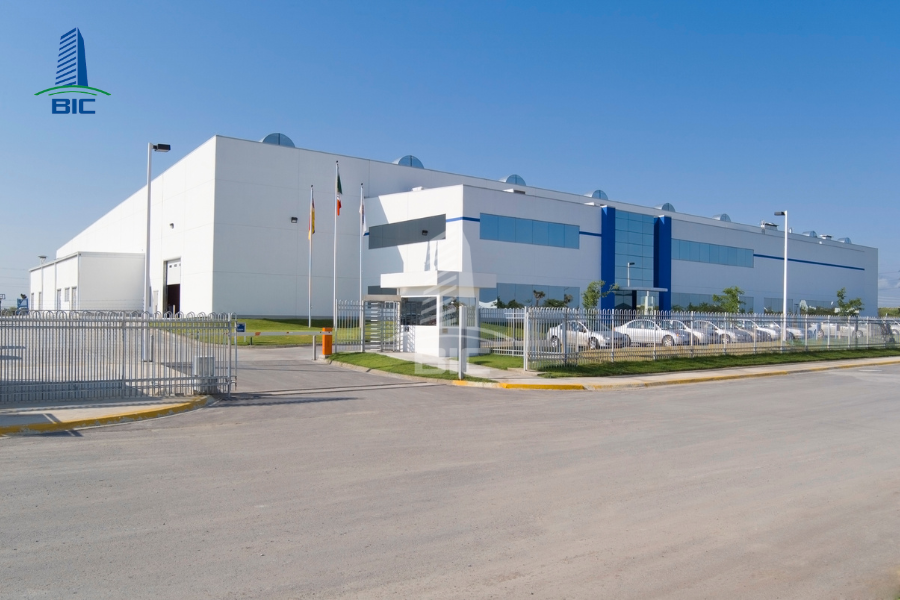
One of the most recognizable characteristics of industrial factory buildings is their large floor area and the requirement for wide structural spans to create open production spaces. This minimizes the number of internal columns, making it easier to organize production lines, transport goods, and install large industrial equipment.
For investors, this characteristic affects not only the appearance of the building but also the structural solution, construction cost, and production organization capability. A factory with appropriate structural spans allows businesses to operate more flexibly and reduces operational inconvenience over the long term.
Unlike many other building types, industrial factory buildings are fundamentally created to support manufacturing operations. From functional layouts and building heights to loading entrances and technical systems, every aspect must align closely with the actual production workflow.
This means factory buildings cannot be designed using a generic approach. Instead, they must be based on the specific industry, manufacturing process, and operational goals of the business. When the facility is properly organized according to the production line, operational efficiency improves, circulation becomes smoother, and long-term operational issues are significantly reduced.
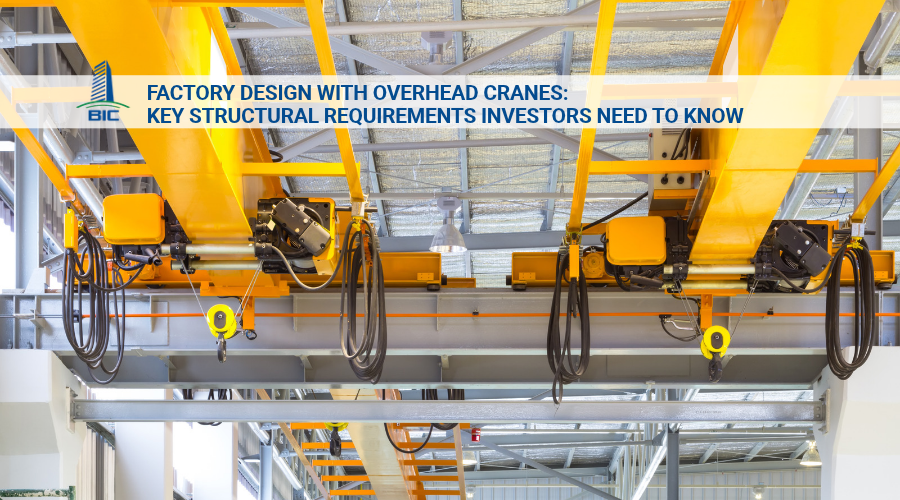
Compared to civil buildings, industrial factories typically require much higher load-bearing capacity. Floors may need to support heavy machinery, goods, forklifts, or concentrated loads during manufacturing and storage operations. Therefore, factory structural systems must always be carefully engineered to ensure long-term safety and stability.
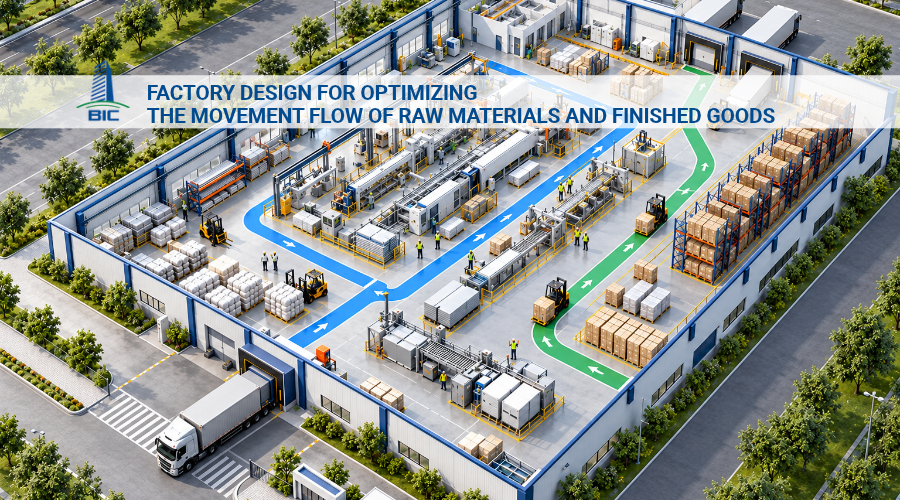
In addition, internal circulation is an extremely important characteristic. Industrial factories must organize movement flows for workers, goods, forklifts, trucks, and loading operations efficiently. If internal traffic planning is not handled properly, the facility may still be completed structurally but will operate inefficiently, creating congestion and reducing actual productivity.
An industrial factory building is far more than just a structural frame. It is always accompanied by integrated technical systems. Depending on the industry, the facility may require industrial power systems, production water supply and drainage, ventilation and cooling systems, fire protection systems, compressed air systems, wastewater treatment, or other specialized technical infrastructure.
This is one of the reasons industrial factory buildings are significantly more complex than ordinary buildings. If technical systems are not properly planned during the construction design phase, the project can easily encounter major issues during construction or struggle to operate efficiently after handover.
One practical characteristic of industrial factory buildings is that they rarely serve only current operational needs. In many cases, businesses will increase production capacity, add new production lines, expand warehouses, or modify operational layouts after several years of operation. Therefore, factory buildings should always be designed with a long-term vision rather than focusing solely on immediate needs.
Planning for future expansion from the beginning helps investors significantly reduce future costs while avoiding situations where the facility quickly becomes overcrowded or difficult to upgrade. This is also why a professionally developed factory project always requires comprehensive long-term thinking—not only during the initial investment stage but also regarding future growth potential.
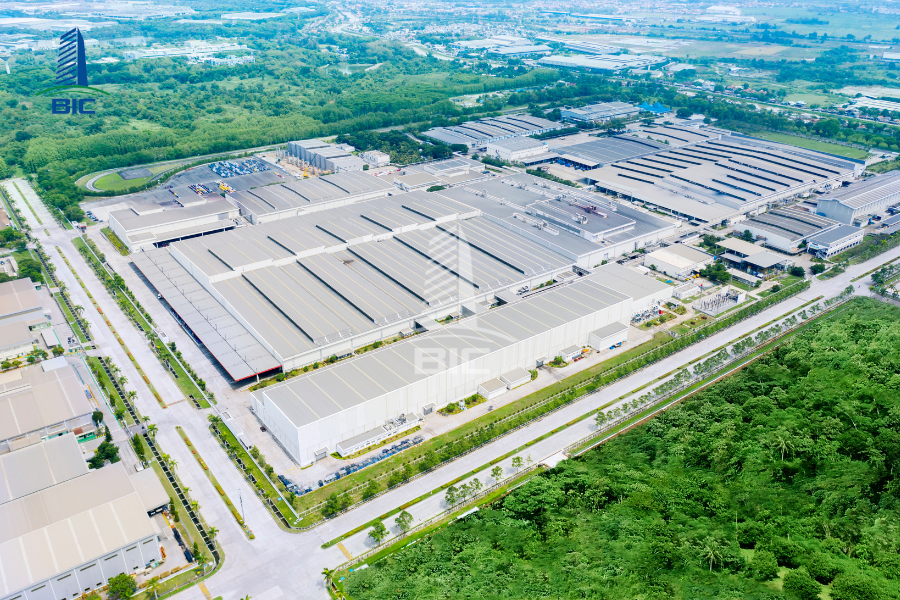
The main production area is the most important part of an industrial factory building, where manufacturing, assembly, processing, or production line operations directly take place. This zone determines the operational capacity and efficiency of the entire facility. Therefore, during the factory design process, this area is always prioritized in terms of floor area, ceiling height, load capacity, and operational convenience.
Depending on the industry, the production area may be organized in a linear production line, divided according to manufacturing stages, or arranged by functional clusters. Regardless of the layout model, the primary objective is to ensure smooth circulation of workers, raw materials, and products while minimizing operational overlap and maximizing production efficiency.
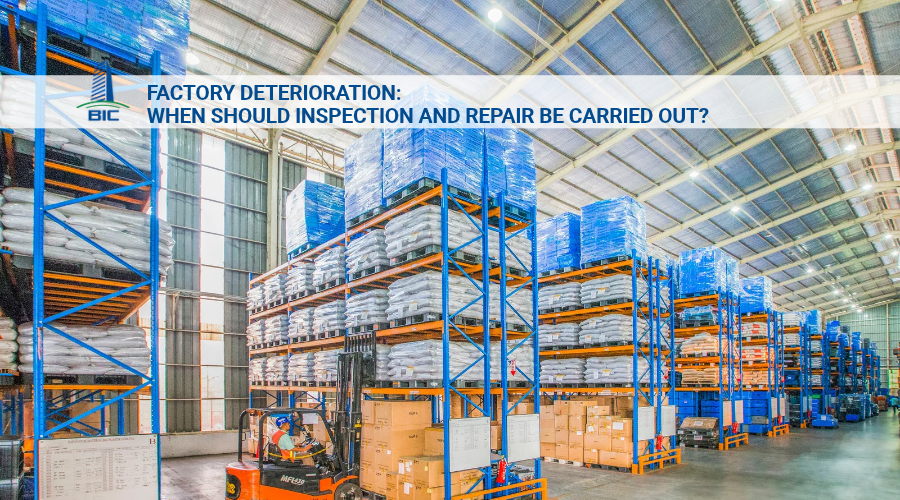
In addition to the production area, raw material warehouses and finished goods warehouses are essential components of industrial factory buildings. The raw material warehouse receives, stores, and distributes inputs for production, while the finished goods warehouse stores completed products before shipment.
The layout of these areas must closely follow the actual operational process to minimize transportation distances and facilitate loading, unloading, and inventory control. If organized poorly, internal logistics can easily become congested, reducing the operational efficiency of the entire factory. Therefore, warehouse design must always be coordinated with the production area and internal traffic planning.
Many investors focus heavily on production areas while overlooking the importance of office and management spaces within industrial factories. These areas support administration, production supervision, engineering operations, accounting, and facility management.
Depending on project scale, office areas may be designed as standalone buildings, attached to the factory structure, or integrated within the same building. Regardless of the approach, office spaces must remain convenient for management operations without disrupting manufacturing activities. A well-designed office layout improves operational coordination and strengthens the connection between management and production teams.
Besides the main operational areas, industrial factory buildings also require auxiliary facilities to ensure smooth and stable operations. These typically include restrooms, technical rooms, maintenance rooms, and security rooms.
Restrooms support workers’ daily needs. Technical rooms accommodate or control operational systems serving the facility. Maintenance rooms support machinery and equipment repairs and servicing. Security rooms manage safety, personnel flow, and vehicle access control. Although these spaces do not directly generate products, they play a crucial role in maintaining continuous, safe, and professional factory operations.
Industrial factories cannot operate efficiently with only the main building structure. External infrastructure areas are equally important. These include internal roads, yards, loading and unloading zones, and drainage systems, all of which connect the building’s internal operations with actual site logistics.
Internal roads organize circulation for trucks, forklifts, and personnel. Yard areas provide space for maneuvering, temporary storage, and logistics support. Loading zones facilitate the movement of raw materials and finished products. Drainage systems help maintain operational stability, prevent flooding, and protect technical infrastructure.
For investors, these components are often underestimated during early planning stages but directly influence long-term operational performance and project efficiency.
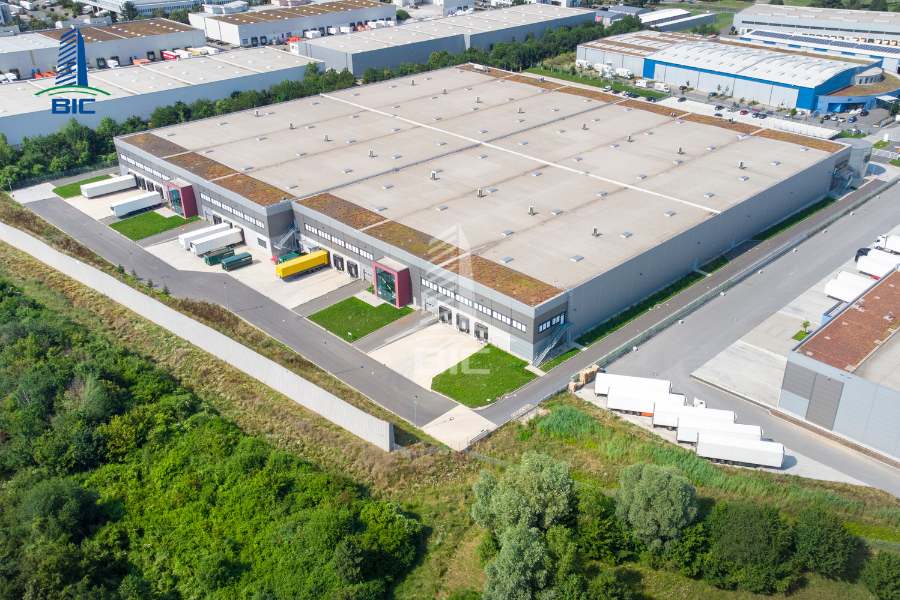
One of the most common ways to classify industrial factory buildings is by manufacturing industry, since each sector has unique operational, structural, and technical requirements.
For example, textile factories usually require wide, well-ventilated spaces with good lighting and efficient production line organization. Food factories prioritize hygiene, clean–dirty separation, and environmental control. Mechanical factories often involve heavy machinery, requiring higher floor loads and stronger structural systems. Electronics factories demand dust control, temperature regulation, humidity management, and precise technical conditions. Chemical factories generally require more complex safety systems, environmental treatment systems, ventilation, and risk control measures.
This classification helps investors understand that there is no universal factory design model suitable for every industry. Each manufacturing sector requires a tailored solution aligned with its operational characteristics.
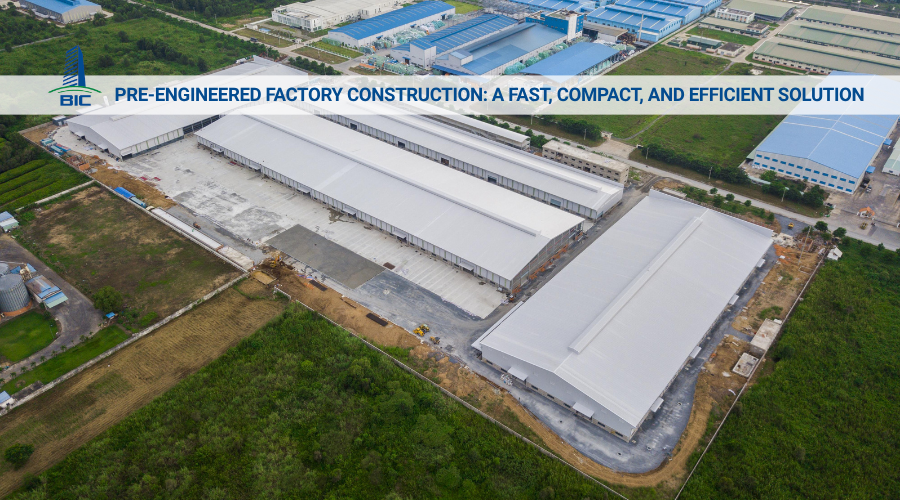
Industrial factories are also commonly classified according to their primary structural systems. The most common types today are steel-frame factories, reinforced concrete factories, and hybrid structures.
Steel-frame factories are widely used because of their fast construction speed, large-span capability, flexible layouts, and ease of future expansion. Reinforced concrete factories are suitable for facilities requiring higher durability, heavier load capacities, or specialized environmental conditions. Hybrid factories combine both steel and reinforced concrete systems to maximize the strengths of each material in different parts of the project.
For investors, structural selection affects not only initial investment costs but also construction progress, building lifespan, and long-term operational efficiency.
Based on building height, industrial factory buildings can be categorized into single-story factories, multi-story factories, and factories with mezzanine floors.
Single-story factories are the most common because they facilitate production line organization, internal circulation, and machinery installation. Multi-story factories are typically used where land is limited or where vertical space optimization is necessary. Factories with mezzanine floors provide an intermediate solution, often used for offices, light storage, technical rooms, or auxiliary functions within the same building.
This classification is important because the number of floors directly affects structural solutions, vertical circulation systems, floor load capacities, and operational organization.
Industrial factory buildings can also be classified according to their operational model. Some facilities focus purely on manufacturing, while others combine production with warehousing, office space, or product showrooms.
Pure production models dedicate most of the facility to manufacturing operations. Production-and-warehouse models optimize the movement of raw materials and finished goods within a single facility. Production-and-office models support businesses requiring management operations directly within the factory complex. Meanwhile, showroom-integrated factories are suitable for businesses that both manufacture and display products or receive clients on-site.
For investors, identifying the correct operational model from the beginning helps ensure the construction design and execution process follows the right direction, minimizes later modifications, and improves overall investment efficiency.
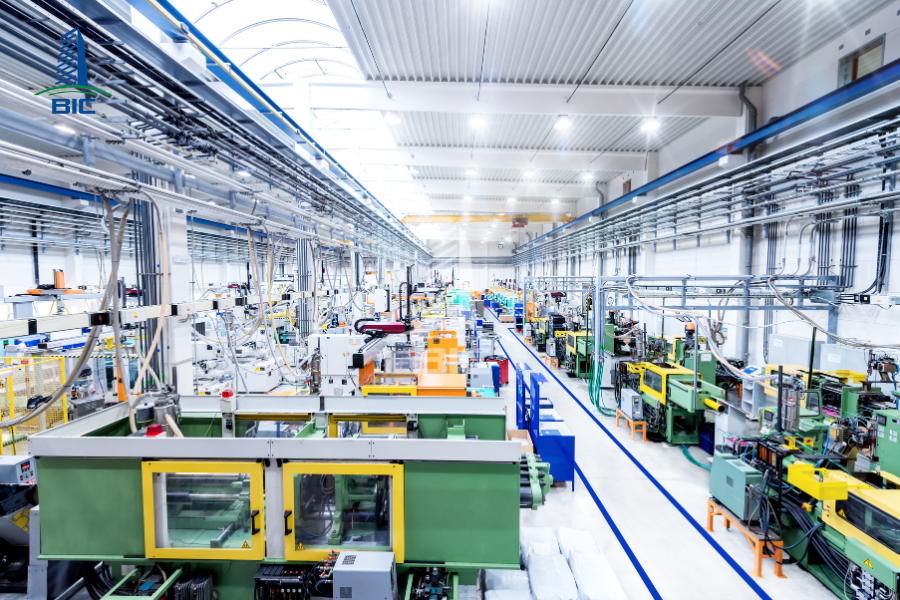
The first factor determining the effectiveness of an industrial factory building is whether the functional layout truly supports manufacturing operations. The facility must not only provide sufficient area but also organize spaces according to the business’s actual operational workflow—from raw material storage and production zones to finished goods storage, auxiliary spaces, and shipping areas.
When functions are organized efficiently, the movement of workers, machinery, and goods becomes more streamlined, reducing handling time, minimizing operational overlap, and improving productivity. On the other hand, even a visually attractive factory can perform poorly if its layout does not align with real manufacturing needs.
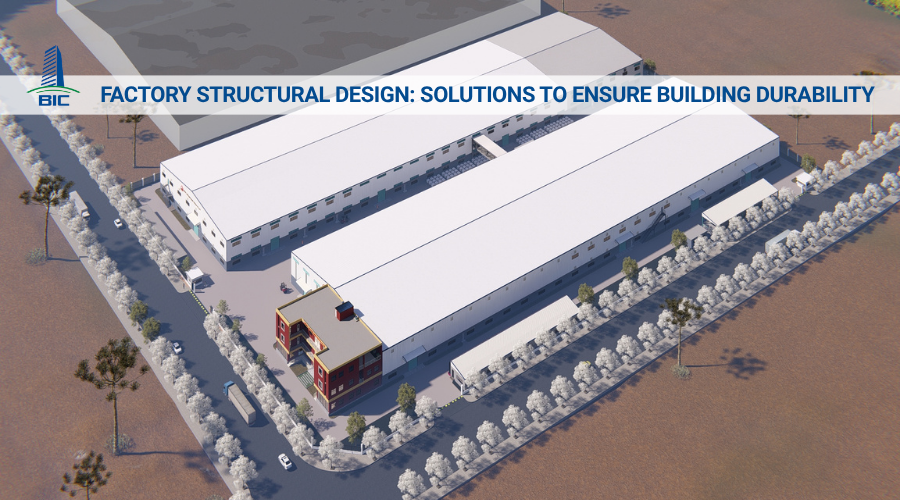
An effective industrial factory building must have a structural system suitable for operational loads and long-term usage plans. This includes loads from machinery, goods, forklifts, work platforms, and future expansion needs. The structure must not only be safe for current operations but also capable of supporting future business growth.
For investors, the structural system directly affects building durability, stability, and investment costs. Under-designed structures may lead to settlement, cracking, deterioration, or expensive strengthening work later. Over-designed structures, meanwhile, unnecessarily increase construction costs. Therefore, an effective structural solution is always one that balances safety, lifespan, and investment efficiency.
No industrial factory building can operate efficiently without integrated technical systems. Electrical systems, water supply and drainage, ventilation, cooling, fire protection, compressed air, wastewater treatment, and other specialized systems must all be planned from the earliest stages of construction design.
Most importantly, these systems cannot be designed independently. They must be closely coordinated with architecture, structural systems, and operational layouts to avoid conflicts during construction and operation. A factory with synchronized technical systems operates more reliably, reduces operational costs, and significantly lowers the risk of post-handover modifications.
Internal circulation is an extremely important factor that is often underestimated during project planning. In industrial factories, internal circulation is not merely about pathways—it includes movement systems for workers, forklifts, trucks, raw materials, and finished products.
When circulation is organized properly, operations become smoother, loading and unloading activities become more efficient, and the risk of congestion or collisions is significantly reduced. Conversely, poor internal circulation planning quickly reveals operational weaknesses, even if the architecture and structural systems are well executed.
An effective industrial factory building should not only support current operations but also provide room for future growth. Businesses may increase production capacity, add new production lines, expand warehouse space, or reorganize operational layouts after several years of operation. If future expansion is not considered from the beginning, upgrades can become extremely difficult and costly.
Therefore, during the factory design process, investors should evaluate medium- and long-term development scenarios. A facility with good expansion capability helps businesses reduce renovation costs, shorten upgrade timelines, and maintain long-term investment value.
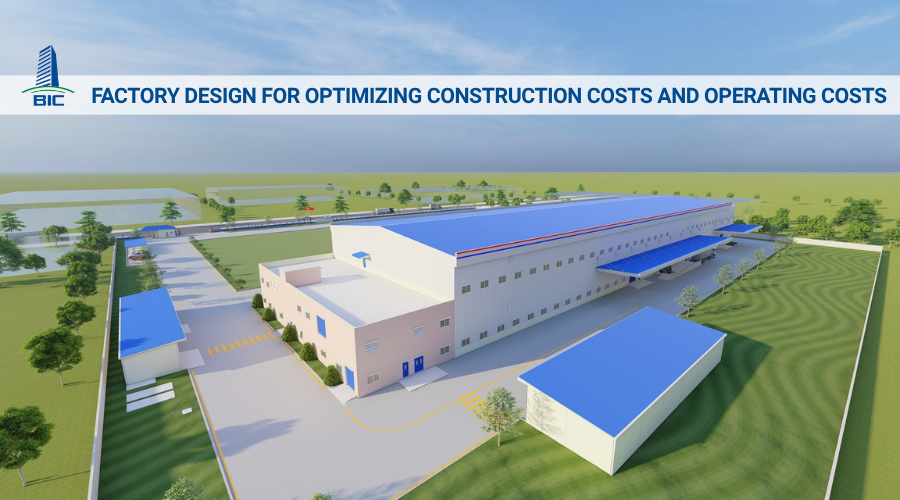
The effectiveness of an industrial factory building cannot be evaluated solely based on initial construction costs. A good factory is one that both fits the investment budget and allows the business to control operating costs throughout the building’s lifecycle. This includes electricity, water, maintenance, repairs, technical operation, and future modification costs.
Many investors focus heavily on minimizing upfront expenses, but if the solution is inappropriate, long-term operating costs can become far greater. Therefore, the key objective is not building at the lowest possible cost, but investing appropriately so the facility can operate efficiently, reliably, and sustainably over time.
The first step in implementing an industrial factory project is understanding investment requirements and evaluating site conditions. Investors need to determine the production model, production line scale, space requirements, load capacities, internal circulation needs, and future expansion plans. At the same time, the project site must be assessed in terms of topography, soil conditions, infrastructure connectivity, drainage capability, and construction accessibility.
This step is extremely important because all later planning depends on this initial information. If site surveys are incomplete, the project can easily encounter issues related to functional layouts, structural solutions, or major additional costs during implementation.
After gathering survey data, the next step is preparing a preliminary factory design concept. At this stage, the consulting team proposes the overall site layout, organization of production zones, warehouses, office spaces, auxiliary facilities, internal circulation systems, and the main architectural, structural, MEP, and fire protection solutions.
The preliminary design acts as the first strategic direction for the entire project. This is when investors evaluate whether the facility aligns with manufacturing requirements, fits the investment budget, and provides sufficient flexibility for future growth plans. A well-approved concept at this stage greatly facilitates later phases.
Once the preliminary concept is approved, the project moves into the detailed construction design stage. The design package typically includes architectural drawings, structural systems, electrical and plumbing systems, MEP systems, fire protection systems, external infrastructure, and technical specifications required for project implementation.
For investors, this stage requires special attention to coordination between disciplines. A high-quality design package not only ensures proper construction but also minimizes future modifications, improves quantity control, and supports efficient long-term operation. In many ways, the quality of the design documentation directly influences the quality of the entire project.
After completing the design documentation, the next step is preparing the cost estimate and investment plan. This involves quantity takeoff, determining construction costs, technical system costs, infrastructure costs, and related expenses so investors can clearly understand the total project investment.
At the same time, the project implementation plan is established, including schedules, funding arrangements, material procurement strategies, contractor selection, and project management approaches. When this stage is carefully prepared, investors can better control budgets and reduce financial risks during construction.
Once the design and investment plans are ready, the project enters the factory construction phase. This stage transforms drawings and technical solutions into the actual building, beginning with foundations and structural systems, followed by roofing, wall systems, auxiliary works, technical systems, and external infrastructure.
During construction, the most important factor is ensuring the work follows the approved design while maintaining control over progress, quality, and costs. Investors should also closely monitor coordination among construction teams, issue resolution, and stage-by-stage inspections to ensure the facility is completed according to both the schedule and the intended operational requirements.
After construction is completed, the project enters the inspection, handover, and operational phase. This stage involves verifying construction quality, technical systems, functional performance, and overall compatibility with actual manufacturing needs.
Handover involves not only delivering the completed building but also providing as-built documentation, technical manuals, and operational guidance for all related systems. For investors, this stage concludes the construction investment process but also marks the beginning of a more important phase: operating the facility efficiently, reliably, and in preparation for future business growth.
From a contractor’s perspective, an effective industrial factory building does not begin with drawings—it begins with understanding the investor’s production requirements. Every business has unique characteristics regarding production lines, goods flow, workforce size, equipment loads, environmental conditions, and future development plans. Without clearly understanding these factors first, a project may appear visually correct but still perform poorly in operation.
At BIC, the first step is always analyzing actual operational needs before proposing solutions. This approach ensures factory design solutions align with production activities, reduce emotionally driven decisions, and create a stronger foundation for the entire project.
One of the most common causes of project complications is the disconnect between construction design documentation and actual execution conditions. If drawings remain only conceptual and do not account for site implementation realities, conflicts can easily arise among architectural, structural, MEP, fire protection, or infrastructure systems.
Based on practical experience, BIC always prioritizes coordination between design intent and construction feasibility from the very beginning. This ensures the project is not only technically correct on paper but also practical in the field, reducing conflicts among disciplines and helping maintain stable project progress.
A good solution is not necessarily the largest or most complex one—it is the solution most appropriate for the investment goals. In industrial factory projects, investors must always balance functionality, budget, and schedule. Prioritizing one factor while ignoring the others can quickly destabilize the project.
Therefore, BIC approaches projects with a comprehensive consulting strategy: functions must support production, solutions must fit the budget, and implementation schedules must align with operational goals. This approach helps investors better control their investment strategy and make more confident decisions from the beginning.
Most project complications do not result from major mistakes, but from small inconsistencies during early planning stages: layouts that do not fully match operations, structural systems that do not align with load requirements, MEP systems disconnected from production lines, or incomplete infrastructure planning. When these issues are discovered late, modification costs increase dramatically and project schedules are heavily affected.
That is why BIC always emphasizes early-stage design review before the project enters deep implementation. The earlier issues are identified, the easier it becomes for investors to control changes, reduce risks, and keep the project moving in the right direction from the start.
The value of a contractor lies not only in completing the building, but also in supporting investors throughout the entire project journey. From site surveys and conceptual planning to detailed design, construction organization, inspection, and handover, every stage requires close coordination to ensure the project remains aligned with its original objectives.
At BIC, the role extends beyond providing construction solutions. The company aims to become a long-term project partner, helping investors implement projects professionally, efficiently, and with minimal complications. A successful industrial factory building is not simply one completed on schedule—it is one fully prepared to operate efficiently and support business growth immediately after handover.
Industrial factory buildings are not merely places to install machinery and organize manufacturing operations. They are integrated systems directly connected to productivity, operating costs, safety, and the long-term development potential of a business. Therefore, for investors, understanding the true nature of industrial factory buildings from the beginning is extremely important for selecting the right model, scale, and implementation direction.
In practice, an effective industrial factory building is not defined by large floor areas or high investment costs, but by how well its production functions, structural systems, technical infrastructure, internal circulation, and future expansion capability work together. When these factors are carefully coordinated from the construction design and execution design stages, the facility operates more efficiently, experiences fewer complications, and delivers more sustainable investment value.
For investors, thorough preparation from the beginning is always the most cost-effective long-term strategy. A correct direction established early helps simplify factory construction, improve operational performance, and create a stronger foundation for future production expansion.